
Strength: meaning and symbolism of the tarot card
Strength is one of the calmest cards in the tarot, and that surprises anyone who sees it for the first time. You would expect a warrior, a clenched fist, a fight; instead there is a woman in a pale dress laying her hands on a lion’s head, and the lion lets her. There are no weapons, no visible effort, no fear. That is exactly the lesson of the card: true strength has no need to show itself.
In a reading, Strength speaks of courage, self-control and patience — of the ability to deal with a difficult situation, with another person or with your own impulses without resorting to violence or to flight. It is a favourable card, but a demanding one: it promises that you will succeed, provided you succeed calmly. It asks for firmness without harshness and gentleness without weakness, which is one of the hardest things to sustain.
The card at a glance
| Number | VIII (XI in the Tarot de Marseille) |
|---|---|
| Arcana | Major Arcana |
| Historical names | La Fortezza (Italy); La Force (Marseille); Strength (Rider-Waite-Smith) |
| Element | Fire |
| Astrology | Leo (Golden Dawn) |
| Hebrew letter | Teth (ט), according to the Golden Dawn |
| Keywords | serene vigour, courage, mastery of desire, patience, compassion, self-confidence |
| Reversed | brute force, discouragement, unleashed instinct, insecurity, harshness |
| Yes or no | Yes, if there is the patience to achieve it without forcing |
The image on the card
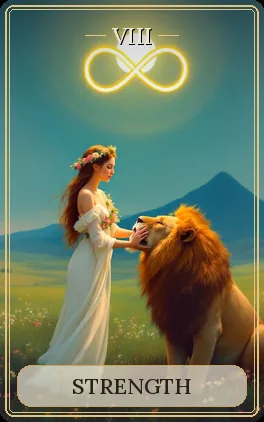
In the Sol da Alma Tarot, Strength is a young woman with long red hair and a crown of pink and white flowers, in an off-the-shoulder white dress with more flowers pinned to her breast. She stands in a green meadow dotted with tiny flowers and holds, with both hands and without squeezing, the muzzle of a large golden lion sitting beside her. The lion raises its head towards her, eyes half closed, calm, almost content. In the background, a cone-shaped blue mountain; in the blue-green sky, above everything, a great golden, luminous infinity sign, with a disc of pale light behind it.
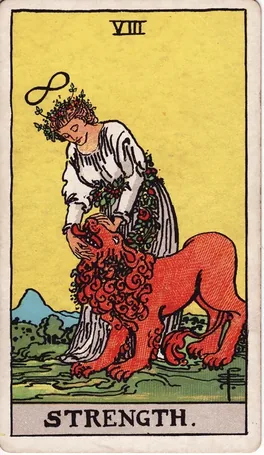
In the Rider-Waite-Smith of 1909, the composition is essentially the same, and it was the starting point for the Sol da Alma painting: a woman in a white robe, girdled with a garland of flowers and with flowers in her hair, bends over a lion and holds its jaws; above her head floats the figure eight lying on its side, the sign of infinity. The differences lie in the tone. The background of the Rider-Waite-Smith is a flat, strong yellow and the lion is orange-red, with a curly mane, its tail between its legs and its mouth open; the woman bends over it. In the Sol da Alma deck the lion is naturalistic, seated and at peace, the woman stands upright and the infinity sign has grown to fill the sky.
In the Tarot de Marseille, the card is numbered XI and is called La Force. A woman in a broad-brimmed hat — whose shape also recalls a figure eight on its side — opens the mouth of a small lion, almost a dog, standing in front of her. There the gesture is one of opening rather than calming; but the idea is the same: the woman masters the animal without a struggle.
The symbolism, detail by detail
Everything in this card turns on a contrast: a fragile figure and a dangerous animal, and it is the fragile one who is in charge. Each detail helps to explain why.
- The lion
- Instinctive energy: desire, anger, pride, passion, the will to live. It is not an enemy to be slain; it is a precious force that needs direction. The card does not ask you to kill the lion — it asks you to live alongside it.
- The woman
- Consciousness, patience, the part of the person that knows how to wait and to choose. She has no armour and no sword: her authority comes from calm and trust.
- The bare hands
- Mastery achieved through contact, not through distance or fear. Touching the lion means accepting that it exists. It is an image of firm gentleness: holding without hurting.
- The infinity sign
- The figure eight on its side, the lemniscate. It speaks of an energy that circulates without running out, of balance between two poles, and of a strength that renews itself instead of being spent. The same sign appears above the head of The Magician.
- The flowers
- Gentleness, life that grows, beauty that has no need to defend itself. In the Rider-Waite-Smith, the garland girdling the woman also runs around the lion’s neck — as if the two were bound by the same chain of flowers.
- The white dress
- Purity of intention. The woman does not want to defeat the lion in order to humiliate it; she wants it to stop being a threat.
- The lion’s gaze
- In the Sol da Alma deck, the lion closes its eyes and raises its head: the scene is no longer one of struggle, but of trust. Tamed instinct does not become sad; it becomes peaceful.
- The mountain
- A distant goal, reached through persistence and not in a single burst. Strength is the card of someone who stays the course.
- The number eight
- The number of work and of repeated movement. Lying on its side, it becomes the infinity sign in the sky of the card: the strength that lasts is the one exercised a little at a time, not all at once.
The history of Strength
Fortitude is one of the four cardinal virtues of the classical and Christian tradition — Fortitude, Justice, Temperance and Prudence — and three of them have been in the tarot since the earliest decks: Strength, Justice and Temperance. The fourth, Prudence, has no card of its own, and that is one of the small puzzles in the history of the tarot.
In the Italian decks of the fifteenth century, La Fortezza was depicted in more than one way. In some early cards it is a figure facing a lion with a club, in the manner of Hercules; in others it is a woman associated with a column, an image of steadfastness. Over time the tradition settled on the woman with the lion, which is the version that reached the Tarot de Marseille, between the seventeenth and eighteenth centuries, under the name La Force and the number XI.
The change of number is recent. At the end of the nineteenth century, the Hermetic Order of the Golden Dawn matched each Major Arcanum with a sign, a planet or an element, and with a Hebrew letter. In the order of the signs, Leo comes before Libra; so the Golden Dawn made Strength card VIII, linked to Leo, and Justice card XI, linked to Libra. Arthur Edward Waite and Pamela Colman Smith followed this swap in the 1909 deck, and most modern decks, including the Sol da Alma Tarot, do the same. In decks of the Marseille tradition, Strength is still XI.
It was also in the Rider-Waite-Smith that the infinity sign moved to above the woman’s head, as with The Magician. The choice is not an innocent one: it links the first card of will in the series to the card of serene will, and suggests that the strength spoken of here is of the same nature as the power to create.
Strength upright: the meaning
Upright, Strength is the card of quiet courage. It says that the person has what they need to face the situation — not through imposition, but through persistence, calm and self-confidence. It is the strength of someone who does not raise their voice and is heard all the same; of someone who gets through a difficult phase without letting themselves harden.
It often speaks of self-mastery: over impulses, irritation, fear, a habit, a desire that pulls where it should not. The card does not ask you to repress anything. It asks you to recognise the lion, to give it a name and to learn how to lead it. The energy that once dragged the person along comes to serve them instead.
It is also a card of compassion and of patience with others. It can describe the ability to calm a difficult person, to handle a conflict without making it worse, to win by gentleness what could never be won by force. And, quite simply, it can announce a period of vitality, good spirits and self-confidence — the lion, after all, is life too.
Strength reversed
Reversed, Strength does not turn into pure weakness: it is the same energy badly directed. On the one hand, the lion breaks loose — impulses that take over, anger that erupts, desire that decides for us, harshness towards others. The person tries to settle by brute force what could only be settled with patience, and the result is the opposite of what they wanted.
On the other hand, it can be discouragement: courage turned inwards that no longer believes in itself. The person feels they cannot do it, that the lion is too big, and gives up before trying. Sometimes it is also strength spent on repression — so much control that there is no life left. In either case, the card asks for the same thing: to put your hands back on the lion, slowly, without haste and without fear.
Strength in love
In love, Strength speaks of a relationship in which passion exists and is well handled: desire, yes, but also tenderness, patience and respect. It is the card of someone who knows how to deal with the hard moments of a relationship without war and without submission. In a relationship with friction, it says that calm and kindness will resolve more than confrontation.
For those who are single, it asks for self-confidence: you have more to offer than you think, and attraction is born of that quiet assurance. Reversed, it can speak of jealousy, of arguments that escalate, of a passion that dominates instead of uniting — or of insecurity, of someone who accepts less than they deserve because they do not feel able to ask for more.
Strength in work and money
At work, Strength is the card of someone who withstands pressure and channels it. It favours persistence in a difficult project, leadership without authoritarianism, negotiation conducted calmly, and the ability to deal with awkward colleagues or clients. In a question about a professional challenge, it says you will succeed — through steadiness, not through a stroke of luck.
With money, it asks for mastery of impulses: not spending out of anxiety, not taking risks out of pride, not abandoning a savings plan at the first difficulty. Upright, it is a card of stability won through patience. Reversed, it warns against decisions taken in the heat of the moment, or against the feeling that nothing can be controlled, which leads to the finances being left to fend for themselves.
Strength in health and wellbeing
In questions about wellbeing, Strength speaks of vitality, stamina and good spirits, and of a good relationship with your own body — looking after it without mistreating it or forgetting it. Reversed, it points to ignored tiredness, to excess, or to a lack of will to look after yourself. The cards are no substitute for any kind of health care: the reading speaks of attitude, not of diagnosis.
Strength in spiritual life
On the inner path, Strength is the work of reconciliation with one’s own nature. It is not a matter of defeating the body, the desires or the emotions, but of integrating them: the lion does not disappear, it becomes an ally. For many readers, it is the card of gentle discipline — the practice carried out every day, without violence against oneself — and of the courage to look at what is wildest in us without running away.
Strength as advice
As advice, Strength says: stay calm and do not give up. Do not force what will not open by force; approach slowly, firmly and respectfully, and hold your ground. It also says: trust yourself — what seems threatening can be guided, and the strength you need is already with you; it is just not being used in the best way.
Strength in the positions of a spread
- In the past
- A trial overcome with courage and patience, which left the person more sure of themselves; or an impulse that was finally mastered.
- In the present
- The moment calls for self-control and persistence. The person has the strength they need; the question is how to use it calmly.
- In the future
- A situation that will demand courage — and a sign that the person will be equal to it.
- As an obstacle
- An instinct that takes over (anger, desire, pride), or a lack of confidence that prevents action.
- As the outcome
- The matter is resolved through patience and serene firmness: the lion ends up on the side of the person asking.
Numerology and correspondences
Eight is the number of work and movement: the hand that repeats the gesture, the thing that keeps going. It is a strength that is not spent all at once but exercised steadily — and, lying on its side, it becomes the infinity sign that the card itself carries. In the Marseille deck, XI (one and ten) links Strength to a new beginning after the Wheel; in the Rider-Waite-Smith, VIII places it straight after The Chariot, as the other face of victory: The Chariot masters through will and movement, Strength masters through patience.
In the Golden Dawn tradition, it corresponds to the sign of Leo, a Fire sign ruled by the Sun, and to the Hebrew letter Teth. Leo gives it courage, generosity and pride — and the risk of pride turning into harshness, which is precisely what the reversed card shows.
Combinations with other cards
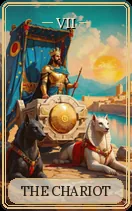 The Chariot — Will and patience together: a victory that is won and knows how to be kept.
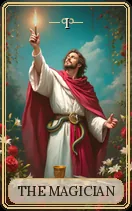 The Magician — All of one’s personal power at hand: the ability to act and to master oneself at the same time.
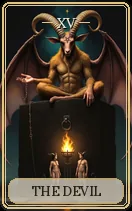 The Devil — The struggle with a vice, a desire or an addiction — and the strength to overcome it without violence against oneself.
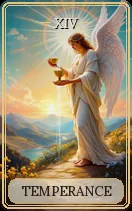 Temperance — Balance and slow healing: calm, moderation and persistence pay off.
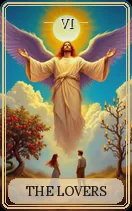 The Lovers — A strong passion lived with tenderness and respect; choosing with the heart, but with a cool head.
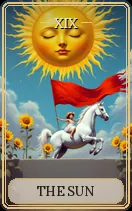 The Sun — Vitality, confidence and joy: a period of plenty of energy put to good use.
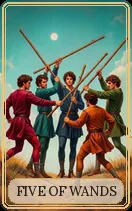 Five of Wands — Conflicts and rivalries resolved calmly, not with more fighting.
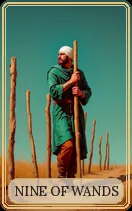 Nine of Wands — Endurance to the very end: the person is tired, but holds on and gets there.
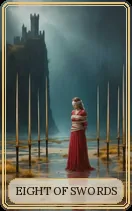 Eight of Swords — The feeling of being trapped by one’s own fear — and the courage needed to get out.
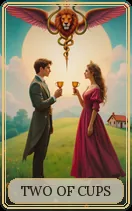 Two of Cups — A relationship in which the attraction is strong and so is the respect.
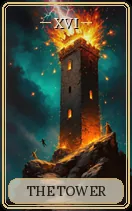 The Tower — Keeping one’s composure in the middle of a break-up; or pent-up anger that finally bursts out.
Frequently asked questions
What does Strength mean in tarot?
Quiet courage, self-control and patience: the ability to face a difficult situation, or your own impulses, firmly and without violence. It is a card of self-confidence.
Why is Strength card VIII in some decks and XI in others?
In the Tarot de Marseille it is XI and Justice is VIII. The Golden Dawn swapped them at the end of the nineteenth century, to link Strength to Leo and Justice to Libra following the order of the signs, and the 1909 Rider-Waite-Smith followed that swap, as does the Sol da Alma Tarot.
What does Strength mean in love?
A relationship with passion and with patience, in which conflicts are resolved calmly. For those who are single, it asks for self-confidence. Reversed, it warns against jealousy, arguments that escalate or insecurity.
Is Strength reversed bad?
It is not a condemnation. It shows strength badly directed — impulses that take over, harshness or discouragement — and asks you to return to calm and persistence.
Is Strength a yes or a no?
Yes, for most questions. But it is a yes that depends on patience and steadiness: you will get there, as long as you do not force it.
No sign-up · Reading written on the spot · Free