
Eight of Swords: meaning and symbolism of the tarot card
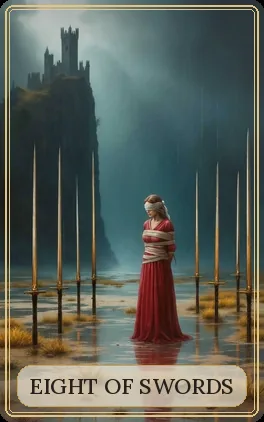
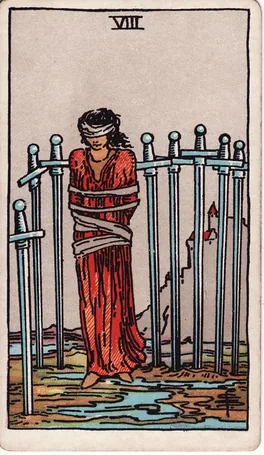
The Eight of Swords is the card of the prison without walls. A woman, blindfolded and with her arms bound, stands on waterlogged ground among swords driven into the earth. She looks trapped — but the swords do not surround her, the bindings do not hold her feet, and ahead of her the way is clear. What holds her is not what lies around her: it is what she cannot see, and what she believes.
In a spread, the Eight of Swords speaks of being stuck, of powerlessness and of fear, and above all of the part your own head plays in it. It is a hard card to hear, because it says the way out exists and that it is you who has not yet taken it. But for that very reason it is also one of the most hopeful cards in the suit: what was built by the mind can be undone by the mind, and sometimes all it takes is removing the blindfold to realise you were free all along.
The card at a glance
| Card | Eight |
|---|---|
| Suit | Swords |
| Element | Air |
| Astrology | Jupiter in Gemini (Golden Dawn) |
| Keywords | mental prison, being stuck, apparent powerlessness, fear, indecision, self-limitation, feeling cornered |
| Reversed | release, the bonds loosening, realisation, a first step, a way out in sight |
| Yes or no | Not for now — the answer depends on whether you move |
The image on the card
In the Sol da Alma Tarot, a young woman with her brown hair tied up stands in the middle of a shallow marsh, the water covering her feet and the hem of her dress. She wears a long red dress with short sleeves; her eyes are covered by a strip of linen-coloured cloth, and her upper body and arms are wrapped in several turns of the same cloth, her hands tied behind her back. Her head is slightly bowed. To her left and right rise eight tall golden swords, four on each side, planted in the ground by the hilt, their slender blades pointing at the sky. Between the two groups runs an open corridor, right in front of her. In the background, on the left, a dark castle with crenellated towers stands on top of a cliff; the sky is a sombre blue-green, a fine rain is falling, and mist hides the horizon. In the water there are tufts of dry grass and the red reflection of the dress.
In the 1909 Rider-Waite-Smith, the scene is essentially the same: a woman in a red dress, blindfolded and bound with grey bandages, stands on ground dotted with puddles, and eight swords stuck in the earth form a kind of incomplete fence — several behind her, a few to the left — leaving the front open. In the background, on the right, is a castle on top of a crag. The Sol da Alma follows this iconography faithfully — the red dress, the blindfold, the bindings, the swords, the water, the castle — but changes three things: the swords are planted the other way round, points upwards, and split into two symmetrical groups, like a corridor; the castle has moved to the left and onto a larger cliff; and the scene has gained rain and mist, which the original does not have. The Sol da Alma painting makes the way out even more obvious — the swords literally open a path for her — and the atmosphere even more oppressive.
In the Marseille Tarot, the Huit d’Épée has no scene at all: it shows only the swords of the suit, curved and interlaced in an ornamental figure, with small flowers. The blindfolded woman among the swords is Pamela Colman Smith’s invention.
The symbolism, detail by detail
Everything in this card plays on the difference between being trapped and feeling trapped. Each detail adds a nuance to that idea.
- The blindfold
- What is not seen — or what one does not want to see. The blindfold is thin and loosely tied: the woman could take it off. It stands for a lack of perspective, the missing information, the blind spot that makes the situation look darker than it is.
- The bindings
- They hold her arms, but not her legs. The woman cannot act with her hands, but she can walk. It is the image of someone who feels powerless and forgets they still have room to move.
- The eight swords
- Thoughts: fears, assumptions, rules, ‘I can’t’, ‘I shouldn’t’, ‘what if’. They look like a prison, but they do not close it. In the Sol da Alma, they part into two groups and leave a corridor in front of her.
- The swords pointing upwards
- In the Sol da Alma painting, the blades point at the sky: the ideas that corner her are all raised, threatening, yet none of them touches her. The danger is more apparent than real.
- The open corridor
- The way out that exists and that she cannot see. This is the detail that decides the meaning of the card: there is no wall ahead, there is a path.
- The marsh water
- Stagnant emotion, ground that is not firm, the feeling of being bogged down. The water comes from the rain: what is felt has been building up little by little.
- The rain and the mist
- The sadness and confusion that make everything heavier. In the Sol da Alma, the overcast sky reinforces the idea that the person cannot see far — neither backwards nor forwards.
- The castle on the cliff
- The place she came from, or the authority, the family, the social order that keeps her there. It is far off and high up: what holds her is also what she believes others expect of her.
- The red dress
- Life, passion, the energy that is still there, intact, beneath the bindings. The woman has not lost her strength; she has lost access to it.
- The bowed head
- Resignation. She does not struggle against the bindings or look for the way out: she waits. This is what the card asks you to change.
The history of the Eight of Swords
In the earliest tarot decks, painted in northern Italy in the fifteenth century, the numbered Minors showed only the suit symbols — just like ordinary playing cards. The Marseille Tarot, which took its settled form between the seventeenth and eighteenth centuries, kept that custom: the Eight of Swords is a design of curved, interlaced blades, with no figures and no story.
At the end of the nineteenth century, the Hermetic Order of the Golden Dawn gave each numbered Minor a title and an astrological correspondence. The Eight of Swords became ‘the Lord of Shortened Force’ and was linked to Jupiter in Gemini. The title says a great deal: the strength is there, but it is cut short, diminished, without reach.
It was with the deck by Arthur Edward Waite and Pamela Colman Smith, published in 1909, that the card gained the scene we know today — the first widely distributed deck to give a picture to every Minor. The blindfolded woman among the swords became one of the most recognisable images in tarot, and it is the starting point for the Sol da Alma painting. In modern readings, the Eight of Swords is almost always interpreted as a mental prison rather than real captivity: the emphasis on the loose blindfold and the clear way out comes precisely from the way Pamela Colman Smith composed the scene.
The Eight of Swords upright: the meaning
Upright, the Eight of Swords is the card of someone who feels there is no way out. It may be a relationship, a job, a family situation, a debt, a decision put off: the person feels cornered, without options, waiting for someone or something to set them free. The card confirms the feeling — the squeeze is real — but questions the conclusion. The bonds are loose, the blindfold is thin, and there is a path ahead.
What the card points to is the role of thought. Fear of getting it wrong, shame, guilt, rules learned long ago, assumptions about what others will say: all of this can turn a difficult situation into a prison. Very often, whoever draws the Eight of Swords already knows what they ought to do; what they lack is not information but permission — permission they have to give themselves.
It is also a card of paralysing indecision. So many options weighed up, so many scenarios imagined, that the person does not move in any direction. The eight swords are eight thoughts, and not one of them has yet become an action.
It is not, however, a card of blame. Nobody puts themselves in this situation for the fun of it; the bindings came from somewhere. What the card says is simpler and more liberating: there is no need to wait for someone else to come and untie the knot. The first step — small, taken blind, but real — is within reach.
The Eight of Swords reversed
Reversed, the Eight of Swords does not become its own opposite: it is the same prison giving way. The bonds loosen, the blindfold slips, and you begin to see that the door was never locked. It is often a card of realisation — the moment you understand that the fear was greater than the danger — and of the first move towards getting out.
It can also show that the release is still only halfway there: the person has already seen the way out but hesitates to take the step, or leaves and comes back, or takes off the blindfold without yet freeing their arms. In other cases, the reversal speaks of the same prison turned inwards — silent anxiety, shutting oneself away. In any of these senses, the card asks for the same thing: keep untying, one turn at a time, without waiting for the perfect moment.
The Eight of Swords in love
In love, the Eight of Swords speaks of someone who feels trapped in a relationship — or outside one. It may be the relationship that no longer makes you happy and that you cannot manage to leave, out of fear of loneliness, of what others will think or of the practical consequences. It can also be the opposite: the person who will not allow themselves to love, who closes off because of old wounds, who believes they do not deserve it or that it will not work out.
It calls for an honest question: what is really holding me? Often the answer lies less in the other person than in your own ideas about love. Reversed, it is a good sign — a conversation that finally happens, a decision made, a heart opening up again after a long time closed.
The Eight of Swords in work and money
In work, the card describes the feeling of being in a dead end: a job that does not satisfy but that you do not leave, a career that seems to lead nowhere, an environment where nothing can be done. It often points to self-limitation — ‘I don’t have the qualifications’, ‘it’s too late’, ‘there’s nothing out there’ — and asks you to check whether these sentences are facts or fears. It can also speak of rules and red tape that tie your hands.
In money, it speaks of tightness and of the feeling of having no margin: debts, fixed expenses, a lack of alternatives. Upright, it asks you to look at your finances without the blindfold — with real figures, not with panic. Reversed, it shows that solutions are beginning to appear, or that the person is beginning to see them.
The Eight of Swords in health and wellbeing
In questions about wellbeing, the Eight of Swords speaks of built-up tension, of mental fatigue, of thoughts going round in circles and leaving the body stuck. It asks for movement — even a little — and for fresh air, and it also asks that you do not carry what weighs on you alone: talking to someone can be the first knot to come undone. The cards are no substitute for any kind of health care: the reading speaks of attitude and tendency, not of diagnosis.
The Eight of Swords in spiritual life
On the inner path, the Eight of Swords is a powerful image of what many traditions call illusion: the prison made of beliefs, the identification with one’s thoughts, the ‘I can’t do it’ repeated until it seems true. The card invites you to observe the mind rather than obey it — to notice that the swords are there, but they do not touch you. It is the card of someone who is beginning to realise that freedom does not depend first on circumstances, but on the way we look at them.
The Eight of Swords as advice
As advice, the Eight of Swords says: take off the blindfold. Ask yourself what is fact and what is assumption, what is danger and what is fear. Look for the information you are missing, ask for help, take a step — just one — even without seeing everything. The way out will not appear while you stand still waiting; it appears when you start to walk.
The Eight of Swords in the positions of a spread
- In the past
- A period of being stuck and powerless, which the person has come out of or is coming out of; or old beliefs that still hold them back.
- In the present
- The person feels cornered. The card asks them to check whether the bonds are as tight as they seem.
- In the future
- A warning that a situation may become paralysing if fear is allowed to decide; or a phase of waiting that calls for clear-sighted patience.
- As an obstacle
- Thought itself: fear, indecision, the belief that there is no alternative.
- As the outcome
- If nothing changes, the deadlock continues. With the right cards alongside, it is a release that comes from within.
Numerology and correspondences
Eight is work and movement: the hand that repeats, the thing that moves along, the craft being practised. In Swords — Air, thought, the word and decision — the movement is that of the mind, and here the mind works against itself: it repeats, ruminates, goes round in circles, and the body stays still. The Eight of Swords is thought in constant motion that leads nowhere; the strength of the number is there, but turned inwards. After the Seven, where one acted alone and on one’s own account, the Eight shows the price of a mind left to its own devices.
In the Golden Dawn, the card corresponds to Jupiter in Gemini. Jupiter is the planet of expansion and abundance; Gemini, the Air sign of communication and multiplicity. The combination explains the card well: an abundance of ideas, of hypotheses, of possibilities — so many that they cancel one another out. Hence the Golden Dawn title, ‘the Lord of Shortened Force’: the Jupiterian strength is there, but scattered and without reach.
Combinations with other cards
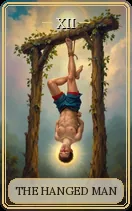 The Hanged Man — An enforced wait; or the change of perspective that turns the prison into a meaningful pause.
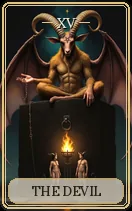 The Devil — A dependency or a tie that binds; the ropes are real, but they were accepted.
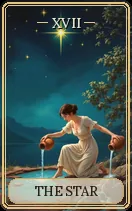 The Star — The hope that removes the blindfold: after the squeeze, a way out full of light.
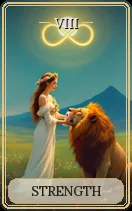 Strength — The inner strength that unties the knots; gentle courage to get out.
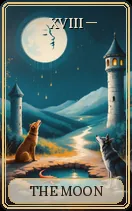 The Moon — Fears and confusion feeding one another; see clearly before deciding.
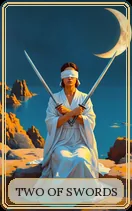 Two of Swords — A decision put off that is starting to become a prison.
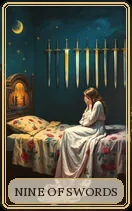 Nine of Swords — From paralysis to sleeplessness: thoughts that give no rest.
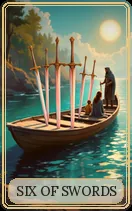 Six of Swords — The way out opening up: a crossing to calmer ground.
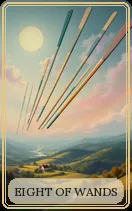 Eight of Wands — Everything gets unstuck quickly, as soon as the first step is taken.
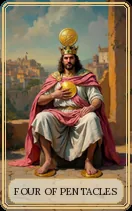 Four of Pentacles — Clinging to what you have for fear of losing it; security that has become a cell.
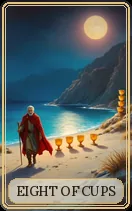 Eight of Cups — The courage to leave behind what no longer serves you.
Frequently asked questions
What does the Eight of Swords mean in tarot?
The prison built by the mind: feeling there is no way out when there is one. It speaks of being stuck, of fear and of indecision, and asks you to take off the blindfold to see the options that exist.
What does the Eight of Swords mean in love?
Feeling trapped in a relationship, or kept from loving by fears and old wounds. Reversed, it speaks of release: a conversation, a decision, a heart opening up again.
Is the Eight of Swords a yes or a no?
For now, it leans towards no — but not because the door is closed. It is a ‘no’ for as long as the person does not move; with a first step, the answer can change.
Is the Eight of Swords reversed a good sign?
Generally, yes. It is the same prison giving way: the bonds loosen and the way out begins to show. Sometimes it indicates that the release is only halfway there and calls for persistence.
Why is the woman in the Eight of Swords blindfolded?
Because what holds her is, above all, what she cannot see. The blindfold is thin and the bindings do not hold her legs: the card shows a prison that is more mental than real.
No sign-up · Reading written on the spot · Free