
The Hermit: meaning and symbolism of the tarot card
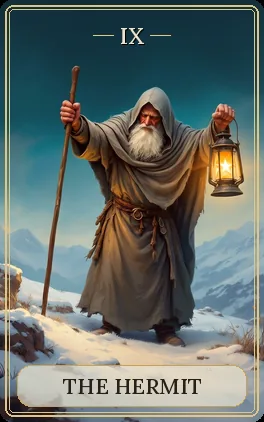
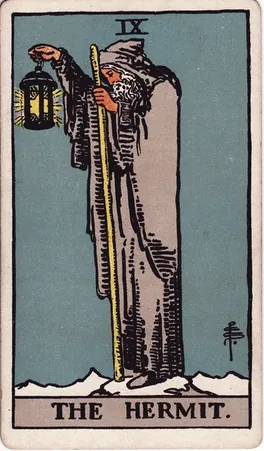
The Hermit is the card of silence. An old man wrapped in a cloak stands alone in a high, cold place, a lantern raised in one hand and a staff in the other. He is in no hurry, he does not look into the distance: with his head bowed, he looks at the ground in front of him, and the light he carries reaches only as far as the next step. It is a card of withdrawal, but not of sadness — The Hermit is alone because he chose to be, and he is looking for something.
In a reading, The Hermit speaks of a time to think: stepping away from the noise, reviewing the path, listening to yourself before deciding. It can also represent a person of experience, a teacher, a counsellor — or the wisdom of the person asking, who already knows more than they think. It is a slow, prudent and honest card, one that rarely hurries anyone and almost never gives easy answers.
The card at a glance
| Number | IX |
|---|---|
| Arcana | Major Arcana |
| Historical names | L’Eremita, Il Tempo (Italy); L’Hermite (Marseille); The Hermit (Rider-Waite-Smith) |
| Element | Earth |
| Astrology | Virgo (Golden Dawn) |
| Hebrew letter | Yod (י), according to the Golden Dawn |
| Keywords | retreat, inner lamp, prudence, reflection, experience, counsel, chosen solitude |
| Reversed | isolation, refusing the light, delay, mistrust, withdrawal from the world |
| Yes or no | ‘Not yet’: it asks for time and reflection before deciding |
The image on the card
In the Sol da Alma Tarot, The Hermit is an old man with a long white beard and a lined face, wrapped in a hooded grey cloak, worn and frayed at the edges, over a tunic of the same colour fastened with a leather belt hung with rings and cords. He stands still at the top of a snow-covered slope, facing us, his head bowed and his eyes on the ground. In his right hand he holds a long wooden staff, planted in the snow; with his left arm stretched out, he raises a lantern of dark metal to shoulder height, and inside it a golden star shines. All around are snowy mountains; the sky shifts from dark blue above to a paler blue near the horizon, and the lantern's light warms the air around it.
In the Rider-Waite-Smith of 1909, the figure is almost the same, but more stripped back: an old man in a grey hooded mantle stands in profile on the top of a snowy peak, against a flat blue-grey background. In his right hand, raised to the height of his face, he holds a lantern with a six-pointed star inside it, and in his left a straight yellow staff. His eyes are lowered, almost closed. The Sol da Alma deck kept the cloak, the beard, the bowed head, the star in the lantern and the snow and, like the Rider-Waite-Smith, shows the old man standing still on the heights with the lantern raised in his hand, separate from the staff. The differences lie elsewhere: the figure faces us rather than standing in profile, holds the lantern in his left hand and the staff in his right, and is surrounded by mountains and sky instead of a flat background.
In the Tarot de Marseille, L’Hermite is an old man in a hooded cloak walking to the left, leaning on a stick and raising a lantern partly hidden by a fold of his mantle. There is no mountain and no snow: only the man, the light and the path.
The symbolism, detail by detail
The Hermit is a card of few elements, and each one carries weight. Almost all of them speak of the same thing: the light you carry with you when there is no other.
- The lantern
- Consciousness, knowledge, the truth being sought. It does not light up the whole world, only the next step: The Hermit does not know where the path leads, but he knows where to put his foot.
- The star in the lantern
- In the Rider-Waite-Smith it is a six-pointed star, joining one triangle pointing up and another pointing down; the Sol da Alma deck kept a golden star. It is the inner light, a guidance that does not come from outside.
- The staff
- The support of experience, the road already travelled. It is the same stick as The Fool’s and The Magician’s, now worn with use: no longer a promise, but a memory.
- The hooded cloak
- Withdrawal, protection, discretion. The Hermit does not put himself on show; he keeps himself back. The grey cloak, the colour of ash and stone, is also the colour of neutrality and maturity.
- The white beard
- Age and what it brings: patience, experience, the wisdom of someone who has seen a great deal. It does not necessarily speak of actual old age, but of maturity.
- The snow and the mountains
- Height, isolation, the cold of someone who withdraws from the world. The Hermit is above ordinary life — not out of contempt, but in order to see better.
- The downward gaze
- Attention to the step and to the present, and humility too. The Hermit does not seek the horizon; he seeks the ground that holds him up.
- The raised lantern
- In the Sol da Alma deck, as in the Rider-Waite-Smith, the old man stands still on the heights and lifts his lantern. It can be read as a light that is not kept for oneself: someone who has reached the top showing the way to those still climbing.
- The number nine
- The end of a series before ten: the moment to gather up what has been lived and understand it before another cycle begins.
The history of The Hermit
In the Italian decks of the fifteenth century, the figure we now call The Hermit was linked to Time. In the decks painted for the Visconti and the Sforza in Milan around 1450, he is an old man holding an hourglass, not a lantern: the image of time passing and wearing everything away. In early Italian lists he even appears under the name Il Tempo.
Over time, the hourglass came to be drawn as a lantern — and the old man of Time became the old man who searches. In the Tarot de Marseille, which took shape between the seventeenth and eighteenth centuries, the figure is already called L’Hermite, the hermit, and raises a lantern half hidden by his mantle. This is the image that reached the modern decks.
At the end of the nineteenth century, the Hermetic Order of the Golden Dawn matched The Hermit with the sign of Virgo and the Hebrew letter Yod. In the 1909 deck, Arthur Edward Waite and Pamela Colman Smith placed him on the top of a snowy mountain and put a six-pointed star inside the lantern. The modern reading of The Hermit as teacher, inner guide and figure of the spiritual search comes mainly from there; but the idea of time, which lies at its origin, never entirely disappeared — The Hermit is still the card of what does not hurry.
The Hermit upright: the meaning
Upright, The Hermit is the card of necessary retreat. It says that it is time to step back a little — from the noise, from other people’s opinions, from haste — in order to think clearly. It is not an escape: it is a pause with a purpose. The person needs time and silence to work out what they really want, and the card gives them that time.
It is also the card of prudence. The Hermit does not leap or take blind risks; he moves forward slowly, with the light he has, and checks each step. In a decision, it asks you to reflect before acting, to gather information and to be wary of quick fixes. His light is small, but it is reliable.
It often represents a person: someone older or more experienced, a teacher, a therapist, a mentor, a sensible friend whose advice is worth hearing. And it can represent the querent in the role of the one who gives advice — or in a phase in which the wisdom already acquired is their greatest resource.
The Hermit reversed
Reversed, The Hermit is still The Hermit: it is the same withdrawal, but taken too far or at the wrong time. Retreat turns into isolation; prudence turns into mistrust; reflection turns into endless brooding. The person shuts themselves away, avoids others, puts off decisions while waiting for a certainty that never comes. It can also speak of solitude that was not chosen, or of a distance that no longer helps.
In other readings, it is the refusal of the light: the lantern shows something the person does not want to see, and they would rather lower their arm. Or it is the opposite — the fear of being alone with one’s own thoughts, which leads to filling the time with noise so as not to have to listen to oneself. The card asks you to find the right measure: to be alone enough to hear yourself, and to return to other people with what you have learnt.
The Hermit in love
In love, The Hermit is not a card of passion: it is a card of reflection. For those who are single, it usually points to a phase in which solitude is useful — time to get to know yourself better, to heal from a relationship that has ended, to understand what you are looking for before you look. A meeting may come, but not now, and not in a hurry.
In a relationship, it can speak of distance, of a more reserved partner, or of a need for space that has to be respected. It can also describe a calm, mature relationship, made of deep conversations more than of fire. Reversed, it warns against isolation within the couple — silences that drag on, someone who closes up and leaves the other outside.
The Hermit in work and money
At work, The Hermit favours study, research, specialisation, work done with concentration and without haste. It is the card of someone who needs to think a project through before launching it, or of someone looking for a more meaningful profession. It can also point to working alone, remotely, or in areas of counselling and teaching. In a question about a change, it asks you to reflect before deciding.
With money, it is prudent and thrifty: it favours planning, restraint and careful analysis before any investment. It is not a card of quick gains. Reversed, it can speak of an excessive fear of spending, of opportunities lost through hesitation, or of a financial situation that you avoid looking in the face.
The Hermit in health and wellbeing
In questions about wellbeing, The Hermit asks for rest, silence and withdrawal: sleeping, slowing down, spending time in nature, listening to the body. Reversed, it is a reminder that prolonged isolation is tiring too. The cards are no substitute for any kind of health care: the reading speaks of attitude, not of diagnosis.
The Hermit in spiritual life
On the inner path, The Hermit is one of the most important cards in the deck. It represents the personal search, meditation, study, prayer, pilgrimage — everything done alone to come closer to what is essential. It says that the light being sought is already in the hand of the seeker, and that there is no need to see all of it at once: it is enough to follow the little that can be seen. It can also point to meeting a teacher, or to the moment when the person begins to guide others.
The Hermit as advice
As advice, The Hermit says: stop and think. Step away for as long as you need, switch off the noise, ask yourself the right questions. Do not decide at the pace others set for you. And it also says: trust the light you have — it may be little, but it is yours, and it is enough for the next step.
The Hermit in the positions of a spread
- In the past
- A period of solitude or reflection that left its mark and its lessons; or a piece of advice that changed the course of things.
- In the present
- The person is in a phase of withdrawal, or needs one. The answers lie within, not outside.
- In the future
- A time of pause on its way, or a meeting with someone wise who will help you see clearly.
- As an obstacle
- Isolation, hesitation, mistrust — or the refusal to stop and think.
- As the outcome
- More clarity than action: the matter ripens slowly and the person comes out of it wiser.
Numerology and correspondences
Nine is the last of the single digits: the far end of a series, the point at which what has been lived is gathered in before moving on to ten. It is therefore a number of taking stock, of maturity and of inner completion. In the sequence of the Major Arcana, The Hermit comes just before Wheel of Fortune — reflection before the change of cycle.
In the Golden Dawn tradition, it corresponds to the sign of Virgo, an Earth sign ruled by Mercury, and to the Hebrew letter Yod, the smallest in the alphabet. Virgo gives it care, analysis, attention to detail and a liking for quiet, unshowy work; the smallness of Yod suits the modest light of the lantern, which lights little but lights it well.
Combinations with other cards
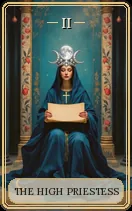 The High Priestess — Deep intuition and silence: the answers come from within, through study or meditation.
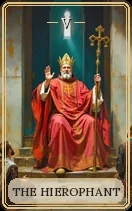 The Hierophant — A master, a teacher or a spiritual adviser; the search for traditional knowledge.
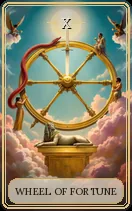 Wheel of Fortune — A pause to reflect before a change of cycle, or the end of a period of retreat.
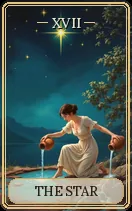 The Star — Hope born of solitude: after withdrawal, the person sees the path again.
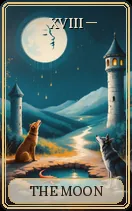 The Moon — A phase of doubt and confusion crossed slowly, with the little light there is.
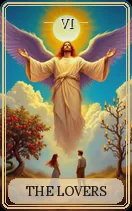 The Lovers — A choice in love that needs to be thought through alone, without pressure.
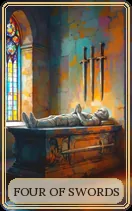 Four of Swords — Rest and withdrawal: retreating to recover one’s strength.
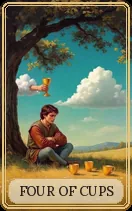 Four of Cups — Retreat that risks turning into apathy; ignoring what is on offer through being too closed off.
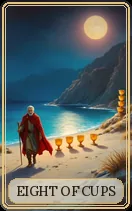 Eight of Cups — Leaving behind what no longer satisfies and setting out in search of something deeper.
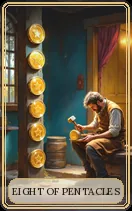 Eight of Pentacles — Study, specialisation, a craft learnt with patience.
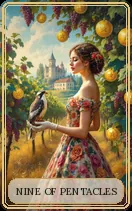 Nine of Pentacles — Independence won: being alone and being well, with what one has built.
Frequently asked questions
What does The Hermit mean in tarot?
Retreat, reflection and prudence: a time to step away from the noise and think calmly. It can also represent a wise or experienced person whose advice is worth hearing.
What does The Hermit mean in love?
A phase of reflection rather than passion: time to get to know yourself, to heal from a past relationship, or a need for space within a relationship. Reversed, it warns against isolation and prolonged silences.
Is The Hermit a card of loneliness?
It is a card of solitude that is chosen and useful — the withdrawal that helps you see clearly. Only when it is reversed, or in poor company in the spread, does it speak of an isolation that weighs heavily.
Is The Hermit reversed bad?
It is not a condemnation. It shows withdrawal taken too far or at the wrong time: isolation, hesitation, a refusal to see. It asks you to find the right measure between being alone and being with others.
Is The Hermit a yes or a no?
Usually ‘not yet’. It does not close the door, but it asks for time, reflection and more information before moving forward.
No sign-up · Reading written on the spot · Free