
King of Pentacles: meaning and symbolism of the tarot card
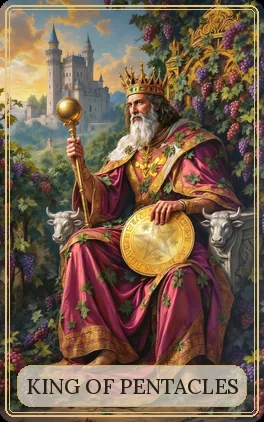
The King of Pentacles is the figure of someone who has arrived. Seated on a golden throne covered in vines heavy with grapes, a grey-bearded king, dressed in purple and gold, holds a gold sceptre in his right hand and rests his left on a large gold coin propped on his knee. Behind him rises a castle, lit by the late-afternoon sun. Everything in this card speaks of things accomplished: the harvest gathered in, the house built, the wealth that no longer needs to be proved. It is the image of established prosperity.
In a spread, the King of Pentacles speaks of material success, mastery and security. It may represent a person — someone competent, reliable, successful, who protects their own — or an attitude the situation calls for. Of the four court cards of the suit, he is the most complete: the Page’s apprentice has become a master, the Knight’s patience has borne fruit, the Queen’s care has become rule. His risk is that of all power resting on money: forgetting what the money was for.
The card at a glance
| Card | King |
|---|---|
| Suit | Pentacles |
| Element | Earth |
| Astrology | Varies between schools |
| Keywords | prosperity, mastery, security, material success, business sense, reliability, protection, generosity |
| Reversed | material rigidity, greed, miserliness, materialism, stubbornness, power through money, fear of loss |
| Yes or no | Yes — a firm yes, especially in matters of work, money and property |
The image on the card
In the Sol da Alma Tarot, the King is a man of mature years, with long grey hair and a full white beard, wearing a tall-pointed gold crown. He wears a wide purple cloak, with broad borders embroidered in gold and green vine leaves scattered across the fabric, and a golden tunic across his chest. He has gold bracelets on his wrists and bare feet resting on the ground. With his left hand he holds a large gold coin propped on his knee, with a five-pointed star at its centre and an inscription engraved around the rim. In his right hand, raised to shoulder height, he holds a gold sceptre topped by an orb. He sits sideways, his face in three-quarter profile and his serious gaze fixed on the distance. The arms of the throne end in carved bulls’ heads, and it has a tall back of worked gold, almost covered by vines laden with bunches of purple and pink grapes that hang down both sides of the card. Behind him, on the left, on a green hill, rises a stone castle with several pointed towers, against a golden and blue late-afternoon sky.
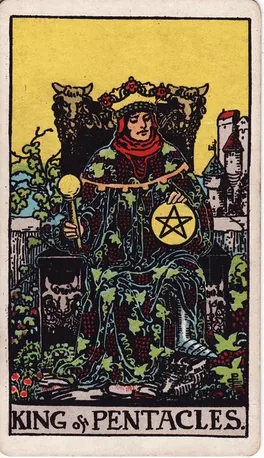
In the 1909 Rider-Waite-Smith, the King of Pentacles sits facing forward on a dark throne decorated with bulls’ heads, in a robe covered in bunches of grapes and vine leaves that almost merges with the garden around him. In his right hand he holds a sceptre topped by an orb and, in his left, the coin with a pentacle, resting on his knee. An armoured foot peeps out from beneath the robe, and behind him there is a wall and a castle. The Sol da Alma essentially follows this iconography — the throne among the vines, with its bulls’ heads, the robe with vine leaves, the orb-topped sceptre in the right hand, the coin on the knee, the castle in the background —, but changes a few details: the throne is of pale gold instead of dark; the cloak is purple instead of dark; and the King is barefoot, with no armour in sight. He is a less warlike King and more of a patriarch.
In the Marseille Tarot, the Roi de Deniers is a crowned figure with the coin, with no vineyard and no castle. The grapes, the garden and the castle are contributions of the Rider-Waite-Smith.
The symbolism, detail by detail
The card speaks of a wealth that has been made and is well governed. Each detail adds a nuance.
- The coin on his knee
- Wealth possessed and secure. The King neither raises it nor contemplates it, as the Page and the Queen do: he rests his hand on it, with the calm of someone who no longer needs to look to know what it is worth.
- The vines and the grapes
- The harvest, abundance, the fruit of a lifetime’s work. They are the same grapes as in the Nine and Ten of Pentacles, now around the throne: wealth has become the very place where the King sits.
- The vine leaves on the cloak
- The King wears what he has cultivated. His identity is inseparable from his work.
- The purple cloak
- Dignity, authority, royalty. It is the traditional colour of power.
- The sceptre and orb
- In the Sol da Alma painting, as in the Rider-Waite-Smith, the King raises in his right hand a gold sceptre topped by an orb: the emblem of authority and of dominion over the world. The orb, round like the coin, is a reminder that what he rules is the earth.
- The bare feet
- Direct contact with the earth. However rich he may be, the King of Pentacles has not forgotten where he comes from: his strength comes from the earth.
- The bulls’ heads on the throne
- Strength tamed in the service of rule. In the Sol da Alma, as in the Rider-Waite-Smith, they are bulls’ heads, the animal of the earth, of fertility and of persistence.
- The castle in the background
- The estate that has been built, the secure domain. It is the finished work, raised to last.
- The late-afternoon light
- Maturity. The day’s work is done, and the golden light is that of someone who is harvesting, not of someone still sowing.
- The white beard
- Experience. The King of Pentacles knows what he knows because he has lived it.
The history of the King of Pentacles
The king has been one of the four court figures of each suit since the first tarot decks, painted in northern Italy in the fifteenth century, and the highest of them. In the Marseille decks, which took their settled form between the seventeenth and eighteenth centuries, he is called the Roi de Deniers and appears with the coin.
At the end of the nineteenth century, the Hermetic Order of the Golden Dawn rearranged the court figures and gave them other names. Arthur Edward Waite and Pamela Colman Smith, in the 1909 deck, gave the King of Pentacles the throne among the vines, the robe of grapes and the castle. In the book that accompanied the deck, Waite wrote that the figure calls for no special description, that the face suggests courage but is somewhat lethargic in tendency, and that the bull’s head should be noted as a recurrent symbol on the throne. As meanings, he gave it valour, realising intelligence, aptitude for business and, sometimes, mathematical gifts — and success in these paths.
The astrological and elemental attributions of the court cards vary from school to school, and none can be given as certain. What the traditions share is the essential point: the King is the rule of the suit, its maturity expressed outwardly. In Pentacles, that is prosperity and mastery. That is the reading of the Sol da Alma.
The King of Pentacles upright: the meaning
Upright, the King of Pentacles is the card of established prosperity. It speaks of material success, of financial security, of work that has borne fruit and of an estate that has been built. In a reading, it can herald the completion of a project, a position of responsibility, a thriving business, a stability that has been won. It is the card of someone who is no longer building: he is governing what he has built.
It is also the card of mastery. The King of Pentacles is the one who knows how — the master of the craft, the experienced businessman, the person you ask for advice when it comes to money, business or practical matters. His authority does not come from a title, but from competence proven over a lifetime.
What sets him apart from a merely rich man is responsibility. The King of Pentacles protects his own, provides work, supports a family or a community. His wealth serves a purpose: he is generous, not on impulse, but because he knows that good rule takes care of everyone who depends on it.
The King of Pentacles reversed
Reversed, the King of Pentacles does not lose his wealth: he loses its meaning. Mastery hardens, and prosperity turns into rigidity. It can speak of greed, of miserliness, of someone who measures everything by what it yields — people, relationships, time. Or of the use of money as a form of power and control, of the boss who exploits, of the father who buys his children’s affection.
It can also speak of the fear of loss: the stubbornness of someone who will not accept any change, the conservatism that rules out any risk, wealth kept so safe that it no longer serves anyone. Or the opposite — a King who has lost his kingdom, poor management, imprudent investments, a business going bankrupt. The card asks you to remember what money was for: for living, and for helping others to live.
The King of Pentacles in love
In love, the King of Pentacles is the partner who gives security. He speaks of a stable, mature relationship, with solid foundations and long-term plans. He can represent a faithful, protective, generous companion who shows love through actions — a home, a comfortable life, a constant presence. For someone who is single, he can herald someone mature and established, who knows what they want.
Reversed, he warns against a relationship in which money calls the shots, against a possessive or controlling partner, or against the coldness of someone who gives everything except attention and tenderness.
The King of Pentacles in work and money
At work, it is one of the strongest cards in the deck. It favours entrepreneurs, managers, experienced professionals, businesses of one’s own, leadership positions. It can represent a boss, an investor, a mentor, or ask you to take ownership of your own knowledge with confidence. In a question about a project, it says the project has what it takes to prosper, if it is managed sensibly.
With money, it is the card of consolidated wealth: an estate, solid investments, a stable income, financial success. Reversed, it warns against greed, against unnecessary risks, or against someone who uses money to dominate.
The King of Pentacles in health and wellbeing
In questions about wellbeing, the King of Pentacles speaks of robustness, of stability, of solid habits kept up over the years, and of enjoying good things in moderation. Reversed, it points to the excesses of comfort and the wear and tear of someone who thinks only of work. The cards are no substitute for any kind of healthcare: the reading speaks of attitude and tendency, not diagnosis.
The King of Pentacles in spiritual life
On the inner path, the King of Pentacles is maturity placed at the service of others. It is the card of someone who has integrated the spirit into practical life — who lives their values at work, in the family, in the way they use money. It is a reminder that wealth can be a form of responsibility, and that governing well what you have is also a practice. And it is a reminder, above all, that nothing you own can be taken with you: what remains is what you did with it.
The King of Pentacles as a person
When he represents someone, the King of Pentacles is traditionally a mature man, or a person of any gender with these qualities: competent, hard-working, reliable, successful, with a head for business and a taste for the good things in life. He is the entrepreneur, the head of the family, the mentor, the professional with years of experience — someone who knows what he is doing, who protects his own and to whom people turn in times of need. His faults are stubbornness, conservatism, and a tendency to measure the world by what it is worth in money.
The King of Pentacles as advice
As advice, the King of Pentacles says: own what you know. Trust your experience, take the reins of your practical affairs, govern well what you have. Be reliable and generous. And he also says: do not let yourself be ruled by money. True wealth is the kind that serves life, not the kind that replaces it.
The King of Pentacles in the positions of a spread
- In the past
- A person who gave security and protection, or a period of success and stability that left solid foundations.
- In the present
- The situation calls for competence, responsibility and practical sense — or there is someone like that beside the person asking.
- In the future
- Material success on its way: a position of responsibility, a thriving business, a security that has been won.
- As an obstacle
- Rigidity, greed, or a person who uses money and power to control.
- As the outcome
- The matter is resolved with success and stability: a solid result that lasts.
The King and the suit of Pentacles
The King is the one who rules: the suit expressed outwardly, with authority, responsibility and the hardness that sometimes comes with it. In Pentacles — the suit of Earth, of the body, of money, of craft and of the home —, this rule takes the form of prosperity and mastery. The King of Pentacles is the end of the whole journey of the suit: the coin the Ace offered, which the Page studied, which the Knight carried slowly through the fields and which the Queen kept in her lap, now rests on the knee of someone who knows how to govern it.
The court cards have no fixed astrological attribution in tarot: each school gives its own, and they do not agree. The safe reading is that of the hierarchy of the suit. The King is the last rung, that of maturity expressed outwardly. And in Pentacles he is perhaps the most solid of all the kings: Earth governed by Earth, the authority that comes from knowing how.
Combinations with other cards
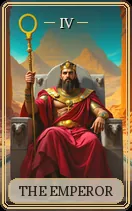 The Emperor — Solid, structured authority; a respected leader, a well-run company.
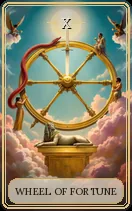 Wheel of Fortune — A lucky phase in business; prosperity that multiplies.
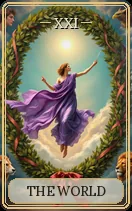 The World — Complete success; a life project fulfilled.
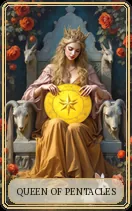 Queen of Pentacles — A prosperous, stable couple; home and business well governed.
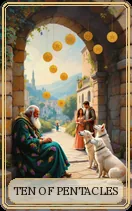 Ten of Pentacles — The patriarch, the founder; an estate that passes from generation to generation.
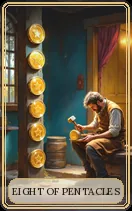 Eight of Pentacles — From apprentice to master: skill that has become prosperity.
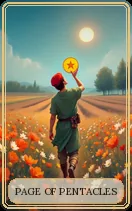 Page of Pentacles — A master and an apprentice; advice from someone experienced about money or work.
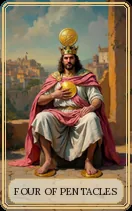 Four of Pentacles — Miserliness, fear of loss; excessive control over money.
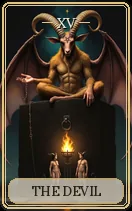 The Devil — Materialism and greed; the power of money used to dominate.
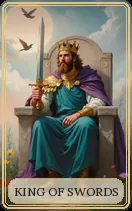 King of Swords — Business and rational decisions; an adviser or a lawyer beside the person in charge.
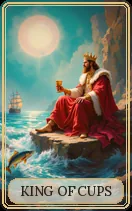 King of Cups — Material stability and emotional maturity: a generous, serene man.
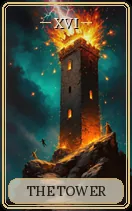 The Tower — A setback to one’s estate; what seemed unshakeable is shaken.
Frequently asked questions
What does the King of Pentacles mean in tarot?
Established prosperity and mastery: material success, an estate that has been built, the authority that comes from knowing how.
What does the King of Pentacles mean in love?
A stable, secure relationship, or a mature, faithful and protective partner. Reversed, it warns against control through money or emotional coldness.
Is the King of Pentacles a yes or a no?
It is a firm yes, especially in matters of work, business and money.
Is the King of Pentacles reversed bad?
No. It is the same mastery hardened: greed, rigidity, fear of loss. It asks you to remember what money is for.
Does the King of Pentacles represent a man?
Traditionally, a mature, competent and successful man. But he can represent any person with these qualities, or simply the attitude the situation calls for.
No sign-up · Reading written on the spot · Free