The Devil: meaning and symbolism of the tarot card
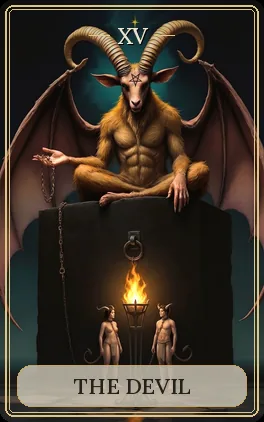
The Devil is the fifteenth card of the Major Arcana and, for many people, the most feared in the deck. A horned figure dominates the scene from the top of a pedestal, and at its feet stand two small figures held by chains. The detail that decides the reading lies in those chains: they are loose and slack, and nobody has locked them. The figures could walk away. They do not.
In a spread, The Devil rarely speaks of wickedness in the moral sense. It speaks of whatever binds — a desire, a habit, a relationship, a job, a debt, a fixed idea — and of the enormous power such things hold over us. It is also the card of raw life force: of attraction, ambition, pleasure, the body and money, with everything good and dangerous about them. The question it asks is always the same: what is holding you, and why have you not let it go yet?
The card at a glance
| Number | XV |
|---|---|
| Arcana | Major Arcana |
| Historical names | Il Diavolo (Italy); Le Diable (Marseille); The Devil (Rider-Waite-Smith) |
| Element | Earth |
| Astrology | Capricorn (Golden Dawn) |
| Hebrew letter | Ayin (ע), according to the Golden Dawn |
| Keywords | bondage, desire, dependence, power of matter, temptation, ambition, sexuality |
| Reversed | release from the bond, shadow acknowledged, dependence laid bare, a habit being broken |
| Yes or no | No, for most questions; ‘yes, but at a price’ when the question is about money or desire |
The image on the card
In the Sol da Alma Tarot, The Devil has a goat’s head, with two great curled ram’s horns, long ears and an inverted pentagram drawn on the forehead; above the horns shines a small star. Its body is covered in golden fur, and it sits cross-legged on a block of black stone, with two huge bat wings spread out behind it. The right hand reaches out palm upwards, a chain dangling from its fingers; the left rests on the knee. The background is dark, with a blue-green glow behind the head. A large iron ring is fixed to the face of the block. Below, at the foot of the block, stand two small figures, a woman and a man, almost naked — each wears only a loincloth — with horns and curling tails; each has a chain round the neck that hangs slack and runs along the ground to the base of the block. Between them a torch burns on a tall iron stand. Another chain runs down from the top of the stone to the ground.
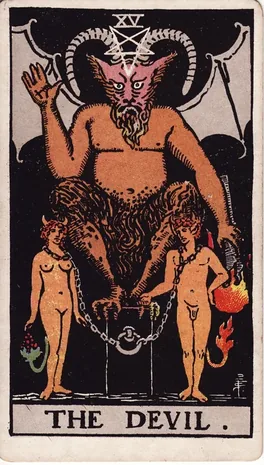
In the Rider-Waite-Smith of 1909, the composition is essentially the same, but the mood is different: a goat-faced creature with an inverted pentagram on its forehead and bat wings crouches on a dark half-cube, its right hand raised and a downturned torch in its left. Chained to the cube by the neck are a naked man and woman, with horns and tails — his ends in a flame, hers in a bunch of grapes. It is a dark parody of The Lovers, where the same couple appeared beneath an angel. The Sol da Alma follows this arrangement — the figure above, the stone, the pair below — and many of its details: the inverted pentagram, the horned and tailed couple, the chains round their necks, the ring on the block. But it seats The Devil cross-legged, puts a chain in its open hand instead of the torch, sets the fire on a tall stand between the two figures, gives them loincloths, and ends their tails in curls rather than in a flame and grapes.
In the Tarot de Marseille, Le Diable is a strange, almost grotesque figure: it has bat wings, horns and breasts, and stands on a kind of pedestal, one arm raised and the other holding a staff. At its feet, two imps with horns, pointed ears and tails are tied to the pedestal by ropes around their necks. There, too, the ropes are loose.
The symbolism, detail by detail
Almost everything in this card speaks of the difference between being trapped and feeling trapped. Each element shows one face of that idea.
- The loose chains
- The heart of the card. Nobody has closed the padlocks: the bond holds because it is consented to — out of fear, comfort, pleasure or habit. That is why The Devil is, for all that, a card of responsibility: what binds us can also be let go.
- The goat’s head
- Instinct, desire, the animal strength of the body. In medieval imagery the goat was the beast of lust and stubbornness; here it is also the life force that nobody can eliminate, only direct.
- The horns
- Power and aggression, but also fertility. The two figures below have small horns and tails: they are beginning to resemble what rules them.
- The bat wings
- The wings of a creature of the night, the reverse of the birds’ wings worn by the angels of the tarot. They speak of what lives in the shadows and of what we would rather not see in daylight.
- The black stone pedestal
- Matter, heavy and opaque. It is a high place, but it is also a block with no way out: whoever sits on it becomes a prisoner of their own throne.
- The open hand
- In the Sol da Alma, the hand reaches out palm upwards with a chain hanging from it: it offers and binds in the same gesture. It is temptation in its purest form — it does not force, it proposes. In the Rider-Waite-Smith, the raised hand recalls a blessing made backwards.
- The torch
- The fire of desire and passion. In the Rider-Waite-Smith, turned downwards in The Devil’s hand, it is energy wasted; in the Sol da Alma it burns on a tall stand between the bound figures — a light within their reach that could show them the way out.
- The two figures
- The human couple, the parts of a person that remain bound. They stand upright and do not seem to suffer: it is the exact portrait of a dependence that is no longer felt as dependence.
- The pentagram on the forehead
- An inverted pentagram, one point downwards, as in the Rider-Waite-Smith: for occultists, the symbol of matter placed above spirit. Above the horns, in the dark sky, a small star still shines.
- The dark background
- Night, the place of what is hidden. Yet the blue-green light behind the head is a reminder that the card is not only darkness: it is also strength, vitality and the desire to live.
The history of The Devil
The Devil has been part of the sequence of trumps since the Italian decks of the fifteenth century, although we do not know it in all of them. In the decks painted for the Visconti and Sforza families in Milan around 1450, which have come down to us incomplete, precisely two major cards are missing — The Devil and The Tower. We do not know what they looked like, and it is wise not to invent.
In the game of tarocchi, The Devil held the place that the Christian imagination of the time gave him: a high power, but below the heavenly bodies and the Last Judgement. The order of the final cards — Devil, Tower, Star, Moon, Sun, Judgement, World — reads almost like an ascent from darkness into light, and that is how many readers came to understand it later.
In the Marseille decks, which took their settled form between the seventeenth and eighteenth centuries, Le Diable took on the strange shape still known today — hermaphrodite, winged, with two imps tied by ropes. In the nineteenth century, Éliphas Lévi drew his figure of Baphomet, a being with a goat’s head, wings, a pentagram on its forehead and one arm raised. It was from that image that Arthur Edward Waite and Pamela Colman Smith set out, in 1909, to create their Devil — adding the chained couple, visibly similar to the one in The Lovers.
The Golden Dawn, at the end of the nineteenth century, assigned it the sign of Capricorn and the Hebrew letter Ayin. It was also the occult reading, and later the psychological one of the twentieth century, that stopped seeing a simple demon in the card and began to see the shadow in it: everything a person does not want to recognise in themselves, and which therefore governs them.
The Devil upright: the meaning
Upright, The Devil is the card of the bond. It points to whatever is holding the querent: a relationship that no longer does them good but that they cannot leave, a job endured only for the money, a habit, an addiction, a debt, an obsession, a fear that makes the decisions. What makes it dangerous is that it is usually pleasant or comfortable — which is why people stay.
It is also the card of the power of matter, and here not everything is negative. The Devil speaks of ambition, sexual desire, personal magnetism, the will to win and to possess. In a question about money or attraction, it can be a card of strength and even of success — provided you know who is in charge of whom. The danger is not desire; it is the pact signed without reading the small print.
In many spreads it also points to manipulation: someone who controls, seduces or keeps another person tied through emotional or financial dependence. In that case, the card asks you to see clearly the game being played. And it always recalls the same thing: the chains are loose. Whoever recognises them can take them off.
The Devil reversed
Reversed, The Devil does not turn into an angel. It is the same bond, seen from another angle: the knot is starting to loosen. Very often it is the card of the moment when a dependence is called by its name — and that recognition is the beginning of release. A habit broken, a relationship left behind, a debt that begins to be paid off, a shadow accepted instead of hidden.
There is, however, a heavier reading. Reversed, The Devil can show dependence with its mask off: excess that no longer hides, loss of control, the bond that tightens precisely because it is being fought badly. The neighbouring cards tell you which of the two paths is under way. In both cases, the message is the same: what was unconscious is now in plain sight, and it is no longer possible to pretend it does not exist.
The Devil in love
In love, The Devil is the card of intense attraction: chemistry, desire, physical passion, a connection that is hard to let go of. It can speak of a very sensual, vivid relationship — and also of one in which desire has taken the place of everything else. For someone who is single, it often heralds a strong, sudden attraction, best looked at with both eyes open.
The shadow side is that of emotional dependence, jealousy, possessiveness, the relationship that goes on out of fear of being alone. It can also indicate a hidden relationship or a love triangle. Reversed, The Devil often shows the moment when one of the two realises they are trapped and starts to walk away — or the wish to regain freedom within the relationship itself.
The Devil in work and money
At work, The Devil speaks of ambition, power and competition, and it can be favourable to anyone who works in business, sales or finance. But it also describes the job you hate and cannot leave, the boss who controls too much, the atmosphere of pressure and power games, the extra hours accepted out of fear. In a question about an offer, it asks you to read the contract carefully.
With money, it is a card of plenty of movement and little prudence: compulsive spending, debts, loans that keep being rolled over, the lure of easy gain. It can also indicate money coming in, but at a high personal cost. Reversed, it usually heralds a way out of a tight financial situation — as long as the habit that created it changes.
The Devil in health and wellbeing
In questions about wellbeing, The Devil speaks of excesses and of habits that weigh on you — eating, drinking, working or being glued to your phone more than is good for you. Reversed, it is often the moment to cut out one of those habits. The cards are no substitute for any kind of healthcare: the reading speaks of attitudes and tendencies, not of diagnoses.
The Devil in spiritual life
On the inner path, The Devil is the encounter with the shadow: the desires, the fears and the parts of yourself you would rather not have. The card does not ask you to fight them blindly, but to look at them head-on. Many traditions say that only those who know what binds them can be set free. Here, spiritual work begins exactly there — with naming the chains.
The Devil as advice
As advice, The Devil says: see what is holding you. Ask yourself what you gain from the very thing that harms you, and what you would have to let go of in order to leave. It is not advice about guilt but about clarity — and sometimes also about accepting your own desire, without shame, but with limits. In certain questions it adds: use your strength and your ambition, but do not sell your soul for the result.
The Devil in the positions of a spread
- In the past
- A dependence, a relationship or a commitment that left its mark on the person and whose weight is still felt.
- In the present
- An active bond: something or someone now has a great deal of power over the querent, and it is worth understanding why.
- In the future
- A temptation drawing near — an offer, a passion, a gain — that calls for caution before saying yes.
- As an obstacle
- The fear, habit or attachment that prevents moving forward; often, whatever the person does not want to give up.
- As the outcome
- If nothing changes, the bond grows stronger. If there is awareness, the outcome is the power to choose — and to stay or leave of one’s own free will.
Numerology and correspondences
The number XV reduces to 6 (1 + 5), and for that reason many readers link The Devil to The Lovers, card VI: in one, the choice made with the heart; in the other, the choice that is no longer free. The Rider-Waite-Smith underlines the kinship with the same human couple in both cards. In the Golden Dawn tradition, The Devil corresponds to Capricorn — an earth sign, the sign of ambition, structure and material things — and to the Hebrew letter Ayin, whose name means ‘eye’: the card asks, precisely, that we see. Its element is Earth, matter in all its power.
Combinations with other cards
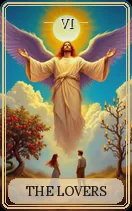 The Lovers — A passion that binds: a very strong attraction, desire that weighs more than free choice.
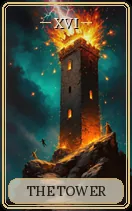 The Tower — The bond that suddenly snaps — often with a crash, but with release in sight.
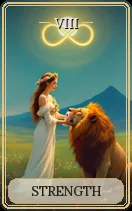 Strength — The inner strength able to tame an addiction or an impulse; instinct directed rather than repressed.
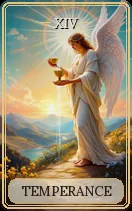 Temperance — The middle way: moderating excess without denying desire.
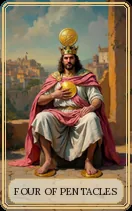 Four of Pentacles — Attachment to money or possessions; a fear of loss that binds more than it protects.
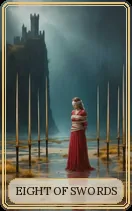 Eight of Swords — Feeling trapped with no way out — but, as in both cards, the bonds are looser than they seem.
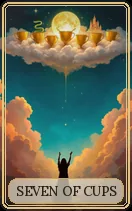 Seven of Cups — Illusions, fantasies and temptations: many choices, and not all of them real.
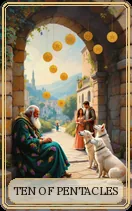 Ten of Pentacles — Wealth or an inheritance with strings attached: family money that comes with conditions.
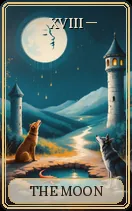 The Moon — Deception and fear combined: secrets, manipulation, a murky situation that is best not accepted blindly.
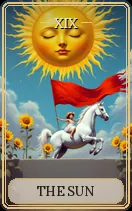 The Sun — The shadow brought into the light: what was hidden is revealed, and loses its power as a result.
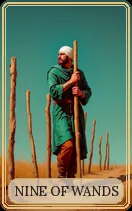 Nine of Wands — A weary resistance; staying in a situation out of stubbornness rather than choice.
Frequently asked questions
Is The Devil a bad card?
Not necessarily. It speaks of what binds us — desire, money, habits, dependences — but also of life force and ambition. It is a warning to see clearly what rules us, not a condemnation.
What does The Devil mean in love?
Intense attraction, chemistry and physical passion. The shadow side is jealousy, possessiveness or emotional dependence. Reversed, it often marks the moment when someone frees themselves from a relationship that held them.
Is The Devil a yes or a no?
For most questions it leans towards no, or towards a yes with a price to pay. In questions about desire, money or ambition it can be a yes, but it asks for caution about the conditions.
Is The Devil reversed good?
Often it is: it shows that the bond is starting to loosen and that the person now recognises what was holding them. It can also show a dependence that has grown worse; the neighbouring cards make clear which of the two it is.
Why are The Devil’s chains loose?
To show that the bond is consented to. The figures could leave, but they stay — out of fear, habit or pleasure. That detail is what makes The Devil a card of responsibility and of possible release.
No sign-up · Reading written on the spot · Free