
Ace of Cups: meaning and symbolism of the tarot card
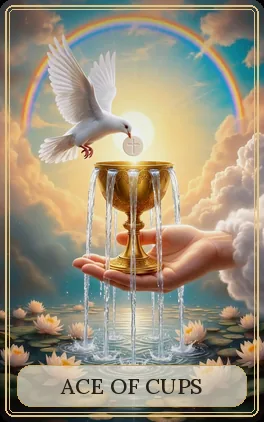
The Ace of Cups is the first card of the suit of Water and one of the loveliest in the deck: a golden cup, offered by a hand, overflows in streams of water that fall onto a pool of flowers. Nobody is drinking and nobody is asking. There is only the cup, too full, and the water running out of it without anyone commanding it to.
In a spread, the Ace of Cups speaks of the heart at its most open: a love that begins, a friendship being born, a new emotion, a reconciliation, a gesture of tenderness that arrives unexpectedly. Like all the Aces, it is a seed — the whole strength of the suit, not yet spent. It says there is something to receive, and that you need to have your hands open to receive it.
The card at a glance
| Card | Ace |
|---|---|
| Suit | Cups |
| Element | Water |
| Astrology | Root of the element of Water (Golden Dawn) |
| Keywords | love being born, gift, openness, emotion, intuition, compassion, emotional new beginning |
| Reversed | spring held back, closed-off feeling, emotion with nowhere to go, neediness, affection left unspoken |
| Yes or no | Yes, especially in questions about love and relationships |
The image on the card
In the Sol da Alma Tarot, a hand comes out of a white cloud on the right and holds a large golden cup with a tall, finely worked stem on its open palm. The cup is so full that water spills over the rim in five broad streams, with a few finer threads behind them, falling straight down into a pool covered with water-lily leaves and white and pink lotus flowers and splashing on its surface. Above, a white dove with outstretched wings descends, head lowered, to place in the cup a white host marked with a cross, which it holds in its beak. Behind it the disc of the sun shines among golden clouds, and a complete rainbow arches over the scene from one side to the other.
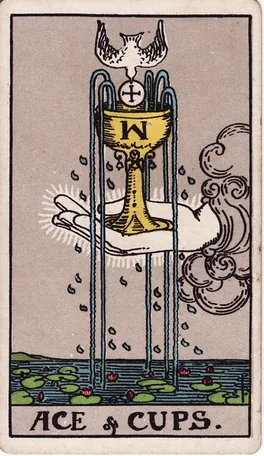
In the 1909 Rider-Waite-Smith, the composition is essentially the same, and the Sol da Alma painting now follows it closely: a hand comes out of a cloud on the right and holds a golden cup in its palm; a dove descends head first with a host marked with a cross in its beak; five streams of water and many loose drops fall from the cup onto a pool of water lilies. On the Rider-Waite-Smith cup there is a letter, a W or an inverted M, whose meaning scholars still debate. The Sol da Alma keeps the cloud, the open palm, the descending dove with the host and the overflowing streams; it leaves out the letter and the shower of loose drops, has the dove descending at an angle rather than fully upside down, swaps the small water lilies for open lotuses and adds the rainbow, which does not appear on the 1909 card.
In the Marseille Tarot, as with all the numbered Minors in that deck, there is no scene: the Ace of Cups is a single large, ornate cup, of almost architectural shape, with no hand, no dove and no water. The idea of an overflowing gift is a modern reading, which the 1909 deck made visible.
The symbolism, detail by detail
Everything in this card speaks of receiving and giving at the same time. The cup is not a vessel for keeping things in: it is a place the water passes through.
- The cup
- The heart, the capacity to feel and to welcome. It is the symbol of the suit of Cups, and here it appears alone, whole, as the promise of everything the suit will bring.
- The overflowing water
- Emotion that no longer fits inside the one who feels it. The Ace of Cups does not speak of a measured affection: it speaks of what is given without counting, because there is more than enough.
- The hand
- The gift that comes from outside. Nobody takes hold of the cup: it is offered. The card says that what arrives is not conquered — it is received.
- The dove
- Peace, tenderness, the spirit descending on what is human. In the Christian tradition it is the symbol of the Holy Spirit, and many readers see it here as the purest part of love.
- The host with the cross
- Communion, food for the spirit. It gives the card a sacred tone: the affection it announces has something of grace about it, of something neither earned nor paid for.
- The pool and the lotus flowers
- The world of the emotions, which the water from the cup feeds. The lotus, which grows out of still water and opens to the light, is the image of feeling that blossoms when it is watered.
- The rainbow
- Unique to the Sol da Alma painting: the covenant, the promise, the reconciliation after the rain. It reinforces the card’s sense of an emotional fresh start.
- The one
- The Ace is number one of the suit: the seed, the whole strength offered like an outstretched hand. Everything Cups can become — the meeting, the celebration, the longing, the fulfilment — is here, still unopened.
The history of the Ace of Cups
The tarot was born in northern Italy in the fifteenth century as a deck for playing games: to the four suits of ordinary cards was added a series of trumps, the trionfi, which gave rise to the Major Arcana. The suits were the Italian ones — cups, swords, batons and coins — and in Portugal and Spain they are still the same. In the decks painted for the Visconti and Sforza court in Milan, around 1450, the Aces and the numbered cards showed only the suit symbols, with no figures.
So they remained in the Marseille decks, which settled into their form between the seventeenth and eighteenth centuries: the Ace of Cups is a large, richly decorated cup, and nothing more. For centuries, those who read the cards read the Minors by suit and number, with no image to help them.
It was the Rider-Waite-Smith, drawn by Pamela Colman Smith under the direction of Arthur Edward Waite and published in 1909, that was the first widely circulated deck to give every minor card a scene. On the Ace of Cups, Waite and Smith added to the cup a dove with a host and a hand coming out of a cloud — an image many readers link to the legends of the Grail, the holy chalice of the chivalric romances. In the book that accompanied the deck, Waite describes the card as the house of the true heart, of joy and of abundance. This is the image most modern decks follow, the Sol da Alma included.
The Ace of Cups upright: the meaning
Upright, the Ace of Cups is the emotional new beginning par excellence: a new passion, a friendship that is starting, a relationship that gains a new depth, a reunion. It can also be a simple joy — a piece of news that touches you, an invitation, a gesture from someone you did not expect. What the card announces reaches the heart before it reaches the head.
It does not speak only of love between two people. The Ace of Cups is the card of emotional openness in general: the capacity to feel, to be moved, to forgive, to trust again after a time of being closed off. In someone who had been tired or hardened, it is the sign that something is flowing inside again. In a creative phase, it may be inspiration arriving suddenly, the work born of what one feels.
It is, above all, a card of gift. What it brings does not depend on effort or merit: it is offered. The only work it asks is to accept — not to be suspicious, not to put it off, not to answer tenderness with calculation. And then to let what is received pass on to others too, like the water falling from the cup into the pool.
The Ace of Cups reversed
Reversed, the Ace of Cups does not become its own opposite: it is still a spring, but a spring held back. A great deal is felt and none of it is let out. It may be love left undeclared, hurt that is stored away, the person who protects themselves so much that they no longer let anyone come close. The cup is full, but turned inwards.
It can also be the excess on the other side: emotion that pours out without measure, where there is nobody to gather it — giving yourself to someone who cannot or will not receive, expecting more from a relationship than it can give, living at the mercy of every feeling. In both cases, the card asks the same thing: to recognise what you feel and to choose carefully where you place it.
Sometimes it speaks only of a delay. The affection is there, and so is the beginning, but it is not yet the moment, or the courage to take the first step is missing.
The Ace of Cups in love
In love, it is one of the most longed-for cards in the deck. For someone who is single, it announces a meeting with real feeling — not a game of seduction, but a connection that touches. For someone in a relationship, it speaks of a phase of renewed tenderness, of a reconciliation, of a step forward: moving in together, making a commitment, making up after a quarrel.
It is also the card of love given with open hands: generosity, patience, care. Reversed, it warns against a closed heart — the questioner’s or the other person’s — against neediness that asks without giving, or against a strong feeling that finds no answer on the other side.
The Ace of Cups in work and money
In work, the Ace of Cups is not the card of profit but of satisfaction. It speaks of a project you truly enjoy, of a good atmosphere, of colleagues with whom you form bonds, of work connected with care, with people, with art or with creation. In a question about an offer, it says this is an opportunity that does you good — whatever the numbers may say.
With money, it points to a phase of some ease and, above all, of generosity: a present, some help, a favour that arrives at the right moment. Reversed, it asks you to watch out for spending driven by emotional impulse, and for work decisions made by the heart alone, without looking at the accounts.
The Ace of Cups in health and wellbeing
In questions about wellbeing, the Ace of Cups speaks of emotional balance, of relief and of renewal: the feeling of breathing again after a difficult phase, the wish to look after yourself. Reversed, it is a reminder that emotions kept inside also weigh on you, and that talking to someone you trust can help. The cards are no substitute for any kind of healthcare; the reading speaks of attitudes and tendencies, not of diagnoses.
The Ace of Cups in spiritual life
On the inner path, the Ace of Cups is the card of grace: the moment when something opens without your quite knowing why — a prayer that is heard, an unexpected peace, the feeling of being loved unconditionally. The host and the dove make it, for many readers, the image of communion. It asks for an available heart, and it is a reminder that spiritual life is not made of discipline alone: it is also made of receiving.
The Ace of Cups as advice
As advice, the Ace of Cups says: open up. Let in what is being offered to you, say what you feel, take the first step of tenderness. Do not wait for guarantees before loving someone or before accepting that someone loves you. And if your heart is full, let it overflow to those around you — that is how the cup fills up again.
The Ace of Cups in the positions of a spread
- In the past
- The beginning of a relationship or a feeling that still marks the present; a moment of happiness that serves as a reference point.
- In the present
- The heart is open, or is being invited to open. Something is being offered right now.
- In the future
- A meeting, a joy, a reconciliation or a piece of happy news on its way.
- As an obstacle
- Emotion overruling judgement or, on the contrary, the fear of feeling, which shuts the door on what is arriving.
- As the outcome
- A happy, heartfelt resolution: the matter ends in closeness, in peace or in the beginning of something good.
Numerology and correspondences
The Ace is the seed of the suit: the whole strength, not yet spent, offered like an outstretched hand. In the suit of Cups — the suit of Water, of feeling, of bonds and of memory — that seed is the very capacity to love and to be moved, before it has a name or a person to turn to.
In the Golden Dawn tradition, the Aces have no planet or sign: they are the ‘roots’ of the elements, and the Ace of Cups is called the Root of the Powers of Water. It is said to contain in potential all the other cards of the suit, from the meeting of the Two to the fulfilment of the Ten. That is why, next to other Cups, the Ace often works as a reinforcement: the emotion they describe is genuine and is at its beginning.
Combinations with other cards
 Two of Cups — A love that begins and is returned: the meeting of two people who recognise each other.
 The Lovers — A true passion, or a choice made entirely by the heart.
 Ten of Cups — Happiness in the family, a home full of affection; a beginning that promises to last.
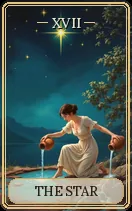 The Star — Renewed hope and emotional healing after a difficult time.
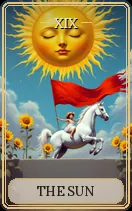 The Sun — An open, radiant joy: happy love, very good news.
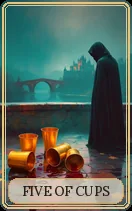 Five of Cups — A heart opening again after a loss or a disappointment.
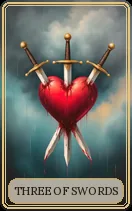 Three of Swords — A hurt feeling; the affection is there, but it is wounded and needs time.
 Ace of Pentacles — A gift that becomes concrete: a present, some help, a heartfelt project taking shape.
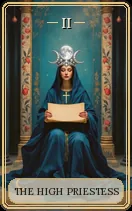 The High Priestess — Very strong intuition; a feeling sensed before it is spoken.
 Ace of Swords — Clarity about what you feel: the emotion finally put into words.
Frequently asked questions
What does the Ace of Cups mean in love?
A genuine emotional beginning: a meeting, a new passion, a reconciliation or a phase of renewed tenderness in a relationship. It is one of the most favourable cards for love.
Is the Ace of Cups a yes or a no?
Yes, especially in questions about feelings, relationships and anything done with the heart. Reversed, it leans towards ‘not yet’ or ‘it depends on opening up’.
Is the Ace of Cups reversed bad?
It is not bad: it is the same spring, but held back. It speaks of feelings kept inside, of the fear of opening up, or of emotion given to someone who does not receive it. It is an invitation to recognise what you feel.
Can the Ace of Cups indicate a new relationship?
It can, and it is one of the cards that does so most clearly. The neighbouring cards tell you whether it is a love, a friendship or another emotional bond.
What do the dove and the host represent in the Ace of Cups?
Peace and communion: the idea that the affection the card announces has something of grace about it, of something offered. They were introduced into the image by the Rider-Waite-Smith in 1909; in the Marseille decks there is only the cup.
No sign-up · Reading written on the spot · Free