
Ace of Wands: meaning and symbolism of the tarot card
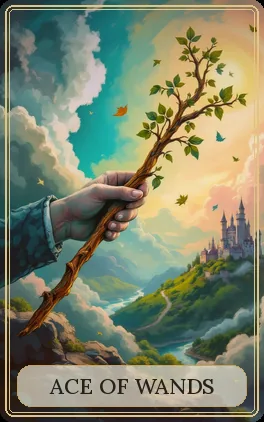
The Ace of Wands is the first card of the suit of Fire, and it has everything you would expect of a first moment: a hand that appears out of nowhere, holds a living branch and offers it to whoever is looking. There is no work yet, no plan, no path mapped out. There is only will — whole, unspent, ready to go in any direction.
In a spread, the Ace of Wands speaks of a beginning full of energy: an exciting idea, an invitation, a proposal, a desire that gains strength overnight. It is one of the most encouraging cards in the deck, but it does nobody’s work for them. It says that the spark exists. What is done with it — whether it lights a bonfire or goes out at the first gust of wind — depends on the person who receives it and on the cards beside it.
The card at a glance
| Card | Ace |
|---|---|
| Suit | Wands |
| Element | Fire |
| Astrology | Root of Fire (Golden Dawn: ‘the Root of the Powers of Fire’) |
| Keywords | seed of fire, creative impulse, beginning, enthusiasm, invitation, initiative, energy |
| Reversed | impulse that fails to catch, delay, scattered enthusiasm, false start, lack of drive |
| Yes or no | Yes — and the sooner you act, the better |
The image on the card
In the Sol da Alma Tarot, an arm enters the card from the left, clad in a grey-blue sleeve of checked fabric with a turned-back cuff. The hand, large and lifelike, firmly grips a gnarled, twisted branch of brown wood that rises diagonally to the top of the card and opens into small boughs full of green leaves. Some leaves break away and fly off — one of them already orange — among small shapes that look like birds or leaves carried on the wind. The sky runs from turquoise blue, with heavy clouds, to a warm, almost solar gold behind the branch. Below, on the right, a castle with pointed towers stands on top of a green hill; a dirt track zigzags up the hill, and a river runs through the valley. In the foreground, on the left, there are rocks.
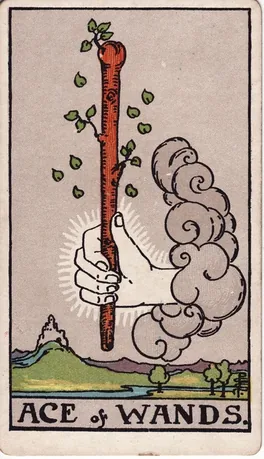
In the 1909 Rider-Waite-Smith, the composition is the same but reversed: the hand comes out of a cloud on the right-hand side, surrounded by a small halo of rays, and holds a straight, smooth, brick-coloured staff from which a few shoots sprout; eight loose leaves fall around it. Below, there is a castle on a hilltop on the left, a river and a few trees. The Sol da Alma kept the hand, the leaves, the castle and the river, but swapped the hand emerging from a cloud for a clothed, human arm, and the straight staff for a twisted and far leafier branch — less emblem, more living plant.
In the Marseille Tarot, where the numbered Minor cards have no scene, the Ace is the exception: there too a hand comes out of a sort of cloud or scalloped sleeve and brandishes a large, rough stick, a knotted club, surrounded by small flames or falling drops. The idea is the same in all three decks — a force that comes from outside and offers itself.
The symbolism, detail by detail
Almost everything in this card speaks of something alive that has not yet grown. Each detail adds a shade to that idea.
- The hand that appears
- The offer. The Ace does not show a person, it shows a gesture: something is placed within reach of the one who asks. In the Rider-Waite-Smith it comes out of a cloud, like a gift from elsewhere; in the Sol da Alma it has a sleeve and a cuff, as if someone of flesh and blood were holding out their arm.
- The living branch
- The difference between the Fire of the tarot and the fire that burns. The wand of the suit of Wands is not dry wood: it has leaves, it is growing. It is energy that generates, and not merely energy that consumes.
- The knots and the twist
- In the Sol da Alma, the branch is irregular and full of knots. The force of a beginning is neither polished nor tidy: it is raw, full of rough edges, and still needs to be worked.
- The falling leaves
- What breaks away from the initial impulse — ideas, sparks, seeds carried off by the wind. Not all of them will take; the card suggests abundance, not a guarantee.
- The orange leaf
- A detail of the Sol da Alma painting: amid the green, one leaf has already changed colour. It is a reminder that all energy has its time, and that the opportunity of the Ace will not wait there for ever.
- The castle on the hill
- The goal, still far away. That is where the branch points: the work that could one day be built with this force, if it is used well.
- The zigzag path
- The route is not direct. Between the hand and the castle lie a valley, a river and a climb — the work that the Ace, on its own, has not yet done.
- The golden light
- The warmth of the element of Fire, concentrated behind the branch. It is the card telling us where its strength comes from: enthusiasm, desire, the will to live.
The history of the Ace of Wands
Wands have been in the tarot from the very start. The earliest decks, painted in northern Italy in the fifteenth century — such as those made for the Visconti and the Sforza in Milan around 1450 — added to the trumps the four suits that Italian playing cards already used: bastoni, coppe, spade and denari. The batons were real sticks, simple weapons and working tools, and the Ace opened the series of numbered cards.
In the Marseille Tarot, which settled into its form between the seventeenth and eighteenth centuries, the Ace of Wands already has the shape that many modern decks inherited: a hand coming out of a cloud and holding a large stick. It was one of the few Minor cards with an image of its own, because the other numbered cards simply arranged the batons in a pattern.
Only with the occultists did the suit acquire an element. At the end of the nineteenth century the Golden Dawn matched Wands to Fire and called the Ace ‘the Root of the Powers of Fire’: not one card among others, but the source from which the whole suit flows. Arthur Edward Waite and Pamela Colman Smith, in their 1909 deck, kept the hand and the cloud and added the leaves, the landscape and the castle. In his book on the deck, Waite read this card as creation, invention, enterprise, and also as birth and origin — the beginning of something.
The Sol da Alma Tarot follows this iconography, with its own painting, and the website’s convention is the same as the Golden Dawn’s: Wands is the suit of Fire — will, impulse, the work that gets under way and the energy spent in making things happen.
The Ace of Wands upright: the meaning
Upright, the Ace of Wands is the card of the spark. It announces a beginning full of energy: an idea that arrives out of the blue and will not leave your head, a project you want to launch, an invitation or proposal that comes along and fires you up. It says that there is strength available, and that the moment favours whoever makes use of it.
It is also the card of one’s own will. Unlike the Ace of Cups, which speaks of what one feels, or the Ace of Pentacles, which speaks of what one has, the Ace of Wands speaks of what one wants to do. It brings initiative, the courage to take risks, creativity, desire — in the broadest sense of the word, from the will to create to the will to live. It often turns up for someone who has been standing still for a while and suddenly feels the urge to get moving.
Like all the Aces, it is a seed and not a tree. The card does not promise that the project will be completed; it says there is strength enough to begin. That is why its best advice is to act while the enthusiasm is still hot. A Fire that is not fed soon goes out, and the Ace of Wands is precisely the card of an opportunity felt with the whole body, but one that does not wait long.
The Ace of Wands reversed
Reversed, the Ace of Wands does not lose its strength: it loses its take-off. The idea is there, and so is the enthusiasm, but the first step is never taken. It is the project postponed from one week to the next, the invitation that never gets an answer, the urge that flares up over dinner and has gone by morning. In many readings it simply speaks of a delayed beginning — the impulse exists, but has not yet found its moment or its ground.
It can also speak of excess: too many sparks, too many ideas, beginnings in every direction and none carried through. Or of the impulse turned inwards, which becomes impatience, irritation, the frustration of someone who wants to act and cannot. In both cases the card asks for the same thing: choose one spark, shelter it from the wind and give it fuel — a first concrete step, however small.
The Ace of Wands in love
In love, the Ace of Wands is attraction: a desire that flares up, a passion that begins, a chemistry felt before it is understood. For someone who is single, it announces a meeting with a spark, often quick and intense, or simply the return of the wish to get to know someone. In a relationship, it brings new energy — a livelier, more physical, more playful phase, a shared project that restores the couple’s enthusiasm.
It is more a card of passion than of commitment. It says the fire exists, not that it will last. Next to Cups, especially the Two or the Ace, the attraction has feeling behind it; next to the Knight of Wands or the Eight of Wands, it may be an intense but brief enthusiasm. Reversed, it speaks of an interest that never gets beyond good intentions, a flame that has cooled, or someone who wants to but cannot yet bring themselves to make the first move.
The Ace of Wands in work and money
In work, it is one of the best cards for anyone who wants to start something: a new project, a business of one’s own, a proposal, a different field, a creative idea with potential. It favours work that depends on initiative, creative professions, entrepreneurship, anything that relies on personal energy. In a question about a job offer, it usually says the offer is worth taking — and that the enthusiasm it stirs is a good sign.
With money, the Ace of Wands speaks more of opportunities than of gains. It points to the start of a source of income, a business getting off the ground, an idea that may bear fruit in time, rather than money already in hand. It asks you to move from idea to action without losing your practical sense: enthusiasm is the fuel, but you also need a plan. Reversed, it warns against projects that stay on paper for ever, or against impulse spending in the heat of an idea that has not yet been thought through.
The Ace of Wands in health and wellbeing
In questions about wellbeing, the Ace of Wands speaks of returning energy, of wanting to move the body, of the drive to take up a physical activity or change a habit. Reversed, it points to the tiredness of someone who wears themselves out on fresh starts with no follow-through, or to a lack of drive to begin. Like any card, it shows attitudes and tendencies, and it is no substitute for any kind of healthcare or for the advice of a professional.
The Ace of Wands in spiritual life
On the inner path, the Ace of Wands is enthusiasm — a word that, at its root, means having a god within. It is the card of a calling that is felt, of the wish to begin a practice, of an inspiration that lights something up inside. It asks that this flame not remain a mere intention: an inner fire needs tending every day, with small and steady gestures, so that it does not shrink to a good idea someone once had.
The Ace of Wands as advice
As advice, the Ace of Wands says: start now. Make the most of the enthusiasm while it is alive, take the first step, accept the invitation, try out the idea. Do not wait for certainty, because Fire does not give it — it gives the courage to go and find out. And it also says: choose. A single branch, well planted, is worth more than ten sparks scattered on the wind.
The Ace of Wands in the positions of a spread
- In the past
- An idea or impulse that set everything in motion; the matter began in a moment of enthusiasm.
- In the present
- The spark is lit now: there is an opportunity, a proposal or a new desire waiting for an answer.
- In the future
- A beginning on its way — an idea, an invitation, a new project that will bring energy.
- As an obstacle
- Enthusiasm without direction: too many beginnings, haste, or the idea that never makes it into practice.
- As the outcome
- A fresh start. The matter does not close; it opens onto a project that is still waiting to be built.
Numerology and correspondences
The Ace is the seed of the suit: the whole force, still unspent, offered like an outstretched hand. In the suit of Wands, that force is Fire — will, impulse, the work that gets under way and the energy spent in making things happen. Everything that the following cards of the suit will show, from the plan of the Two to the burden of the Ten, is already contained in this first branch, as the tree is contained in the seed.
In the Golden Dawn tradition, the Aces are given neither planet nor sign: they are the roots of the elements, and the Ace of Wands is the Root of the Powers of Fire. This helps explain why the card speaks so much of setting out and so little of harvest — it is Fire before it has taken shape, before it has divided into the planets and signs that the cards from Two to Ten will receive.
Combinations with other cards
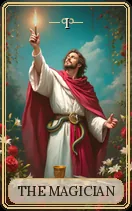 The Magician — The idea meets its means: will, talent and tools to get it up and running right away.
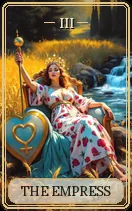 The Empress — A highly fertile creativity; a project that grows fast and bears fruit.
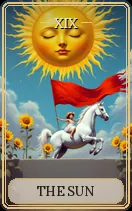 The Sun — A happy, confident beginning, with success in sight.
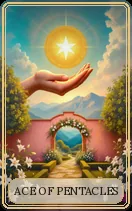 Ace of Pentacles — The idea that becomes concrete: a business, an income, a project with a material footing.
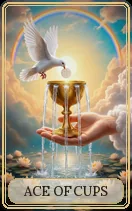 Ace of Cups — Passion and feeling at once: a love that begins with both desire and affection.
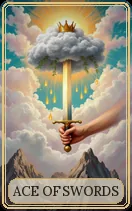 Ace of Swords — A clear idea and a firm decision — the impulse gains a head and a direction.
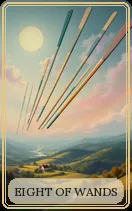 Eight of Wands — Everything starts very quickly: news, an answer, an immediate take-off.
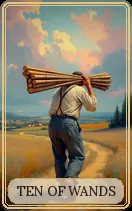 Ten of Wands — Enthusiasm that turns into a burden: take care not to take on more than you can carry.
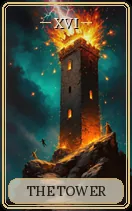 The Tower — A beginning born of a rupture: what fell makes room for something new and full of energy.
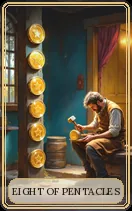 Eight of Pentacles — A new trade or a new apprenticeship, taken seriously from day one.
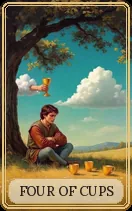 Four of Cups — An invitation or opportunity allowed to slip by through apathy or lack of interest.
Frequently asked questions
What does the Ace of Wands mean in tarot?
It is the seed of Fire: a beginning full of energy, an exciting idea, an invitation or a proposal. It says there is strength to begin and that the moment favours whoever acts.
What does the Ace of Wands mean in love?
Attraction, desire, a passion that flares up or a relationship that gains new energy. It speaks more of spark than of commitment: the neighbouring cards tell you whether the fire will last.
Is the Ace of Wands a yes or a no?
Yes, and one of the clearest in the deck, especially in questions about starting something. It is a yes that calls for action: if nobody takes the first step, the opportunity cools.
Is the Ace of Wands reversed bad?
No. Reversed, it is the same impulse that has not yet caught: a postponed beginning, scattered enthusiasm or a frustrated will. It asks you to choose one thing and take the first concrete step.
What is the element of the Ace of Wands?
Fire. In the Golden Dawn tradition, the Ace of Wands is the Root of the Powers of Fire, the source from which the whole suit flows: will, creativity, enthusiasm and action.
No sign-up · Reading written on the spot · Free