
King of Swords: meaning and symbolism of the tarot card
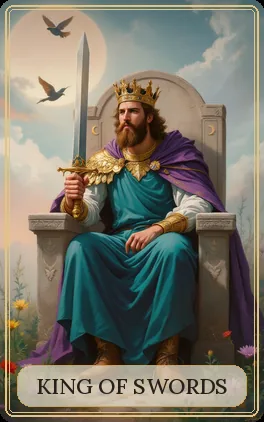
The King of Swords is the figure of the word that decides. Seated on a stone throne, a crown on his head and a sword raised in his hand, a bearded king gazes into the distance, deep in thought, like someone weighing a matter before passing sentence. He does not fidget, he does not raise his voice: he judges. He is the suit of Air at its highest rank — thought made law, discernment placed at the service of others.
In a spread, the King of Swords speaks of authority, of justice and of well-founded decisions. It may represent a person — a judge, a lawyer, an expert, someone whose word counts — or the attitude the situation calls for: thinking with a cool head, deciding on the facts, taking responsibility for what is decided. His risk is harshness: reason that forgets people, the law applied without mercy.
The card at a glance
| Card | King |
|---|---|
| Suit | Swords |
| Element | Air |
| Astrology | Varies between schools |
| Keywords | authority, law, discernment, justice, decision, intellectual rigour, responsibility, formal matters |
| Reversed | merciless rigour, harsh judgement, authoritarianism, coldness, abuse of power, manipulation through words |
| Yes or no | Yes, if it is fair and well founded — the King decides on the facts |
The image on the card
In the Sol da Alma Tarot, the King is a man of mature years, with long auburn-brown hair and a full beard, seated on a throne of pale stone. On his head is a gold crown with tall points, set with dark blue stones. He wears a long blue-green tunic over a white shirt, and on his shoulders pieces of worked gold, like scales or feathers, with a golden gorget at his neck; a purple mantle falls from his shoulders to the ground, fastened by a brooch with a blue stone. He wears gold cuffs at his wrists and brown leather boots. In his right hand he holds a long sword upright, point up, with a golden hilt; his left hand rests on his knee. He does not look straight out: his face is turned to one side, serious and thoughtful. The throne has an arched back engraved with crescent moons, and its arms are decorated with reliefs. Behind the sword is a large, pale disc of sun or moon; in the sky, pale clouds and two birds in flight. On the ground around the throne grow wild flowers in red, yellow and lilac.
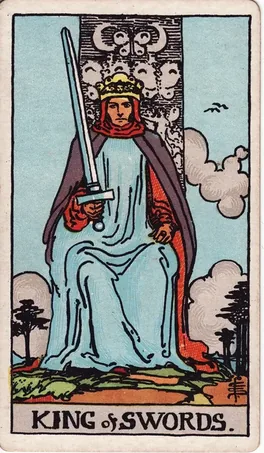
In the 1909 Rider-Waite-Smith, the King sits facing forward, looking directly at whoever is looking at the card, with his sword raised in his right hand, slightly tilted, and his left hand resting in his lap. He wears a pale blue tunic, with a purple mantle lined with red and a red hood beneath his crown. The high back of the throne is decorated with butterflies. In the background there are low clouds, a few trees and two birds in the sky. The Sol da Alma closely follows this iconography — the king seated on the stone throne, the sword raised in his right hand, the other hand at rest, the blue-green tunic and the purple mantle, the clouds and the two birds — but changes the gaze: the King no longer faces the viewer, he looks to the side, like someone reflecting. The butterflies on the throne have given way to crescent moons, the red hood has gone, the figure has gained a beard and gold pieces on his shoulders, and the ground has filled with flowers.
In the Marseille Tarot, the Roi d’Épée is a seated, full-length figure with his sword, with no sky or landscape. The throne among the clouds and the birds are contributions of the Rider-Waite-Smith.
The symbolism, detail by detail
The card speaks of thought that has become authority. Each detail adds a nuance.
- The raised sword
- The law, the decision, the judgement. The straight blade, pointing at the sky, is the truth that does not bend — and the power to cut, to separate, to pass sentence.
- The hand on the knee
- Calm and self-mastery. The King does not need to brandish his sword: it is enough for him to hold it.
- The sideways gaze
- In the Sol da Alma painting, the King does not face the viewer: he is weighing things up. It is the moment of reflection before the sentence, attention given to the matter rather than to the person.
- The stone throne
- Stability and permanence. The decisions of the King of Swords carry weight and they last.
- The crescent moons
- Change, cycles, a world in transformation. The King rules in an element — Air — that never stands still, and he has to decide in the midst of the movement.
- The gold crown
- Recognised authority. Unlike the Knight, who conquers, the King already holds power; what falls to him is to exercise it well.
- The purple mantle
- Dignity and wisdom. Purple is traditionally the colour of royal power and of reflection.
- The blue-green tunic
- Serenity, clear thought, a clear sky. The King of Swords wears the colours of Air.
- The gold pieces on his shoulders
- The weight of responsibility, borne with dignity. They recall armour: the King has fought before, and is ready to defend what is right.
- The two birds
- The freedom of thought and the elevated view. They are also the two sides the King must hear before he decides.
- The wild flowers
- The life that grows at the feet of the law. In the Sol da Alma painting, the King reigns over fertile ground: justice well exercised makes things flourish.
The history of the King of Swords
The king has been the highest court figure of each suit since the first tarot decks, painted in northern Italy in the fifteenth century. In the Marseille decks, which took their settled form between the seventeenth and eighteenth centuries, he is called the Roi d’Épée and appears seated, sword in hand.
At the end of the nineteenth century, the Hermetic Order of the Golden Dawn reorganised the court cards of the Minors and gave them other names and another hierarchy, and the Thoth deck by Aleister Crowley and Frieda Harris went its own way. Arthur Edward Waite and Pamela Colman Smith, in the 1909 deck, kept the traditional order and gave the King of Swords the scene of the forward-facing throne, with the sword raised and clouds all around, which became the reference image.
In cartomancy, the King of Swords was associated early on with the law, the courts and the professions of word and judgement — the judge, the lawyer, the magistrate, the man of authority. It is a reading that still holds. The astrological and elemental attributions of the court cards vary between schools, and none of them is universally agreed.
The King of Swords upright: the meaning
Upright, the King of Swords is the card of law and discernment. It speaks of decisions made with a cool head, grounded in facts and principles, and taken on with responsibility. In a reading, it may indicate that the time has come to decide — fairly, clearly, without being swayed by emotions or pressures.
It is also the card of formal matters: contracts, legal proceedings, paperwork, official decisions, courts, exams, negotiations. It often announces that these matters are going to be resolved, and resolved through reason and the law. It may represent the intervention of a competent professional — a lawyer, a judge, an expert — whose word will carry weight.
It also speaks of intellectual authority. The King of Swords does not lead by force or by charm: he leads because he knows, because he thinks clearly, because his word can be trusted. It is the card of someone who takes on the responsibility of deciding for themselves and for others.
His justice may seem cold, but it is not cruel. The King listens, weighs things up, and only then cuts. The card therefore asks you to separate what you feel from what is fair — without forgetting that laws exist to serve people.
The King of Swords reversed
Reversed, the King of Swords loses neither his intelligence nor his authority: he loses his mercy. Discernment becomes pitiless rigour, justice becomes harsh judgement, authority becomes authoritarianism. It may speak of someone who applies the letter of the law and forgets the people, who uses words to dominate or manipulate, who decides coldly about other people’s lives.
It can also indicate unfair decisions, legal proceedings that go badly, crushing bureaucracy, or the abuse of intellectual power — the expert who uses what they know to impose rather than to help. Turned inwards, the reversal speaks of someone excessively hard on themselves, unable to forgive themselves a mistake. The card asks you to set the heart beside the sword: reason without humanity is no longer justice.
The King of Swords in love
In love, the King of Swords speaks of mature relationships, founded on respect, loyalty and clear conversation. It may describe a rational and reliable partner, who shows what they feel through actions and principles more than through sweet words. It asks for honesty and considered decisions — and may point to the moment to put the relationship on a clear footing, or to deal with formal matters, such as a contract or a division of property.
Reversed, it warns against coldness, control, constant criticism, or someone who treats the relationship like a courtroom. It can also speak of a separation handled harshly.
The King of Swords in work and money
In work, the King of Swords is an excellent card for anyone who holds or is seeking a position of responsibility, especially in law, justice, management, science, teaching or consultancy. It may represent a demanding but fair boss, an expert whose opinion is decisive, or ask the person themselves to take the lead with rigour. It favours contracts, legal proceedings and official decisions.
In money, it calls for strategy, analysis and professional advice. Upright, it points to well-founded financial decisions and legal matters that get resolved; reversed, it warns against litigation, unfavourable clauses or someone using their power to take advantage.
The King of Swords in health and wellbeing
In questions about wellbeing, the King of Swords asks for informed decisions: listening to professionals, seeking competent opinions, following through with discipline on what has been decided. Reversed, it is a reminder that a mind always under tension grows tired too, and that the body cannot be governed by the head alone. The cards are no substitute for any kind of health care: the reading speaks of attitude and tendency, not of diagnosis.
The King of Swords in spiritual life
On the inner path, the King of Swords is mastery of the mind: the ability to choose one’s own thoughts, not to be ruled by impulses, to live by clear principles. It is the card of someone who studies, thinks and takes responsibility for their own search. It is a reminder, however, that reason is a tool and not an end — and that true wisdom joins discernment with compassion.
The King of Swords as a person
When it represents someone, the King of Swords is traditionally a mature man, or a person of any gender with these qualities: intelligent, rational, fair, with authority and a sense of responsibility. This is someone whose word counts — a judge, a lawyer, a doctor, a teacher, a leader — who thinks before speaking and decides on the facts. His faults are coldness, difficulty in dealing with emotions, and a tendency to judge others too harshly.
The King of Swords as advice
As advice, the King of Swords says: decide. Think with a cool head, get informed, hear both sides, and then take responsibility for the decision. Handle formal matters rigorously. And it also says: be fair, not merely correct. The law exists to serve people, and the strongest sword is the one used with measure.
The King of Swords in the positions of a spread
- In the past
- An important decision, a legal process or an authority that shaped the situation.
- In the present
- The moment calls for discernment and decision — or there is someone in authority who will have the last word.
- In the future
- A formal matter that will be resolved; a fair decision; the intervention of a competent professional.
- As an obstacle
- Rigidity, coldness, authoritarianism, or a bureaucratic process that holds everything up.
- As the outcome
- The matter is resolved through reason and the law; a clear and final decision.
The King and its correspondences
The King is the one who rules: the suit turned outwards, with authority, responsibility and the hardness that sometimes comes with it. In Swords, the suit of Air — thought, the word, decision and conflict — this rule is that of reason: the word that decides, the law that binds, the judgement that separates the just from the unjust. That is why the King of Swords is, of all the court cards, the one most associated with justice and institutions.
The suit’s element is Air. The elemental and astrological sub-attributions of the court cards vary between schools, and none is universally agreed; what matters is that the King represents Air mastered and directed — the wind put to the service of an order — after the curiosity of the Page, the speed of the Knight and the clear sight of the Queen.
Combinations with other cards
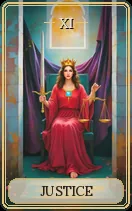 Justice — A legal decision or a process resolved with justice.
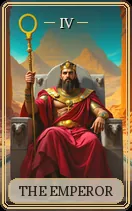 The Emperor — Authority and order; a firm structure, clear rules, institutional power.
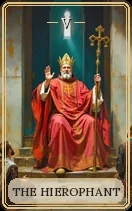 The Hierophant — Institutions, tradition, teaching; advice from someone of recognised learning.
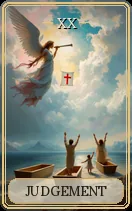 Judgement — A final decision, a verdict, a matter brought to a close.
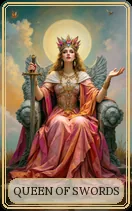 Queen of Swords — Intellectual authority; a partnership of great clarity.
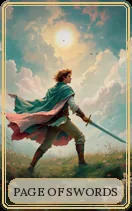 Page of Swords — The master and the apprentice; an authority who trains someone young.
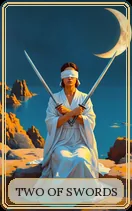 Two of Swords — Indecision that needs someone from outside to resolve it.
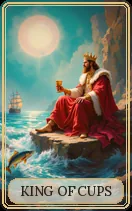 King of Cups — Reason and emotion in balance; deciding with the head without forgetting the heart.
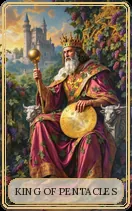 King of Pentacles — Solid, well-advised business; weighty financial decisions.
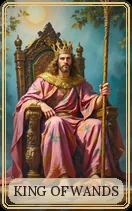 King of Wands — Strong leadership and vision; putting a decision into practice with energy.
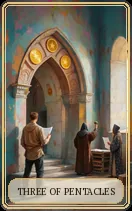 Three of Pentacles — Work assessed by an expert; contracts and skills.
Frequently asked questions
What does the King of Swords mean in tarot?
Law and discernment: the word that decides, intellectual authority, formal matters resolved through reason. He is the figure of someone who thinks with a cool head and takes responsibility for deciding.
What does the King of Swords mean in love?
A mature, loyal relationship built on clear conversation, or a rational and reliable partner. Reversed, it warns against coldness, control and constant criticism.
Is the King of Swords a yes or a no?
It leans towards yes, if what you are asking is fair and well founded. The King decides on the facts: if the facts are on the side of the person asking, the answer is favourable.
Is the King of Swords reversed a bad sign?
It is not the opposite of the card: it is the same authority without mercy — excessive rigour, harsh judgement, abuse of power. It asks you to join humanity to reason.
Does the King of Swords represent a lawyer or a judge?
Often, yes: he is the traditional figure of the professions of law and judgement. But he can represent anyone with authority and clear thinking, or the decisive attitude the situation calls for.
No sign-up · Reading written on the spot · Free