Ace of Swords: meaning and symbolism of the tarot card
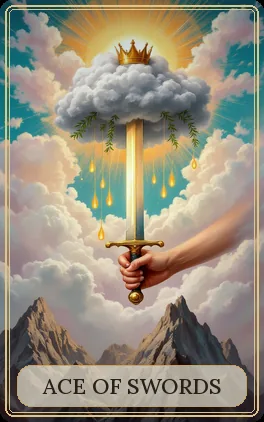
The Ace of Swords is the moment when you see clearly. A hand raises an upright sword with a clean blade, and its point rises into a crown. There is no figure, no landscape to distract: there is an edge, and that edge cuts. It is the card of the truth that arrives suddenly, of the idea that solves the problem, of the decision that can no longer be put off.
In a spread, the Ace of Swords speaks of lucidity and mental courage — of separating what is from what you would like to be. It is the seed of the suit of Air, and like every seed it carries the whole of its strength, still unspent. That strength can serve to set free as easily as to wound: a sword does not choose what it cuts. It is whoever holds it who chooses, and so the card speaks as much of the truth as of the way it is told.
The card at a glance
| Card | Ace |
|---|---|
| Suit | Swords |
| Element | Air |
| Astrology | Root of Air (Golden Dawn: ‘the Root of the Powers of Air’) |
| Keywords | clarity, truth, decision, lucidity, new idea, justice, firm word, necessary break |
| Reversed | cutting truth, mental confusion, wounding words, hasty decision, idea without direction |
| Yes or no | Yes — a clear yes, provided you accept the truth that comes with it |
The image on the card
In the Sol da Alma Tarot, an arm enters the card from the right-hand side and, with a closed fist, holds a sword raised straight up. The hilt is golden, with a straight guard and a round pommel; the blade, broad and luminous, rises until it disappears into a large grey cloud. Above that cloud rests a golden crown, and behind it a sun rises, radiating yellow and orange rays. From the underside of the cloud hang small green sprigs and, suspended on fine threads, several golden drops. The sky is blue-green, full of pinkish clouds, and below rise grey, craggy mountain peaks.
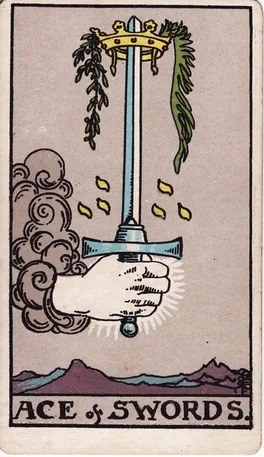
In the 1909 Rider-Waite-Smith, the scene is essentially the same, and it was the starting point for the Sol da Alma painting: a hand comes out of a cloud on the left-hand side and holds a sword whose point passes through a crown; from the crown hang an olive branch on one side and a palm frond on the other, and around the blade fall six yellow drops in the shape of flames. Below, a line of low mountains. The Sol da Alma changes three things: the hand belongs to a human arm rather than coming out of a cloud; it is the cloud that swallows the tip of the blade, with the crown resting above it; and it adds a radiant sun that does not exist in the 1909 deck.
In the Marseille Tarot, the Ace is one of the few cards of the suit with an image of its own: a hand appears from one side and holds an upright sword whose point enters a crown; branches hang from the crown, and small coloured drops or flames float around it. The 1909 composition clearly comes from this tradition, which is a good deal older.
The symbolism, detail by detail
Almost everything in this card points upwards, and everything revolves around a single straight line. Each detail adds a nuance to the idea of clarity.
- The upright sword
- Thought that goes straight to the point, without detours: logic, decision, the word that says what is. It is double-edged — it can cut to set free or to wound.
- The hand that holds it
- The card does not show the sword falling from the sky: it shows it held by someone. Clarity is a gift, but using it is the responsibility of whoever has it in hand.
- The human arm
- In the Sol da Alma painting, the hand belongs to a visible arm of flesh and blood. It is a choice that pulls the card down to earth: lucidity does not only come from above, it is also exercised.
- The crown
- Victory, authority, mastery. The clear idea that ends up prevailing, or the power that comes from being right — and the risk of becoming trapped by it.
- The cloud
- In the 1909 deck, the cloud is where the hand comes from: what arrives from outside, suddenly. In the Sol da Alma, the cloud wraps the tip of the sword: the truth touches what is still murky, and begins to open it up.
- The green branches
- In the Rider-Waite-Smith, the olive and the palm: peace and victory, the two things a good decision can bring. In the Sol da Alma they are small green sprigs hanging from the cloud, with the same sense of fruit born of the cut.
- The golden drops
- In the tarot tradition, these drops recall the Hebrew letter Yod, and are read as portions of strength or grace coming down. They say that clarity, when it comes, spreads.
- The sun
- An addition of the Sol da Alma: the light that illuminates what the sword reveals. It gives the card a luminous leaning — the truth, here, comes to shed light.
- The mountains
- The difficulties the decision will have to cross, or the heights of thought. They lie below: the edge rises above them.
The history of the Ace of Swords
The tarot was born in northern Italy in the fifteenth century as a card game — the tarocchi — with the four suits of the Latin cards: cups, swords, batons and coins. In the oldest decks, such as those painted for the Visconti and the Sforza in Milan around 1450, and later in the Marseille decks, which settled into their form between the seventeenth and eighteenth centuries, most of the numbered cards showed only the suit symbols. The Aces were the exception: they had an image of their own, more elaborate, and the Marseille Ace of Swords already shows the hand, the raised sword and the crown.
With the occultists, the Ace came to be read as the seed of the whole suit. The Hermetic Order of the Golden Dawn, at the end of the nineteenth century, called each Ace the ‘root’ of its element; the Ace of Swords is ‘the Root of the Powers of Air’. Unlike the cards from Two to Ten, the Aces were not given a planet in a sign: they remained above that division, as the force still undivided.
Arthur Edward Waite, who followed the Golden Dawn closely, published the deck drawn by Pamela Colman Smith in 1909, and kept for this Ace the image of the hand, the sword and the crown. In his description, the card signifies triumph, conquest, the excessive degree in everything — a card of great force, he writes, in love as well as in hatred. It is this reading of the card as a whole force, which can serve good or ill, that most modern decks, including the Sol da Alma, follow.
The Ace of Swords upright: the meaning
Upright, the Ace of Swords is clarity arriving. An idea that solves things, a sudden understanding, a conversation that clears everything up. After a period of doubt, the fog lifts and you can see what has to be done. It is one of the strongest cards in the suit, and one of the cleanest: it brings no deceptions and no half-truths.
It is also the card of decision. The Ace does not sit and think: it cuts. It may be the end of a hesitation, a choice that is owned, a word finally said out loud. It often announces a break — but a necessary one, the kind that separates what no longer served and leaves the way clear.
Finally, it speaks of justice and truth. In a confused situation, it promises that the truth will come out; in a question of rights, it says that being in the right carries weight. The price is directness: whoever draws the Ace of Swords can rarely go on pretending not to know.
The Ace of Swords reversed
Reversed, the Ace of Swords does not become its own opposite: it is the same blade, but badly wielded. The truth is still there, only now it is spoken to wound — with needless harshness, at the wrong moment, to win rather than to clarify. It can speak of words that hurt, of a directness that has turned into cruelty, of a decision taken in anger.
It can also speak of a clarity that has not yet arrived. The person already wants to act, already wants to cut, but does not yet see properly: the blade turns inwards and becomes confusion, thoughts going round in circles, too many ideas and none of them settled. In both cases, the card asks the same thing — to wait for the moment when you see clearly, and to choose your words well before using them.
The Ace of Swords in love
In love, the Ace of Swords is not the sweetest card, but it is one of the most honest. It announces a sincere conversation, a declaration without beating about the bush, the moment when you say what you feel or what you want. For a relationship that lived on things left unsaid, it is a turning point: from here on, things are spoken. It can also mark a decision — to stay or to leave — taken with a cool head.
For those who are single, it speaks of clarity about what you are looking for, and sometimes of meeting someone intelligent, direct, a lively conversationalist. Reversed, it is the warning of arguments in which more is said than was meant, of jealousy that turns into accusation, or of a relationship in which there is so much thinking that there is no longer any feeling.
The Ace of Swords in work and money
At work, it is an excellent card for everything that depends on the head: a new idea, the solution to a technical problem, a project that finally takes clear shape, a well-drafted contract, a negotiation won through argument. It favours those who work with words, with numbers, with law, with analysis. In a question about a professional decision, it says you already know what to do.
With money, it asks for lucidity: do the sums, read the small print, cut what weighs you down. It can announce the end of an expense or of an agreement that was no longer worth it. Reversed, it warns against financial decisions made in the heat of the moment and against disputes over money in which you win the argument and lose the deal.
The Ace of Swords in health and wellbeing
In questions about wellbeing, the Ace of Swords speaks of mental clarity, of decisions about habits and of cutting out what wears you down. It may be the day you decide to change your routine. Reversed, it is a reminder of the mind that never rests and of accumulated tension. The cards are no substitute for any kind of health care: here, as with any other card, the reading speaks of attitude, not of diagnosis.
The Ace of Swords in spiritual life
On the inner path, the Ace of Swords is discernment: the ability to see things as they are, without dressing them up or fearing them. It is the card of someone who cuts through an illusion, who suddenly notices a pattern they had been repeating for years, who prefers an uncomfortable truth to a comfortable lie. In many traditions, the sword is the symbol of the awakened mind — the one that separates the essential from the incidental.
The Ace of Swords as advice
As advice, the Ace of Swords says: see clearly, and say so. Do not put off the decision you already know you must make, do not wrap the truth in excuses. But it also says: hold the sword firmly. Frankness is a virtue when it clarifies; when it only serves to win, it becomes something else. Think before you cut — and then cut cleanly, once and for all.
The Ace of Swords in the positions of a spread
- In the past
- A decision or a truth that changed the course of things — a conversation, a break, a discovery whose consequences are still being felt.
- In the present
- A moment of lucidity: the person sees what they did not see before, and has the decision in their hands.
- In the future
- Clarity on its way — an answer, an idea, a conversation that will put things in their place.
- As an obstacle
- Coldness, harsh words, or a mind that analyses so much it cannot act.
- As the outcome
- The matter is resolved by a clear-cut decision. It may cost something, but it leaves everything clear.
Numerology and correspondences
The Ace is the seed of the suit: the whole force, still unspent, offered like an outstretched hand. In the suit of Swords — the suit of Air, of thought, of speech, of decision and of conflict — that seed is lucidity in its pure state: the first clear idea, before it becomes argument, quarrel or wound. Everything the other cards of the suit will go through, from the balance of the Two to the ruin of the Ten, begins here, with this still-clean blade.
In the Golden Dawn tradition, the Ace of Swords is ‘the Root of the Powers of Air’, and it has neither planet nor sign: it comes before that division, as the very force of the element. Air is the space between things, what allows them to be told apart; it is also the breath that carries the word. That is why this card brings together, in a single image, thinking and speaking.
Combinations with other cards
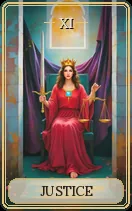 Justice — A fair decision, a legal matter resolved with clarity, the truth that prevails.
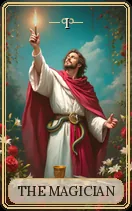 The Magician — A brilliant idea with the means to put it into practice: communicating, persuading, acting intelligently.
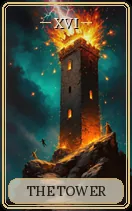 The Tower — A sudden revelation that brings down an illusion; a swift and inevitable break.
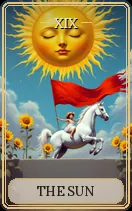 The Sun — The truth that brings relief: everything becomes clear, and what is revealed is good.
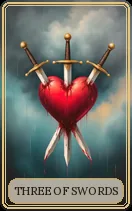 Three of Swords — A truth that hurts: words that wound, or difficult news that nonetheless sets you free.
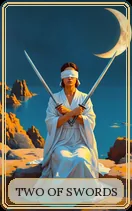 Two of Swords — The end of a stalemate: the decision that kept being put off becomes clear and is made.
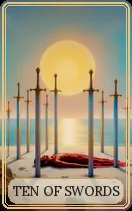 Ten of Swords — A definitive cut; the end of a situation that was already worn out.
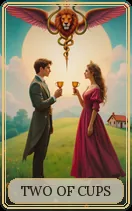 Two of Cups — A frank conversation that brings people closer; a commitment made with clarity.
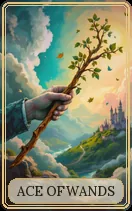 Ace of Wands — An idea with plenty of energy behind it: the determined start of a project.
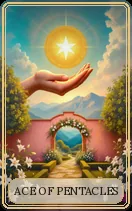 Ace of Pentacles — A good idea that could make money; a clear contract, a concrete proposal.
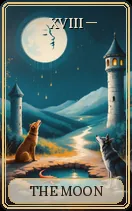 The Moon — Lucidity that cuts through confusion: what was hidden is discovered.
Frequently asked questions
What does the Ace of Swords mean in tarot?
Clarity, truth and decision: an idea that arrives suddenly and solves things, a word that is spoken, a necessary cut. It is the seed of the suit of Air, the suit of thought and communication.
Is the Ace of Swords a good or a bad card?
It is a strong card, generally positive, because it brings lucidity and settles doubts. But a sword cuts: the truth it brings may be uncomfortable, and the card asks for care in how it is used.
What does the Ace of Swords mean in love?
A sincere conversation, a direct declaration or a decision taken with a cool head. Reversed, it may warn of arguments in which words wound.
Is the Ace of Swords reversed bad?
It is not a condemnation. Reversed, it is the same force badly wielded: the truth spoken harshly, or the rush to decide before seeing clearly. It asks for calm and care with words.
Is the Ace of Swords a yes or a no?
Yes, and a clear yes. But it is the yes of someone who accepts the truth that comes with it: if the question hides an illusion, the card cuts through it.
No sign-up · Reading written on the spot · Free