
The Empress: meaning and symbolism of the tarot card
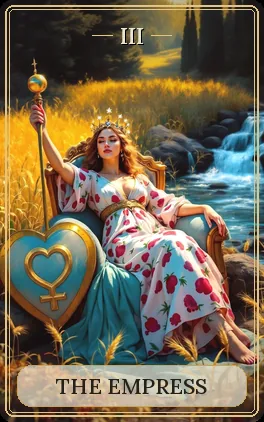
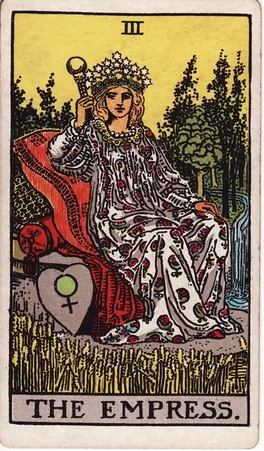
The Empress is the third card of the Major Arcana and the fullest in the sequence. A crowned woman sits on a throne, sceptre in hand, surrounded by wheat, trees and running water. Everything around her is growing. If The Magician has the idea and The High Priestess keeps it, The Empress is the one who gives it a body: this is the card of fertility, of what sprouts, grows and multiplies.
In a spread, The Empress speaks of abundance — material, emotional, creative — of nurture, of pleasure and of everything that bears fruit. It is one of the most generous cards in the deck: wherever she falls, there is material to work with. But fertility also has its side of excess, and the hand that nurtures can grip too tightly. As always, the question and the neighbouring cards say which side is at play.
The card at a glance
| Number | III |
|---|---|
| Arcana | Major Arcana |
| Historical names | L’Imperatrice (Italy); L’Impératrice (Marseille); The Empress (Rider-Waite-Smith) |
| Element | Earth (through its link to nature, in the common reading) |
| Astrology | Venus (Golden Dawn) |
| Hebrew letter | Daleth (ד), according to the Golden Dawn |
| Keywords | fertility, abundance, the womb of form, creativity, nurture, pleasure, nature |
| Reversed | barrenness, excess, smothering possessiveness, creative block, neglect, dependence |
| Yes or no | Yes — what you are asking about has what it needs to grow |
The image on the card
In the Sol da Alma Tarot, The Empress reclines on a golden chair with turquoise cushions, in a field of ripe wheat. She is a woman with wavy brown hair, eyes half closed and a serene air, wearing a crown of small stars. She wears a loose white gown printed with red fruit, fastened with a golden belt, and has a turquoise cloth over her legs; her feet are bare. In her right hand she holds a tall sceptre topped by a golden orb with a small cross. Leaning against the throne, on the left, is a heart-shaped shield, blue and gold, bearing the symbol of Venus (♀) in gold. Behind her are dark pines and cypresses and, on the right, a waterfall runs between rocks and becomes a stream. The light is warm, late-afternoon light, and the wheat glows.
The Rider-Waite-Smith of 1909 has the same composition, and it was the starting point for the Sol da Alma painting: the woman crowned with stars, the gown printed with pomegranates, the sceptre with its orb, the heart-shaped shield, the cushions, the wheat in the foreground, the woods and the waterfall. The differences lie in posture and colour: in the RWS she sits upright, facing forward, with red cushions and a yellow sky. In the Sol da Alma she reclines, more at ease, and the shield and cushions have turned turquoise; but the shield bears, as in the RWS, the symbol of Venus, here in gold.
In the Tarot de Marseille, L’Impératrice is more hieratic: a crowned woman seated facing forward, with a sceptre in one hand and a shield bearing an eagle in the other, against a plain background. It is the scene the Sol da Alma table sums up. There is no wheat and no waterfall: there is a sovereign. It was the Rider-Waite-Smith that took her out into the countryside and made her a figure of nature.
The symbolism, detail by detail
Everything in this card speaks of growth: of the earth that gives, the body that creates, the time that brings things to ripeness. Each detail adds a nuance to that idea.
- The ripe wheat
- The harvest, the fruit of labour, the abundance that nourishes. It is also the sign of the right time: wheat does not hurry, but it always ripens in the end.
- The crown of stars
- Sovereignty that comes from above and is exercised over the earth. In the RWS there are twelve stars — the number of the months and of the signs, the full cycle of the year.
- The sceptre with the orb
- Power over the material world. The Empress rules, but she rules by making things grow, not by giving orders.
- The heart-shaped shield
- Love as protection and as strength. It bears the symbol of Venus, the card’s planet: in the RWS and in the Sol da Alma alike, where it is drawn in gold.
- The printed gown
- In the RWS, pomegranates; in the Sol da Alma, red fruit. Both speak of the same thing: fruit, seeds, fertility, life in abundance.
- The running water
- Emotion that flows, life that never stops. The waterfall feeds the field: without water, nothing she stands for would grow.
- The woods
- Nature in its own right, which needs no one to order it to grow. That is the force The Empress represents: life multiplying.
- The reclining posture
- In the Sol da Alma, the relaxed body and the bare feet speak of pleasure, comfort and wellbeing — abundance that is also enjoyed, not just produced.
- The number III
- The first work: what is born from bringing two things together. After one and two, three is the fruit.
The history of The Empress
The Empress has been in the tarot since the first Italian decks of the fifteenth century. In the Visconti-Sforza, painted in Milan around 1450, she is a crowned woman with a sceptre and a shield bearing the imperial eagle. In the Italy of the time, the figures of the Emperor and the Empress evoked the Holy Roman Empire and the hierarchy of the world — temporal power, alongside the spiritual power of the Popess and the Pope. In the game of tarocchi they were low-ranking trumps, among the first in the sequence.
In the Tarot de Marseille, which took its settled form between the seventeenth and eighteenth centuries, L’Impératrice keeps the crown, the sceptre and the shield with the eagle. She is a figure of authority, frontal and sober, with none of the elements of nature that we associate with her today.
Reading The Empress as mother, nature and fertility is more recent. It came with the occultists, and above all with the Golden Dawn, which at the end of the nineteenth century assigned her the planet Venus and the letter Daleth. In the 1909 deck, Arthur Edward Waite and Pamela Colman Smith took away her imperial eagle, put the symbol of Venus on her shield and twelve stars in her crown, and seated her in a field of wheat beside a waterfall. The sovereign became a goddess of the fertile earth. That is the image the Sol da Alma follows.
The Empress upright: the meaning
Upright, The Empress is the card of fertility in every sense. She says that what was sown is bearing fruit: a project that grows, a relationship that blossoms, a home that fills with life, an idea that takes shape. She is the womb of form — the moment when what was possible becomes real and visible.
It is also the card of nurture and generosity: feeding, welcoming, protecting, helping others grow. She can represent a mother figure, a warm and present woman, or the ability of the person asking to tend something until it flourishes.
Finally, The Empress speaks of pleasure and beauty: a taste for comfort, good food, nature, things that are well made and pleasant. She is a reminder that abundance is not only work — it is also to be enjoyed. Wherever she appears, there is substance, there is time and there is life.
The Empress reversed
Reversed, The Empress does not become her own opposite: it is the same abundance that is not flowing. It may be held back — creation that does not take root, a project that will not get going, a dry spell in which nothing seems to grow. Or it may be in excess — care that smothers, the controlling mother, comfort that turns into complacency, pleasure that turns into overindulgence.
Often it speaks of the person’s relationship with themselves: someone who looks after everyone and forgets about themselves, or who depends on others’ approval to feel worthwhile. The advice is to restore the balance: to give without smothering, to receive without depending, and to go back to tending your own ground before expecting it to bear fruit.
The Empress in love
In love, The Empress is one of the best cards in the deck. She speaks of an affectionate, sensual and stable relationship, of tenderness, of attraction, of a life together that brings pleasure and comfort. For those who are single, she heralds a phase in which the person feels beautiful and attractive, and in which love finds fertile ground. In a relationship, she can speak of a step forward: moving in together, making a home, starting a family.
Reversed, she asks you to watch out for too much care or dependence: one partner smothering the other, jealousy, a relationship in which too much is given or too much is demanded. She can also speak of an emotional dry spell, which needs time and tenderness to renew itself.
The Empress in work and money
At work, The Empress is the card of projects that grow. She favours creativity, production, launching a product, developing a business and every profession connected with the land, beauty, care, food, the arts and nature. She says the effort will bear fruit, as long as you give it time.
With money, she speaks of abundance and material wellbeing: good harvests, rising income, comfort. Reversed, she warns against spending on pleasures that throws the accounts off balance, against complacency, or against a project in which a great deal is invested and which is slow to pay off.
The Empress in health and wellbeing
In questions about wellbeing, The Empress speaks of vitality, of enjoying looking after the body, of good food, of time spent in nature. Reversed, she points to overindulgence at the table, missing rest or neglecting oneself. The cards are no substitute for any kind of healthcare: the reading speaks of attitude, not diagnosis.
The Empress in spiritual life
On the inner path, The Empress is a reminder that the spirit also passes through the body and through nature. Hers is the spirituality of the earth, of the cycle of the seasons, of gratitude for what is received, of contact with plants, animals and the beauty of the world. She says that growing inwardly does not require fleeing from life, but living it to the full. Reversed, she can point to a distance from nature and from oneself, which calls for a return to what is essential.
The Empress as advice
As advice, The Empress says: tend whatever you want to grow. Give it time, attention and care; do not pull it out of the ground to see whether it has roots yet. Allow yourself, too, to enjoy what you have — comfort, beauty, affection. And remember that the best way to help others grow is not to smother them.
The Empress in the positions of a spread
- In the past
- A phase of abundance or creation, or a mother figure who left a deep mark on the person.
- In the present
- A fertile moment: what was sown is growing, and the conditions are there to go further.
- In the future
- Fruit on its way — a project that grows, a relationship that blossoms, a material improvement.
- As the obstacle
- Too much care, dependence, complacency, or a phase in which nothing seems to bear fruit.
- As the outcome
- The harvest: effort is rewarded, and what was longed for takes on a body.
Numerology and correspondences
Three is the first work: what is born from bringing two things together, and can already be seen from outside. After The Magician’s affirmation and The High Priestess’s receptiveness, The Empress is the fruit — the creation that results from the meeting of active and passive. That is why she is the fullest card in the sequence: everything about her is a result.
In the Golden Dawn tradition she corresponds to the planet Venus — love, beauty, harmony, pleasure and fertility — and to the Hebrew letter Daleth, whose name means ‘door’. The Empress is the door through which things enter the world: what was once only an idea passes through her and takes form.
Combinations with other cards
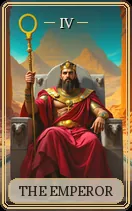 The Emperor — Creation and structure: a project that grows and consolidates; a couple or a family on firm ground.
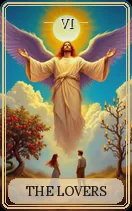 The Lovers — A fertile and happy love, a union that bears fruit.
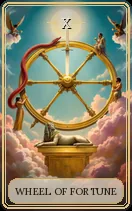 Wheel of Fortune — A phase of expansion and good fortune; life bringing abundance.
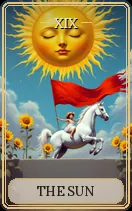 The Sun — Joy, growth and wellbeing: one of the happiest combinations in the deck.
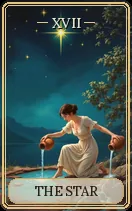 The Star — Hope coming true; inspired creativity.
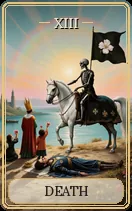 Death — The end of one phase so that another can grow; a deep transformation in the way of caring.
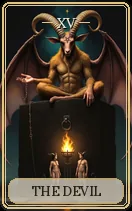 The Devil — Too much pleasure or dependence: care that turns into possession.
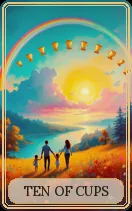 Ten of Cups — Family harmony, a home full of affection.
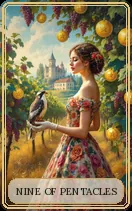 Nine of Pentacles — Hard-won material comfort, independence, wellbeing.
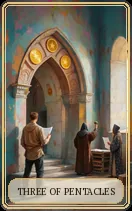 Three of Pentacles — Creative work that is recognised; a project taking shape with the help of others.
 Five of Pentacles — A material or emotional dry spell; the missing abundance that has to be rebuilt.
Frequently asked questions
What does The Empress mean in tarot?
Fertility, abundance, creation and nurture: what was sown is growing and bearing fruit. It is one of the most generous cards in the deck.
Is The Empress a yes or a no?
It is a yes. It says the situation has what it needs to grow — provided it is given time and care.
What does The Empress mean in love?
An affectionate, sensual and stable relationship; a love that blossoms and may lead to building a life together. Reversed, it speaks of dependence, jealousy or an emotional dry spell.
Is The Empress reversed bad?
It is not a card of misfortune. Reversed, it speaks of the same abundance held back or in excess: creation that does not take root, care that smothers, complacency. It asks for balance between giving and receiving.
Does The Empress represent a woman?
It can: a mother figure, a warm and generous woman. But often it represents a quality — the ability to create and to nurture — in whoever is asking.
No sign-up · Reading written on the spot · Free