
Death: meaning and symbolism of the tarot card
Death is the card that most frightens people who do not know the tarot, and one of those that should frighten them least. It is not a prediction of physical death. It is the card of endings: the end of a phase, of a relationship, of a habit, of a way of being — everything that has already served its purpose and has to make way for something else. The skeleton does not choose, does not negotiate and does not turn back, and that is why the card is so powerful: what it announces is already happening.
In a reading, Death speaks of deep transformation. It can be painful, as every ending is, but it is almost always necessary, and often liberating. What the card asks is not that you be afraid, but that you let go. Behind the rider, in most versions of the image, there is a rising sun: after the ending comes a beginning, even if you cannot yet see which.
The card at a glance
| Number | XIII |
|---|---|
| Arcana | Major Arcana |
| Historical names | La Morte (Italy); unnamed, ‘l’Arcane sans nom’ (Marseille); Death (Rider-Waite-Smith) |
| Element | Water |
| Astrology | Scorpio (Golden Dawn) |
| Hebrew letter | Nun (נ), according to the Golden Dawn |
| Keywords | transmutation, necessary ending, threshold, transformation, cutting away, renewal |
| Reversed | refusing the ending, clinging, a stalled transition, stagnation, fear of change |
| Yes or no | No to what you want to keep as it is; yes to what needs to change |
The image on the card
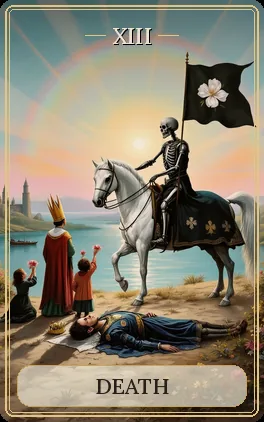
In the Sol da Alma Tarot, Death is a skeleton riding a white horse, advancing at a walk along the bank of a wide river. The horse wears a dark caparison embroidered with golden crosses; the skeleton holds the reins and a pole bearing a black banner on which a large white five-petalled flower is painted. On the ground in front of the horse lies a man in blue clothes embroidered with gold, his eyes closed, and beside his head, fallen on the earth, a golden crown. Near him, with his back to us, stands a figure in a red mantle and a tall golden mitre; two children — one kneeling, the other standing — hold out pink flowers to the rider. In the background a boat passes on the water, and on the far bank rise the towers of a castle. The sun is low on the horizon, and a rainbow crosses the pink and blue sky.
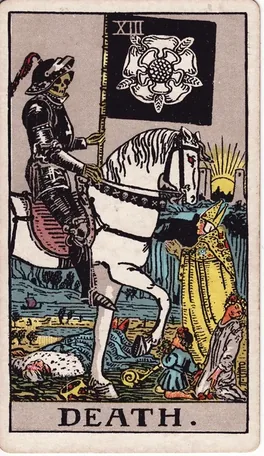
In the Rider-Waite-Smith of 1909, the scene is essentially the same, and it was the starting point for the Sol da Alma painting: a skeleton in black armour on a white horse, with a black banner bearing a white rose; a fallen king on the ground, his crown beside him; a mitred bishop standing with his hands joined; a young woman turning her face away and a child offering flowers; a river with a boat and, in the distance, a sun rising between two towers. The Sol da Alma deck took the skeleton’s armour off, softened the gesture of the young woman, who here also offers flowers, placed the towers on the riverbank and added the rainbow — a sign of passage and promise that is not in the original.
In the Tarot de Marseille, the card is numbered XIII and has no written name. A skeleton mows a dark field with a scythe, and out of the ground sprout hands, feet and heads — one of them crowned. There is no horse and no banner: only the act of cutting, and what has been cut sprouting from the earth.
The symbolism, detail by detail
Death is a card full of figures, and each one reacts differently to the same event. That is its lesson: the end comes to everyone, but each of us receives it in our own way.
- The skeleton
- What remains when everything passing has disappeared: the structure, the essential. Death strips things to the bone.
- The white horse
- The force of time that moves forward and does not stop. The white speaks of purity: the ending is not a punishment, it is a cleansing.
- The black banner with the white flower
- Life within the ending. The five-petalled flower — a white rose in the Rider-Waite-Smith — is a symbol of renewal and purity against the black ground of mourning.
- The fallen king and the crown on the ground
- Not even power escapes the end. What seemed firm and secure eventually falls; the crown stays in the earth, like everything that belongs to the world.
- The mitred figure
- Religious authority, which receives the rider standing. It can be read as the ritual acceptance of the ending, or as an attempt to bargain with it.
- The children with flowers
- Innocence that knows no fear. Those who have not yet learnt to cling to things welcome change with open arms.
- The river and the boat
- The crossing from one bank to the other. In many ancient traditions the river separates the worlds, and the boat carries you from one to the other.
- The towers and the low sun
- The threshold and the horizon. In the Rider-Waite-Smith the sun rises between two towers; in the Sol da Alma deck it hangs low over the water. In both, what ends opens the way to a new light.
- The rainbow
- In the Sol da Alma deck, the bridge between heaven and earth and the promise after the storm: the ending brings with it a covenant with what is to come.
- The scythe (Marseille)
- The cut that clears the field for the next sowing. Reaping is not destroying: it is gathering what was ripe and preparing the soil.
The history of Death
Death has been in the tarot since the first Italian decks of the fifteenth century, where it was simply called La Morte and depicted as a skeleton. The image came from the art of the late Middle Ages, marked by the great epidemics: death that reaps without distinguishing rich from poor, the danse macabre in which kings, bishops and peasants are led away by the same hand. It is this equality before the end that the card has kept from the very beginning.
In the Tarot de Marseille, which took shape between the seventeenth and eighteenth centuries, card XIII is the only one of the Major Arcana with no written name. That is why French authors call it ‘l’Arcane sans nom’, the arcanum with no name. No one knows for certain whether the omission was superstition, caution or workshop tradition, and there is no point in inventing reasons; the fact is that the card has come down to us like this, and that many readers see the silence of the name as a form of respect.
The image of the rider is modern. In the 1909 deck, Arthur Edward Waite and Pamela Colman Smith replaced the reaper with the armoured skeleton on horseback, with the banner of the white rose, and added the figures of the king, the bishop, the young woman and the child. At the end of the nineteenth century, the Hermetic Order of the Golden Dawn had assigned it the sign of Scorpio and the Hebrew letter Nun. It was also the occultism of that period that established the reading of the card as transformation rather than literal death.
Death upright: the meaning
Upright, Death is the card of the necessary ending. Something has reached its conclusion: a job, a relationship, a home, a phase, a belief, a version of oneself. The card does not ask whether the person agrees — it announces that the ending is already under way. It often confirms what the person already knew and had not yet had the courage to accept.
It is a card of deep transformation. What comes next is not a continuation of what was there; it is something else. That is why it may be lived with pain, with fear or with relief — it depends on what is ending. But almost always, looking back, you realise that the ending was necessary: what does not end takes up the space of what needs to be born.
It also speaks of deliberate cuts: giving up a habit, distancing yourself from someone who does you harm, closing a chapter. Death is swift and clean; it does not like half-measures. In a question about a change, it says the change is inevitable and that it is better to go with it than to resist it.
Death reversed
Reversed, Death still announces an ending: it is the same ending, but refused or held back. The person clings to what has already died — a relationship that is over, a job with no future, a way of living that no longer serves — and prolongs the agony instead of cutting it short. The transition stops halfway: the old does not carry on, and the new does not begin.
It can point to fear of change, attachment, nostalgia, or the attempt to save what cannot be saved. Sometimes it speaks of a slow transformation, one that happens on the inside before it shows on the outside. The advice is the same as for the upright card, with more urgency: let go. The more you resist the ending, the longer it lasts.
Death in love
In love, Death speaks of the end of a phase. It may be the end of a relationship — especially if it had already run its course — but it may also be the end of a stage within the relationship: the first passion giving way to something else, a crisis that forces everything to be reinvented, a deep change in the way of being together. For anyone still tied to a past relationship, it is the sign that it is time to let it go.
For those who are single, it can announce the end of a period of being alone, or the need to let go of old patterns before meeting someone. Reversed, it is a warning against a relationship that is already over and carries on out of fear, or against the difficulty of grieving for someone.
Death in work and money
At work, Death indicates profound changes: the end of a job, a project or a role, a restructuring, a change of career. It may be imposed or chosen, but it is rarely small. In many cases it is a release — the end of a situation that no longer made sense and the room to start another.
With money, it asks you to cut out what does not work: needless expenses, investments that do not pay, old debts that drag on. It can point to the end of a source of income and the need to find another. Reversed, it warns against the stubbornness of keeping a dead business or investment going because you will not accept the loss.
Death in health and wellbeing
In questions about wellbeing, Death is not a physical prediction: it speaks of ending habits that wear you down and starting others, of renewal and a change of lifestyle. Reversed, it points to the difficulty of giving up what does you harm. The cards are no substitute for any kind of health care: the reading speaks of attitude, not of diagnosis.
Death in spiritual life
On the inner path, Death is the card of transformation. Many traditions speak of the need to ‘die’ to an old identity in order to be reborn — letting go of the ego, of certainties, of the image one has of oneself. It is one of the central cards of any inner journey: without it, nothing truly changes. For many readers, it is also the card of impermanence — the acceptance that everything passes, and that this is where freedom lies.
Death as advice
As advice, Death says: let go. Do not cling to what is already over; grieve, close the chapter, cut what has to be cut. And trust what comes next, even if you cannot see it yet. An ending lived well is the best beginning you can have.
Death in the positions of a spread
- In the past
- An ending that changed everything and whose consequences are still felt; a closed phase that made room for the present.
- In the present
- A transformation under way. Something is ending, and it is best not to resist.
- In the future
- An ending on its way, necessary and liberating, which will prepare a new phase.
- As an obstacle
- Clinging to what is already over, fear of change, a transition that is not allowed to happen.
- As the outcome
- The matter comes to an end — and with that ending, room opens up for something else.
Numerology and correspondences
Thirteen is the number that comes after the complete cycle of twelve: the extra step that forces you out of the known order. That is why it is traditionally a number of change and discomfort. Its digits added together make four — the number of structure — as if the ending already carried within it the foundation of a new order. In the sequence of the Major Arcana, Death comes after The Hanged Man and before Temperance: after the pause, the cut; after the cut, the slow reassembly.
In the Golden Dawn tradition, it corresponds to the sign of Scorpio, a Water sign linked to transformation, depth and regeneration, and to the Hebrew letter Nun, which is associated with the fish — life moving in deep waters. Traditional astrology makes Mars the ruler of Scorpio; modern astrology gives it Pluto, the planet of radical transformations.
Combinations with other cards
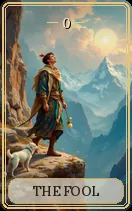 The Fool — An ending that sets you free: what ends clears the way to start again from scratch.
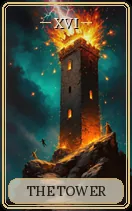 The Tower — A radical and sudden change: everything that was false collapses at once.
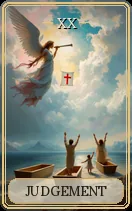 Judgement — Rebirth: after the ending, an awakening and a second chance.
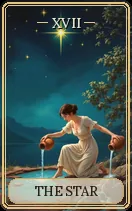 The Star — Hope after loss; the healing that comes after grief.
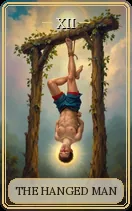 The Hanged Man — The waiting is over: what was suspended comes to an end, and the change can go ahead.
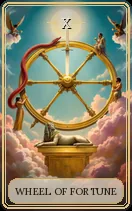 Wheel of Fortune — The end of a whole cycle and the beginning of another — an inevitable turning point.
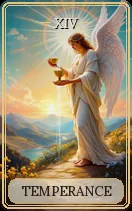 Temperance — A transformation that happens slowly and with balance; the reassembly after the cut.
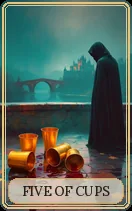 Five of Cups — Grief and loss: you need to mourn what has ended before you can see what remains.
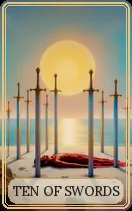 Ten of Swords — A final and painful ending — but rock bottom has been reached, and from here the only way is up.
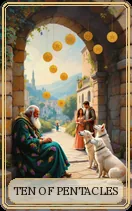 Ten of Pentacles — Changes in the family, the home or the estate; an inheritance, a division of property.
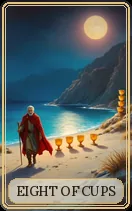 Eight of Cups — Leaving behind, by one’s own choice, what no longer nourishes.
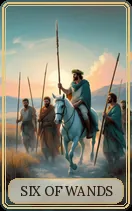 Six of Wands — A change that, in the end, brings recognition and a victory.
Frequently asked questions
Does the Death card mean someone is going to die?
No. In tarot, Death speaks of symbolic endings: the end of a phase, a relationship, a habit or a situation. It is not a prediction of physical death.
Is Death a bad card?
Not necessarily. It announces an ending, which may be difficult, but it is almost always a necessary and liberating ending that makes room for a new phase.
What does Death mean in love?
The end of a phase: it may be the end of a relationship that has run its course or a deep transformation within the relationship. Reversed, it warns against clinging to a relationship that is already over.
Why does card XIII have no name in the Tarot de Marseille?
No one knows for certain. In the Tarot de Marseille it is the only card of the Major Arcana with no written name, and so it is known as ‘l’Arcane sans nom’, the arcanum with no name.
Is Death reversed worse than upright?
It is the same ending, but held back: clinging, fear of change, a transition that drags on. It asks you to let go of what is already over.
Is Death a yes or a no?
It is ‘no’ to what you want to keep as it is, and ‘yes’ to what needs to change. It says that the current situation is going to end.
No sign-up · Reading written on the spot · Free