The Hanged Man: meaning and symbolism of the tarot card
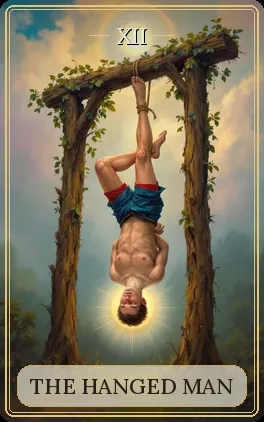
At first sight, The Hanged Man is the most disconcerting card in the tarot. A man hangs by one foot, upside down, his hands behind his back — and his face is calm, almost happy, with a light around his head. He is not dying, nor struggling to break free. He is suspended, and he accepts it. That is exactly what the card speaks of: a time when nothing moves forward, and when the only thing that can be changed is the way you see.
In a reading, The Hanged Man indicates a pause, waiting, suspension. A project on hold, a decision that cannot yet be taken, a situation that does not depend on the person asking. But it is not a card of defeat: it is the card of the new perspective that only appears once you stop forcing. It asks for patience, surrender, and sometimes a sacrifice — letting go of something today in order to gain something else later.
The card at a glance
| Number | XII |
|---|---|
| Arcana | Major Arcana |
| Historical names | L’Appeso, Il Traditore (Italy); Le Pendu (Marseille); The Hanged Man (Rider-Waite-Smith) |
| Element | Water |
| Astrology | The element of Water (Golden Dawn); Neptune, in the modern reading |
| Hebrew letter | Mem (מ), according to the Golden Dawn |
| Keywords | suspension, pause, reversed vision, surrender, fruitful sacrifice, patience |
| Reversed | stagnation, fruitless sacrifice, resistance, playing the victim, pointless waiting |
| Yes or no | ‘Not yet’: it is time to wait and to see things differently |
The image on the card
In the Sol da Alma Tarot, The Hanged Man is a bare-chested young man in blue shorts with a red belt, hanging upside down from a rope tied to his right ankle. The rope is fastened to a wooden beam resting on two tree trunks, like a gateway, and green leaves and sprigs of climbing plants sprout from the wood. His left leg is bent behind his right, forming a cross; his hands are hidden behind his back. His eyes are closed and his face serene, and a halo of golden rays shines around his head. Above the beam, a veiled sun lights a cloudy sky; below, grass and trees fading into the mist.
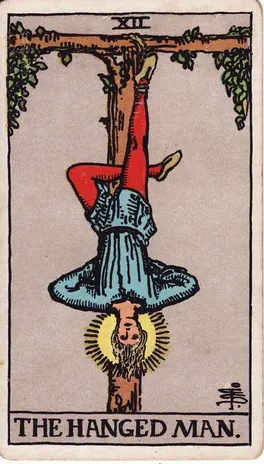
In the Rider-Waite-Smith of 1909, the position of the body is the same — hanging by the right foot, left leg crossed behind, hands behind the back, yellow halo — and this was the starting point for the Sol da Alma painting. But there the gallows is a single T-shaped cross of living wood with leaves at the ends, against a flat grey background, and the man wears a blue tunic, red hose and yellow shoes. The Sol da Alma deck replaced the T-cross with a gateway of two trunks, stripped the figure, gave him a sky and a landscape, and kept the living wood, the crossed leg and the light around the head.
In the Tarot de Marseille, Le Pendu hangs by his foot from a beam resting on two trees with lopped branches, his legs likewise crossed and his hands behind his back. The two-trunk gateway of the Sol da Alma deck is closer to this old image than to the cross of the Rider-Waite-Smith.
The symbolism, detail by detail
Almost everything in this card is upside down — and it is that inversion that gives it meaning. Each detail helps to show that the suspension is not a punishment, but a passage.
- The head hanging down
- Reversed vision: seeing the world upside down and discovering what could not be seen standing up. Many solutions only appear once you stop looking at the problem in the usual way.
- The serene face
- Acceptance. The man is neither suffering nor struggling: he is where he is, and he is at peace. That is what distinguishes fruitful suspension from stagnation.
- The halo
- Understanding, the illumination that comes from the pause. The light is around the head — that is, in the way of seeing — and it only appears because he has been turned upside down.
- The bound foot
- What ties the person to a situation, with no way out for now. But it is only one foot: the rest of the body is free, and the rope is not around the neck.
- The crossed leg
- The leg bent behind the other forms a cross, or an inverted four. Many readers see in it the number four of The Emperor — the order of the world — turned upside down.
- The hands behind the back
- The impossibility of acting, and the choice not to act. The Hanged Man does nothing with his hands: his work now is inner work.
- The living wood
- The gallows has leaves: it is alive. The situation that holds you is also a situation that makes you grow. It is not an instrument of death; it is a tree.
- The blue and the red
- In the Sol da Alma deck, the blue shorts with the red belt; in the Rider-Waite-Smith, the blue tunic and the red hose. Calm and passion, spirit and body, together in the same suspended figure.
- The number twelve
- The number of the months of the year and the signs of the zodiac: a whole cycle. The Hanged Man’s suspension lasts as long as it takes for the cycle to be completed.
The history of The Hanged Man
The Hanged Man has been in the tarot since the first Italian decks of the fifteenth century. In the decks painted for the Visconti and the Sforza in Milan around 1450, he is already a man hanging upside down by one foot from a beam. In early Italian lists he is called L’Appeso (the hanging one) and also Il Traditore — the traitor.
This second name helps to explain where the image comes from. In Italy at the time there was the custom of ‘defamatory paintings’: traitors, forgers and absconding debtors were painted on public walls hanging upside down, to expose them to shame. Many historians of the tarot see this as the source of The Hanged Man. Originally, then, the card would have been a figure of dishonour — a long way from the spiritual reading it has today.
In the Tarot de Marseille, which took shape between the seventeenth and eighteenth centuries, he is called Le Pendu and hangs between two trees with lopped branches. The reading as sacrifice, surrender and initiation comes mainly from nineteenth-century occultism. The Hermetic Order of the Golden Dawn matched him with the element of Water and the Hebrew letter Mem; in the 1909 deck, Arthur Edward Waite and Pamela Colman Smith gave him the halo around his head and the serene expression, and Waite himself wrote that the card speaks of suspension, not of martyrdom. Modern astrology associates him with Neptune.
The Hanged Man upright: the meaning
Upright, The Hanged Man is the card of the necessary pause. Things have stopped, or are about to, and there is no point in forcing them: this is a time for waiting. It may be a project on hold, an answer that does not come, a situation that depends on other people or on time. The card says that this waiting is not time wasted — it is time in which something is ripening.
Above all, it is the card of the change of perspective. The Hanged Man sees the world upside down, and so he sees what others do not. It asks you to look at the situation from another angle, to question your certainties, to accept that you may be seeing it wrongly. Often the solution appears precisely when you give up looking for it in the usual way.
It also speaks of sacrifice — but of a fruitful sacrifice, chosen and meaningful: giving something up now for a greater good later, letting go of control, putting your own interests on hold for a cause or for another person. And it speaks of surrender: to stop fighting against what cannot be changed, and to let yourself be carried.
The Hanged Man reversed
Reversed, The Hanged Man is still suspended, but the suspension no longer bears fruit. It is stagnation: waiting that drags on for no reason, indecision that settles in, a situation that does not move because no one wants to budge. It can point to someone clinging to an impossible position just to avoid having to change, or someone who always puts things off for fear of choosing.
It can also be fruitless sacrifice: giving yourself without limits to someone who neither asks nor thanks you, playing the victim, mistaking suffering for virtue. Sometimes it is the opposite — the refusal of any pause, the restlessness of someone who cannot bear to wait and forces things before their time. The advice is the same in every case: work out whether the waiting still serves any purpose; if it does not, cut the rope.
The Hanged Man in love
In love, The Hanged Man indicates a relationship on pause, or a phase of waiting: someone who has not yet made up their mind, a relationship that neither moves forward nor ends, a feeling that has not yet found its shape. It asks for patience — and also for you to look at the relationship in a different way, without the usual expectations. Sometimes it speaks of giving way, of setting pride aside for the good of the relationship.
For those who are single, it can point to a time to understand yourself better before looking for someone. Reversed, it is a warning against waiting for ever — for someone who is not coming, for a relationship that does not change — and against sacrifices no one asked for, which end in resentment.
The Hanged Man in work and money
At work, The Hanged Man speaks of stalled projects, postponed decisions, a phase in which you have to wait for others. It is not the moment to force a change, but it is a good moment to rethink your strategy, to study, to look at the situation from another angle. It can also point to a professional sacrifice — accepting less now for a better position later.
With money, it asks for prudence and patience: this is no time for large investments or quick decisions. It can point to money held up, a payment that is late, a period of restraint. Reversed, it warns against money left idle through indecision, against continuing to invest in a project that no longer gives anything back, or against financial sacrifices that do not pay off.
The Hanged Man in health and wellbeing
In questions about wellbeing, The Hanged Man asks for a pause: resting, slowing down, accepting a slower period, changing your perspective on your own habits. Reversed, it is a reminder that inertia weighs heavily too. The cards are no substitute for any kind of health care: the reading speaks of attitude, not of diagnosis.
The Hanged Man in spiritual life
On the inner path, The Hanged Man is one of the deepest cards in the tarot. It represents surrender, meditation, the moment when the self stops wanting to control everything and opens up to what is greater. For many readers, it is the card of initiation: the person is turned upside down in order to be reborn with a different way of seeing. The halo says that this inversion is not a loss, but an illumination.
The Hanged Man as advice
As advice, The Hanged Man says: stop forcing. Accept the pause, wait patiently, and use it to see things differently. Ask yourself what you are prepared to let go of. And remember that not acting is also a choice — sometimes the wisest one.
The Hanged Man in the positions of a spread
- In the past
- A phase of waiting or a sacrifice that changed the way things were seen and prepared the present.
- In the present
- Everything seems to have stopped. It is a moment to wait, observe and change perspective, not to act.
- In the future
- A pause on its way, or a situation that will force you to see things differently.
- As an obstacle
- Indecision, stagnation, or a sacrifice that no longer makes sense.
- As the outcome
- Not an immediate solution, but a new understanding that changes the way the matter is handled.
Numerology and correspondences
Twelve is the number of a complete cycle — twelve months, twelve signs, twelve hours of the day and of the night. In the sequence of the Major Arcana, The Hanged Man comes straight after Justice and before Death: after the decision comes suspension, and after suspension, the end of what had to end. It is the pause that prepares the transformation. Its two digits reversed give twenty-one, The World — as if the upside-down card held, the other way round, the image of fulfilment.
In the Golden Dawn tradition, it corresponds to the element of Water and to the Hebrew letter Mem, which in Hebrew means precisely ‘water’. Water gives it surrender, fluidity, the ability to let itself be carried without resisting. Modern astrology associates it with Neptune, the planet of dissolution, sacrifice and spiritual experience.
Combinations with other cards
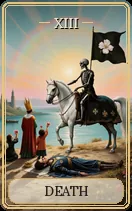 Death — A wait that ends in a necessary ending: the pause prepares the transformation.
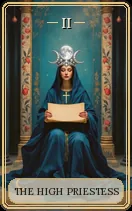 The High Priestess — A time of silence and intuition: the answers come from within, if you know how to wait.
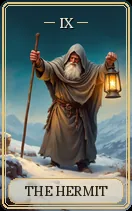 The Hermit — Retreat and deep reflection; a time away from the world in order to see clearly.
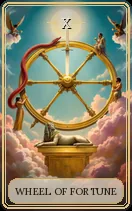 Wheel of Fortune — The waiting that comes before the turning point: the wheel is about to turn.
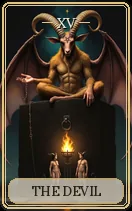 The Devil — Feeling trapped by a situation or a habit — and the need to see the rope in a different way.
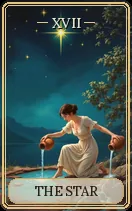 The Star — A pause that brings hope and renewal; the surrender that heals.
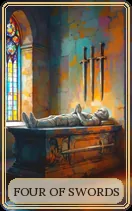 Four of Swords — Rest, enforced or chosen; a halt in order to recover.
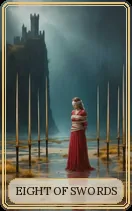 Eight of Swords — The feeling of being trapped, when the way out depends on changing the way you think.
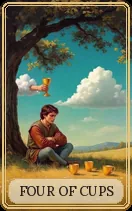 Four of Cups — Apathy and lack of interest: the pause turning into stagnation.
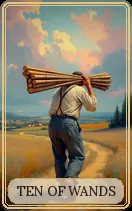 Ten of Wands — A heavy sacrifice: carrying too much on behalf of others.
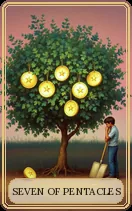 Seven of Pentacles — Waiting for the harvest: the work is done, only time is still needed.
Frequently asked questions
What does The Hanged Man mean in tarot?
Pause, waiting and a change of perspective: a time when nothing moves forward and when what matters is seeing things differently. It also speaks of surrender and meaningful sacrifice.
Is The Hanged Man a bad card?
No. Despite its name, it does not speak of death or punishment. The serene face and the halo say that the suspension is accepted and fruitful. It is a card of patience, not of misfortune.
What does The Hanged Man mean in love?
A relationship on pause or a phase of waiting, which asks for patience and a fresh look at the relationship. Reversed, it warns against waiting for ever and against sacrifices no one asked for.
Is The Hanged Man reversed worse?
It is the same suspension to no purpose: stagnation, indecision, fruitless sacrifice. It asks you to work out whether the waiting still serves any purpose — and, if it does not, to move on.
Is The Hanged Man a yes or a no?
Usually ‘not yet’. It indicates that the matter is on hold and that you need to wait or change your approach before getting an answer.
No sign-up · Reading written on the spot · Free