
Five of Cups: meaning and symbolism of the tarot card
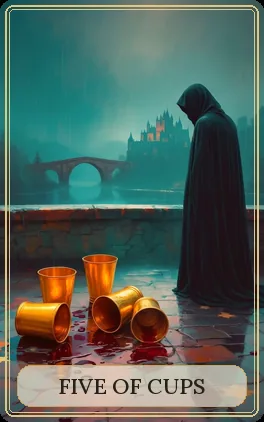
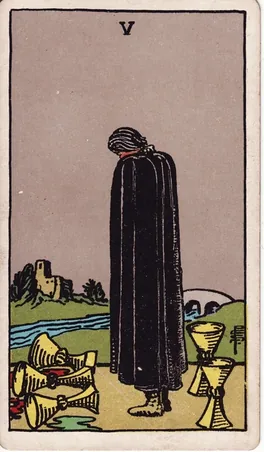
The Five of Cups is the card of grief. A figure wrapped in a black cloak, hood pulled over the head, stands alone on a rainy night, head bowed, eyes on the ground. Beside them are three spilt cups, the wine poured out across the ground — and two that are still standing. The whole card lies in that difference: what has been lost is real, but it is not everything.
In a spread, the Five of Cups speaks of disappointment and emotional loss: a relationship that has ended, an expectation that fell through, a regret, a sadness still fresh. It does not play it down — the pain is real and needs its time. But it gently reminds you that something is still standing, waiting for you to look at it.
The card at a glance
| Card | Five |
|---|---|
| Suit | Cups |
| Element | Water |
| Astrology | Mars in Scorpio (Golden Dawn) |
| Keywords | grief, disappointment, loss, regret, sadness, what was spilt, what remains |
| Reversed | consolation, acceptance, turning towards what remains, or sadness kept inside and left unspoken |
| Yes or no | No, or not as you hoped — but not everything is lost |
The image on the card
In the Sol da Alma Tarot, the scene takes place at night, in the rain, on a terrace of wet flagstones bounded by a low stone wall. On the right, a figure in a large black hooded cloak, turned almost fully away from the viewer, bows their head and looks down at the ground. Beyond the wall runs a river of still water, crossed by an arched stone bridge leading to the far bank, towards a castle with pointed towers and lit windows on a hill half blurred by blue-green mist; dark trees stand on either side. On the terrace floor, to the left, there are five stemless golden cups, like tall beakers: three have fallen on their sides, one of them still holding some wine, and two, further back, are still standing. Around them, the ground glistens with pools of a dark red liquid, and here and there small golden leaves lie fallen on the flagstones.
In the 1909 Rider-Waite-Smith, the basic scene is the same, and it was the starting point for the Sol da Alma painting: a figure in a black cloak, head bowed, looks at three overturned cups from which red and green liquid is running; behind the figure, two cups are still standing; in the background flows a river, crossed by a bridge leading to a small tower or castle. The Sol da Alma follows it closely: the bowed head, the three fallen cups and the two standing ones, the river and the bridge leading towards the castle. The remaining differences are few: all five cups are together on the same side, rather than divided in front of and behind the figure, the liquid is only red, it is raining, the scene is set at night and the castle windows are lit.
In the Marseille Tarot, the numbered cards have no scene: the Five of Cups shows five cups arranged among leafy ornaments. The grieving figure and the spilt cups are a creation of the Rider-Waite-Smith.
The symbolism, detail by detail
This card is made of two halves that do not look at each other: what has been lost and what remains. Every detail speaks of that distance.
- The black cloak
- Mourning, the sadness that wraps everything and hides the person from the world. It is the garb of someone not yet ready to come out of their pain.
- The figure seen from behind
- Withdrawal, loneliness. We cannot see the face, and the head bowed towards the ground says the rest: the pain of the Five of Cups is private, lived on the inside.
- The fallen cups
- What has been lost: a relationship, a hope, an opportunity, a plan. There is no way to fill them again with what has been spilt.
- The spilt liquid
- What was given and never came back, what was wasted. The red colour recalls wine, and also the wound of the one who feels.
- The standing cups
- What remains: friends, resources, abilities, other possibilities. There are only two, against three fallen, as in the Rider-Waite-Smith — fewer than what was lost, but still there, waiting to be noticed.
- The rain and the night
- Unique to the Sol da Alma painting: the time of sadness, when everything seems dark and wet. But no rain lasts for ever.
- The river, the bridge and the castle
- The way forward and the shelter waiting on the other side. As in the Rider-Waite-Smith, a bridge crosses the river to reach it; in the Sol da Alma it is made of stone and the castle has lit windows — there is a way across, there is light and there is home, even if for now they seem far away.
The history of the Five of Cups
The tarot was born in northern Italy in the fifteenth century as a card game, with the four Latin suits — cups, swords, batons and coins. In the oldest decks, such as those painted for the Visconti and Sforza in Milan around 1450, and later in the Marseille decks, which settled into their form between the seventeenth and eighteenth centuries, the numbered cards showed only the suit symbols. The Five of Cups was an arrangement of five cups, with no mourning and no figure.
The scene was born with the Rider-Waite-Smith, drawn by Pamela Colman Smith under the direction of Arthur Edward Waite and published in 1909 — the first widely circulated deck with figures on all the Minors. Waite describes a dark, cloaked figure looking sideways at three overturned cups, while two others stand behind, with a bridge in the background leading to a small keep. And he sums the card up in a phrase that is still the best key to reading it: it is a card of loss, but something remains over.
The Hermetic Order of the Golden Dawn, to which Waite belonged, had given it at the end of the nineteenth century Mars in Scorpio and the title ‘Lord of Loss in Pleasure’. This is the image most modern decks follow, the Sol da Alma included, which added the rain, the night and the lit windows of the castle.
The Five of Cups upright: the meaning
Upright, the Five of Cups is the card of disappointment and emotional grief. It describes a moment when something has been lost — a relationship, a friendship, a cherished project, a hope — and the person is still turned towards that loss. It may be sadness, it may be regret, it may be the bitterness of feeling that you gave and did not receive.
The card does not ask you to skip this phase. Pain is part of it, and the Five — the number of trial, in which the stable form of the Four breaks — is precisely the moment when something changes by force. But it asks you not to stay there for ever. As long as you look only at what has fallen, you do not see what is still standing: the people who stayed, what you have learnt, the possibilities that still exist.
Often, the Five of Cups describes a partial loss, not a total one. The matter is not entirely lost: one part has gone, and the part that remains deserves attention.
The Five of Cups reversed
Reversed, the Five of Cups does not become its own opposite: it is the same grief changing direction. In most readings, it is the beginning of consolation — the person finally turns towards the cups that remain, accepts what has been lost, forgives or forgives themselves, and looks ahead again. It is the card of slow recovery, of making peace with the past, of returning to the company of others.
It can also speak of grief turned inwards: sadness kept inside and left unspoken, heartache disguised, regret brooded over in silence and never resolved. In this case, the card asks for the pain to be acknowledged out loud — with someone you trust — so that it can begin to pass.
The Five of Cups in love
In love, the Five of Cups speaks of disappointment: a separation, a quarrel, an expectation the other person did not meet, regret for what was said or done. For someone who is single, it may describe a person still tied to a past relationship and unable to open up to another.
But it also reminds you of what is still standing: in a relationship in crisis, the affection that still exists; after a separation, the possibility of loving again. Reversed, it announces reconciliation — with the other person or with the past — and the end of a time of sadness.
The Five of Cups in work and money
In work, it speaks of a project that did not go as hoped, of a missed opportunity, of disappointment with colleagues or with a company. The advice is to take stock of what you still have — experience, contacts, skills — and not to let one setback define everything.
With money, it may indicate a loss or an expense you regret. It is rarely ruin: it is one part that has gone. Reversed, it indicates recovery, the ability to learn from the mistake and to rebuild from what is left.
The Five of Cups in health and wellbeing
In questions about wellbeing, the Five of Cups speaks of sadness and emotional tiredness, and of the importance of not going through them alone: talking to someone close, or to a professional if the sadness goes on, is a step of self-care, not of weakness. The cards are no substitute for any kind of healthcare; the reading speaks of attitudes and tendencies, not of diagnoses.
The Five of Cups in spiritual life
On the inner path, the Five of Cups is the card of detachment learnt through pain. What is lost teaches us to tell apart what was essential from what was not, and sadness, when it is lived through to the end, makes room for something else. For many readers, the standing cups are the image of grace that remains present even in the worst moments, waiting for us to turn our face towards it.
The Five of Cups as advice
As advice, the Five of Cups says: cry what you need to cry, but do not keep your back turned on life. Give sadness its time and, when you can, turn towards what is still standing. Count what you still have. Ask for help if you need it. What has been spilt will not go back into the cup — but the other cups are still full.
The Five of Cups in the positions of a spread
- In the past
- A loss or a disappointment that still weighs on you, and that explains part of what you are living through now.
- In the present
- A time of sadness or regret; too much attention paid to what went wrong.
- In the future
- A possible disappointment, usually partial; it is best not to put all your expectations in the same place.
- As an obstacle
- Clinging to what has been lost, which stops you seeing and using what still exists.
- As the outcome
- The matter does not go as you wanted, but it leaves something standing on which you can rebuild.
Numerology and correspondences
The Five is the trial: the form of the Four breaks, and there is loss, friction or lack. It is the step that forces things to move. In the suit of Cups — the suit of Water, of feeling and of bonds — the trial is emotional: the stability of the Four, which no longer tasted of anything, comes apart, and what was boredom becomes real loss. But it is also what forces the person to leave their place and seek the crossing of the Six.
In the Golden Dawn tradition, the Five of Cups corresponds to Mars in Scorpio and bears the title ‘Lord of Loss in Pleasure’. Mars is the planet of cutting and conflict; Scorpio, a Water sign, is the sign of deep emotions, of losses and of transformations. Together they give the card the intensity of its pain — and also the idea that what is lost transforms the one who loses it.
Combinations with other cards
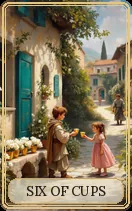 Six of Cups — Missing someone who has been lost; or consolation arriving through good memories and people from the past.
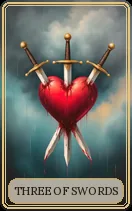 Three of Swords — Deep heartbreak; the pain of a separation or a betrayal.
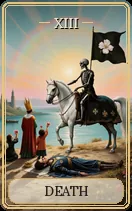 Death — A definitive ending that needs to be mourned so that something else can begin.
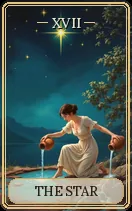 The Star — Hope returning after grief; slow, steady healing.
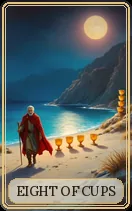 Eight of Cups — Walking away from what can no longer be saved and setting out in search of something else.
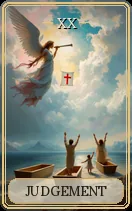 Judgement — A second chance; forgiveness that releases regret.
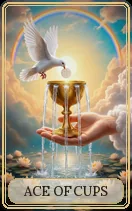 Ace of Cups — A heart opening again; a new affection after the loss.
 Five of Pentacles — A phase of lack, material and emotional; feeling left out in the cold.
 The Hermit — Grief lived in withdrawal; time alone to understand what happened.
 Six of Wands — Recovery and recognition after a setback: what has fallen does not stand in the way of victory.
Frequently asked questions
What does the Five of Cups mean in love?
Disappointment or sadness: a separation, a quarrel, an expectation that was not met, or someone still tied to a past relationship. It reminds you, however, that something is still standing.
Is the Five of Cups a yes or a no?
It leans towards no, or towards ‘not as you hoped’. But it is rarely a total loss: something remains, and you can build from there.
Is the Five of Cups reversed good?
Often, yes: it speaks of consolation beginning, of acceptance and of returning to life. Sometimes, however, it describes a sadness kept inside that needs to be spoken.
What do the standing cups mean in the Five of Cups?
What remains after the loss: people, resources, possibilities. They are the key to the card — the person does not see them yet, but they are there.
Can the Five of Cups be about a separation?
It can, especially next to cards such as the Three of Swords or Death. But it can equally describe a passing disappointment within a relationship that carries on.
No sign-up · Reading written on the spot · Free