
Three of Swords: meaning and symbolism of the tarot card
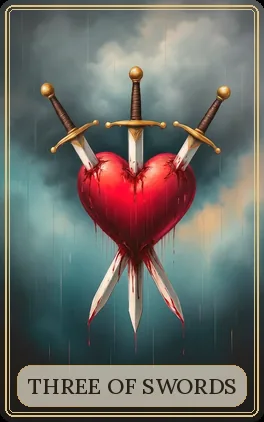
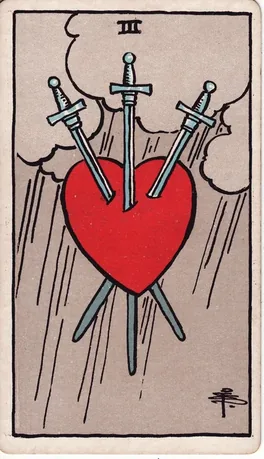
The Three of Swords is the most direct image in the whole tarot: a red heart pierced by three swords, beneath a rainy sky. There is no figure, no story, nothing to soften it. Anyone, even without knowing anything about tarot, understands what the card means. It is the card of heartbreak.
In a spread, the Three of Swords speaks of a pain that comes from the truth — hurtful words, a disappointment, a separation, news that is hard to hear. But it has a quality the other difficult cards do not always have: it does not deceive. The wound is in plain sight, and what is in plain sight can be tended. The rain falling on the heart also washes it clean.
The card at a glance
| Card | Three |
|---|---|
| Suit | Swords |
| Element | Air |
| Astrology | Saturn in Libra (Golden Dawn) |
| Keywords | heartbreak, wound, painful truth, separation, grief, disappointment, hurtful words, tears |
| Reversed | wound healing, pain draining away, forgiveness, slow relief, hurt held inside, recovery |
| Yes or no | No — or a yes that comes at a cost |
The image on the card
In the Sol da Alma Tarot, three identical swords, with golden guards and pommels and wrapped brown grips, pierce a large, glossy red heart. They enter from above, spread in a fan — the middle one straight, the side ones slanting — and cross inside the heart, so that their points emerge crossed beneath it. Blood runs from the wounds, down the heart and along the blades, and drips from the tips. The background is a stormy sky, in shades of blue-green and grey, streaked with fine rain; on the right-hand side, between the clouds, a small warm patch of light opens up.
In the 1909 Rider-Waite-Smith, the scene is essentially the same, and it was the starting point for the Sol da Alma painting: a red heart pierced by three swords, with clouds and heavy rain behind it. The arrangement of the swords is the same in both decks: the middle one straight, the side ones slanting, crossing inside the heart, with the points coming out below. In the Rider-Waite-Smith, however, the clouds are heavy and the rain falls in thick strokes; and there is no blood. The Sol da Alma makes the heart fuller and adds the blood running from the wounds and the small light in the background.
In the Marseille Tarot, the numbered cards have no scene. The Three of Swords shows curved blades interlaced in a kind of oval, with flowers, and a straight sword running through the centre, as in the other odd numbers of the suit.
The symbolism, detail by detail
This card has few elements, and they all say the same thing with different intensities. Each one adds a nuance to the idea of the wound.
- The heart
- The affections, what we love and trust. It is the target of the card: the pain of the Three of Swords is always the pain of someone who cares.
- The three swords
- Thoughts, words, truths. It is the mind — the suit of Air — that wounds the heart: something that was said, found out or realised. Three, because pain rarely comes from one side only.
- The crossed blades
- In the Sol da Alma painting, as in the Rider-Waite-Smith, the swords enter at different angles and cross inside the heart: pain that arrives by several paths, mingles and multiplies.
- The blood
- An addition of the Sol da Alma: blood runs from the three wounds and drips from the points. The wound is open and real; it is not an imagined pain. But the blood that runs out is also what leaves — what has to come out for the wound to close.
- The rain
- Tears, sadness. It is also the water that cleanses: after the storm, the air is clearer. The rain is what allows heartbreak to pass.
- The clouds
- Heavy weather, the dark period. They are behind the heart, not in front of it: the storm is the setting, not the destination.
- The light in the background
- In the Sol da Alma painting, on the right-hand side, a warm light opens up between the clouds. It is a small detail, but it says what matters most: the storm does not last for ever.
The history of the Three of Swords
The tarot was born in northern Italy in the fifteenth century as a card game — the tarocchi — with the four suits of the Latin cards. In most of the old decks, such as those painted for the Visconti and the Sforza in Milan around 1450, and later in the Marseille decks, which settled into their form between the seventeenth and eighteenth centuries, the numbered cards showed only the suit symbols. The Three of Swords was an arrangement of blades, and its meaning came from the suit and the number.
There was one notable exception: the Sola Busca deck, made in Ferrara or Venice around 1490, which already had figures on every card. Its Three of Swords shows a heart pierced by three swords — the very image that, four centuries later, Pamela Colman Smith took up again. It is one of the clearest cases of the Rider-Waite-Smith borrowing a scene from that old deck.
The Hermetic Order of the Golden Dawn, at the end of the nineteenth century, gave each numbered card a planet in a sign and a title. The Three of Swords is Saturn in Libra, with the title ‘Lord of Sorrow’. Arthur Edward Waite, who followed the Golden Dawn closely, published the deck drawn by Pamela Colman Smith in 1909, and gave the card the meanings of removal, absence, delay, division, rupture and dispersion — and, he adds, all that the design naturally signifies. It is this reading, clear at first glance, that most modern decks follow, including the Sol da Alma.
The Three of Swords upright: the meaning
Upright, the Three of Swords is the wound. It may be heartbreak in love, disappointment with a friend, words that hurt, a separation, sad news. It is a pain that comes from outside but is felt within — and that often arrives through a truth: discovering, hearing, realising something we would rather not have known.
The card softens nothing, and that is its honesty. It does not say the pain is small, nor that it will be gone tomorrow. It says it is real, and that it deserves to be lived through rather than hidden. In many readings, the Three of Swords turns up when someone is trying to pretend everything is fine: the card brings the sadness into the light, where it can begin to be tended.
There is also a broader meaning: that of the truth that cuts a tie or an illusion. Sometimes pain is the price of seeing clearly. It hurts, but it frees you from a situation that was already wounding you inside, without your noticing.
The Three of Swords reversed
Reversed, the Three of Swords does not become its own opposite: it is the same wound, at a different moment. Very often, it is the wound healing — pain draining slowly away, no longer the centre of the day, sadness turning into memory. It can speak of forgiveness, of a conversation that finally brings calm, of grief finding its own rhythm.
But it can also speak of pain turned inwards: hurt held in rather than wept, resentment left unspoken, heartbreak that refuses to be looked at and so does not pass. In both cases, the card asks the same thing — let the rain fall. The wound only closes when it is given time and attention.
The Three of Swords in love
In love, the Three of Swords is the card of heartbreak: a separation, a betrayal discovered, harsh words in an argument, the disappointment of realising the other person does not feel the same. It can also point to a love triangle — the three swords, the three people — or to a relationship in which someone is suffering in silence.
It does not always speak of an ending. Sometimes it describes a crisis that, once spoken out loud, can be come through: the truth hurts, but it is with the truth that a couple can rebuild. For those who are single, it may be the wound of a past relationship that has not yet healed. Reversed, it is the beginning of healing — the pain losing its force, the heart opening up again.
The Three of Swords in work and money
At work, it speaks of disappointments and conflicts: criticism that stings, a rejected project, a falling-out with a colleague or a business partner, difficult news. It can point to a tense atmosphere, where words wound more than they should. The advice is not to take everything personally, and to tell fair criticism from unfair.
With money, it can speak of a loss that hurts more for what it means than for what it is worth, of a deal that falls through or of a disagreement over money. Reversed, it announces recovery: the blow was felt, but it is starting to be left behind.
The Three of Swords in health and wellbeing
In questions about wellbeing, the Three of Swords speaks above all of emotional weight: sadness that wears you out, heartbreak that takes away sleep or appetite, the need to cry and to be heard. Reversed, it is a reminder that emotional recovery also needs care. The cards are no substitute for any kind of health care: here, as with any other card, the reading speaks of attitude, not of diagnosis. In times of suffering, seeking support from those close to you, or from a professional, is always a sensible step.
The Three of Swords in spiritual life
On the inner path, the Three of Swords is the experience of pain as a teacher. Many traditions say that the heart that breaks also opens: the wound makes us more sensitive to the suffering of others, humbler, more genuine. The card does not ask you to seek out pain, nor to force a meaning onto it. It asks you not to run from it — because what is gone through with open eyes ends up teaching something.
The Three of Swords as advice
As advice, the Three of Swords says: accept the sadness. Do not pretend it does not hurt, do not hurry to be all right. Cry what you need to cry, say what you need to say, and give the wound time. It also says: do not turn the swords on yourself — do not keep repeating the words that hurt, do not turn pain into guilt. The rain passes more quickly when you let it fall.
The Three of Swords in the positions of a spread
- In the past
- A heartbreak or disappointment that left its mark on the person, and still influences the way they feel or decide.
- In the present
- A moment of pain, or a difficult truth that is coming to the surface.
- In the future
- A conversation or piece of news that will be hard, but that clarifies. A warning to be prepared, not a sentence.
- As an obstacle
- An old hurt that has not healed, or the fear of being wounded again.
- As the outcome
- The matter is resolved with some pain. But it is resolved, and the truth is out in the open.
Numerology and correspondences
The Three is the first work: what is born of having brought two things together, and can already be seen from outside. In the suit of Swords — the suit of Air, of thought, of speech and of conflict — that work is the consequence of the stalemate of the Two. The two blades that were balancing each other stop balancing, and the result falls on the heart. What was thought, said or decided now produces an effect, and that effect is felt.
In the Golden Dawn tradition, the Three of Swords corresponds to Saturn in Libra and bears the title ‘Lord of Sorrow’. Saturn is the planet of limits, of time and of trials; Libra, an Air sign, is the sign of relationships and justice. The two together give the card the pain that comes from relationships and hard truths — and also the idea that this pain, like everything Saturnine, teaches over time.
Combinations with other cards
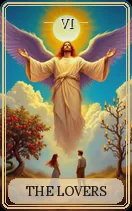 The Lovers — Heartbreak in love, a choice that hurts someone, or a love triangle.
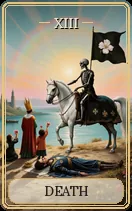 Death — The end of a relationship or a phase, painful, but opening up space for something else.
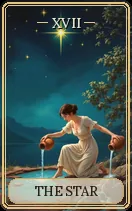 The Star — Healing after heartbreak: hope returns slowly.
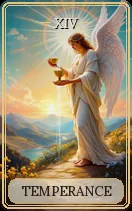 Temperance — The wound healing with time and patience; reconciliation is possible.
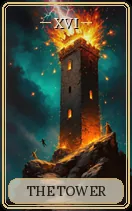 The Tower — A sudden, painful revelation; a shock that brings down an illusion.
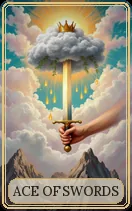 Ace of Swords — A truth that wounds: a clear and cutting word.
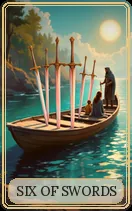 Six of Swords — Moving away from the pain: a sad departure, but one that leads to calmer waters.
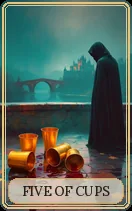 Five of Cups — Sadness and loss doubled: grieving for what has ended.
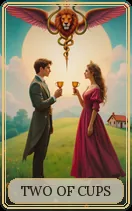 Two of Cups — A relationship wounded by words or by a misunderstanding; the bond is there, but it is hurting.
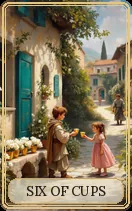 Six of Cups — An old hurt that comes back to mind; painful nostalgia.
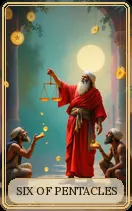 Six of Pentacles — A loss that can be made up for; help that arrives at a difficult time.
Frequently asked questions
What does the Three of Swords mean in tarot?
Heartbreak, a wound and a painful truth: hurtful words, a separation, a disappointment. It is a difficult card, but an honest one — the pain is out in the open and can be tended.
What does the Three of Swords mean in love?
Heartbreak, a separation, harsh words or a love triangle. It is not always the end: it may be a crisis that, once spoken out loud, can be come through.
Is the Three of Swords reversed good or bad?
It is often a sign of healing: the pain drains away and begins to be left behind. It can also speak of hurt held inside, which needs to be looked at before it can pass.
Is the Three of Swords a yes or a no?
It leans towards no. When it is a yes, it is a yes that comes at a cost — the answer arrives with some pain or a hard truth.
Does the Three of Swords mean betrayal?
It can, but not always. It speaks of a pain that comes from the truth — discovering, hearing or realising something. The neighbouring cards tell you whether that truth is a betrayal, a separation or simply a disappointment.
No sign-up · Reading written on the spot · Free