
Six of Cups: meaning and symbolism of the tarot card
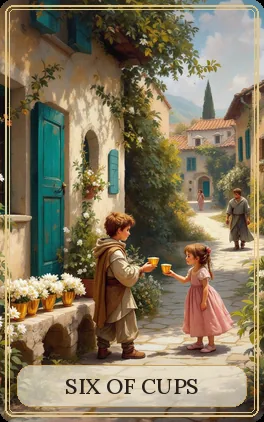
The Six of Cups is the card of memory. In a sunlit village street, a boy holds out a golden cup to a little girl, and she holds out hers to him. All around there are white flowers, painted doors, tiled roofs, a late-afternoon light. There is no hurry and no tension: there is only a gesture of kindness between two children, in a place that seems to come straight out of a memory.
In a spread, the Six of Cups speaks of the past that does you good: childhood, roots, people you have known for a long time, reunions, a happy kind of nostalgia. It also speaks of simple goodness — giving without expecting anything in return, as children do. After the loss of the Five, it is the crossing to calmer ground: the consolation found in what has already been lived and in what is still familiar.
The card at a glance
| Card | Six |
|---|---|
| Suit | Cups |
| Element | Water |
| Astrology | Sun in Scorpio (Golden Dawn) |
| Keywords | memory, childhood, innocence, reunion, kindness, giving without counting, roots |
| Reversed | longing that holds you back, idealising the past, an impossible return, immaturity |
| Yes or no | Yes, especially if the question involves someone from the past |
The image on the card
In the Sol da Alma Tarot, the scene takes place in a stone street in a Mediterranean village. On the left, a house with pale walls has a door and shutters painted blue-green, an arched niche with a vase of flowers and a climbing plant with white flowers covering part of the front. In front of it, on a stone bench, there are four golden pots full of white flowers. In the middle of the street, a boy with brown hair, in an earth-coloured hooded cape over a pale tunic and boots, holds out a small golden cup to a little girl in a pink dress with a flower in her hair, who holds out a matching cup to him. Further back, along the cobbled path, comes a man in a grey tunic and, in the distance, by an archway, a small figure in pink can be seen. In the background, tiled roofs, a cypress, mountains and a blue sky with clouds.
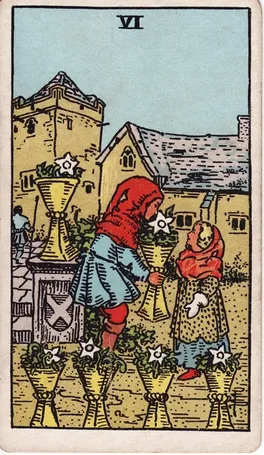
In the 1909 Rider-Waite-Smith, the idea is the same, and it was the starting point for the Sol da Alma painting: in an old courtyard, a boy in a red hood offers a smaller girl, in a hood and mittens, a cup filled with white star-shaped flowers. All six cups are full of these flowers — four in a row at the front, one on a stone pedestal bearing a shield, and the one passing from hand to hand. In the background there is a house and a stone tower, and a man walking away. The Sol da Alma moves the scene to a southern village, puts a cup in each child’s hand, gathers four flowering pots on the bench and swaps the cold stone courtyard for a sunny street full of climbing plants.
In the Marseille Tarot, the numbered cards have no scene: the Six of Cups shows six cups arranged in two columns among leafy ornaments. The children and the flowers are a creation of the Rider-Waite-Smith.
The symbolism, detail by detail
Everything in this card has the size and the light of a memory: small, sweet and slightly gilded by time.
- The children
- Childhood, innocence, the part of every person that still knows how to play and to trust. They may be real children, people you have loved for ever, or the child each of us once was.
- The gesture of giving
- Kindness without calculation. The boy offers the cup without asking for anything — and, in the Sol da Alma painting, the girl offers hers too: the exchange is mutual and simple, as between children.
- The white flowers
- The purity of feelings, memory in bloom. In the Rider-Waite-Smith, the flowers fill the cups; in the Sol da Alma, they fill the pots and cover the house.
- The house and the street
- Roots, the place where you were born, the place you come from. It is a safe, familiar place that you can visit — but where you can no longer stay and live.
- The figure walking away or approaching
- In the Rider-Waite-Smith, a man walks away in the background; in the Sol da Alma, a man comes along the path. It is the adult world, still there at the edge of the scene, which one day calls the children.
- The stone bench with the pots
- What has been kept and cared for over time: traditions, old affections, what one inherits.
- The warm light
- In the Sol da Alma painting, everything is bathed in a soft late-afternoon light. It is the tone of nostalgia: the past seen with fondness, and perhaps a little more beautiful than it was.
The history of the Six of Cups
The tarot was born in northern Italy in the fifteenth century as a card game, with the four Latin suits — cups, swords, batons and coins. In the oldest decks, such as those painted for the Visconti and Sforza in Milan around 1450, and in the Marseille decks, which settled into their form between the seventeenth and eighteenth centuries, the numbered cards showed only the suit symbols. The Six of Cups was an arrangement of six cups, and those who read it started from the suit and the number.
The scene of the children was born with the Rider-Waite-Smith, drawn by Pamela Colman Smith under the direction of Arthur Edward Waite and published in 1909 — the first widely circulated deck with figures on all the Minors. Waite describes children in an old garden, their cups filled with flowers, and calls it a card of the past and of memories: of looking back, on childhood, and on things that have vanished.
The Hermetic Order of the Golden Dawn, to which Waite belonged, had given it at the end of the nineteenth century the Sun in Scorpio and the title ‘Lord of Pleasure’. The image of the children added the sense of memory and childhood that dominates its reading today, and which most modern decks, the Sol da Alma included, preserve.
The Six of Cups upright: the meaning
Upright, the Six of Cups is the card of good memories. It speaks of childhood, of family, of the place you come from, of long-standing friends, of everything that gives a person the feeling of having roots. It often announces a reunion: someone from the past who reappears, a visit to the house where you grew up, a conversation with an old friend that does you good.
It is also the card of simple kindness: a present for no occasion, help given without expecting anything back, an unexpected gesture of tenderness. In many readings, it describes a phase of calm and consolation after a difficult period — the crossing of the Six, after the trial of the Five.
It can also speak of children in the literal sense — of sons and daughters, nieces and nephews, of working with young people — or of the inner child: the ability to play again, to wonder, to trust.
The Six of Cups reversed
Reversed, the Six of Cups does not become its own opposite: it is the same memory, but turned only backwards. It is longing that holds you back — living on what used to be, comparing everything with the past, idealising a time or a person to the point of being unable to be in the present. It is the wish for a return that is no longer possible, because the people and the places have changed.
It can also indicate a certain immaturity: a refusal to grow up, to take on responsibilities, or the weight of old family patterns that go on repeating without anyone noticing. And sometimes it is simply memory that hurts — a recollection that cannot yet be looked at with tenderness.
The Six of Cups in love
In love, the Six of Cups speaks of tenderness, of closeness and of uncomplicated affection. It often announces the return of someone from the past — an ex, a youthful passion — or a relationship with someone you have known for a long time. In a stable relationship, it is the card of shared memories and of the fondness that time has not worn away.
Reversed, it warns against idealisation: wanting to relive a relationship that is over, comparing your current partner with someone from the past, or going back to someone out of nostalgia alone. What was good may have been good at that time, not at this one.
The Six of Cups in work and money
In work, it may indicate a return to a former job, contact with former colleagues, a project connected with childhood, education, traditions or heritage. It is also the card of friendly workplaces and kind collaboration.
With money, it speaks of help from family, of presents, of small inheritances or of possessions with sentimental value. Reversed, it warns against decisions made out of attachment to the past — keeping a business that no longer works out of tradition, or refusing change out of nostalgia.
The Six of Cups in health and wellbeing
In questions about wellbeing, the Six of Cups speaks of the comfort of familiar places and people, of the importance of resting, of playing, of going back to simple things that used to give you pleasure. Reversed, it is a reminder that too much nostalgia also weighs on you. The cards are no substitute for any kind of healthcare; the reading speaks of attitudes and tendencies, not of diagnoses.
The Six of Cups in spiritual life
On the inner path, the Six of Cups is the card of making peace with your origins: looking at childhood and family with understanding, being grateful for what you received, forgiving what was lacking. It also speaks of simplicity of heart — the trust and wonder of children, which many traditions point to as a condition for understanding what is essential.
The Six of Cups as advice
As advice, the Six of Cups says: draw strength from your roots. Call someone you have not seen for a long time, visit the places that do you good, make a kind gesture without expecting anything in return. And it also says: visit the past, but do not move there. Memories are there to give strength to the present, not to replace it.
The Six of Cups in the positions of a spread
- In the past
- Childhood, family, an old relationship — the roots of the matter you are now asking about.
- In the present
- A reunion, a phase of nostalgia or consolation; someone from the past is back in your thoughts or in your life.
- In the future
- The return of a person or a familiar situation; a moment of tenderness and simplicity.
- As an obstacle
- Attachment to the past, idealisation, difficulty in accepting that things have changed.
- As the outcome
- A peaceful, affectionate ending, often connected with familiar people or with a return.
Numerology and correspondences
The Six is the passage: after the trial comes relief, fair exchange, the crossing to calmer ground. In the suit of Cups — the suit of Water, of feeling, of bonds and of memory — that crossing is made through memory and kindness: after the grief of the Five, the person finds consolation in what is familiar, and the simple exchange between the two children is the image of that fair exchange.
In the Golden Dawn tradition, the Six of Cups corresponds to the Sun in Scorpio and bears the title ‘Lord of Pleasure’. The Sun is the centre, vitality, light; Scorpio, a Water sign, is the sign of deep emotions and of what is hidden. Together they suggest light cast on what has stayed deep down — memories, roots — and the quiet pleasure that comes from it.
Combinations with other cards
 Two of Cups — A relationship with someone from the past that is reborn; an old love that returns.
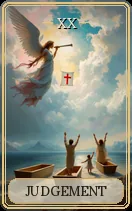 Judgement — An important reunion; someone or something returning to be seen anew.
 Ten of Cups — Happiness in the family, strong blood ties, a home full of good memories.
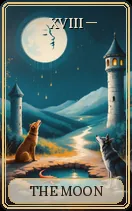 The Moon — Confused or idealised memories; the past seen through illusions.
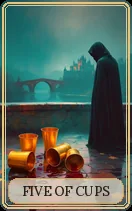 Five of Cups — Longing and sadness for someone who has been lost; consolation that begins with memories.
 Ten of Pentacles — Inheritance, family tradition, the family home.
 The Sun — A simple, childlike joy; happy moments with children.
 Eight of Cups — Leaving the past behind in order to move on.
 Six of Pentacles — Generosity: a present, help given or received with nothing asked in return.
 The Fool — Regaining a child’s lightness; starting again with innocence.
Frequently asked questions
What does the Six of Cups mean in love?
Tenderness, closeness and shared memories. It often announces the return of someone from the past or a relationship with a person you have known for a long time.
Does the Six of Cups indicate an ex coming back?
It can, especially next to Judgement or the Two of Cups. But it can also speak only of memories — the neighbouring cards tell you whether the return is real or only in memory.
Is the Six of Cups a yes or a no?
Yes, especially when the question involves familiar people, family or a return. Reversed, it asks you to be careful about idealising the past.
Is the Six of Cups reversed bad?
It is not bad: it is the same memory turned only backwards. It speaks of longing that holds you back, of idealisation or of difficulty in accepting that things have changed.
Is the Six of Cups about children?
It can be about real children — sons and daughters, nieces and nephews, working with young people — but more often it speaks of the questioner’s own childhood and their inner child.
No sign-up · Reading written on the spot · Free