
Six of Pentacles: meaning and symbolism of the tarot card
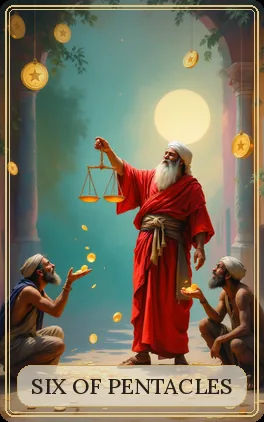
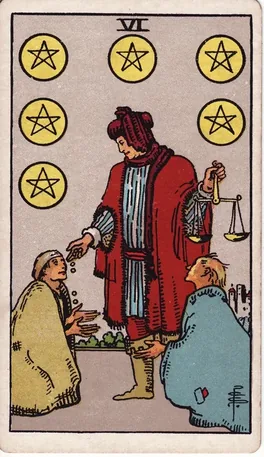
The Six of Pentacles is the card of the gift. A man in red robes raises a pair of scales in one hand, while gold coins fall into the hands of two people kneeling at his feet. It is an image of generosity, but not only that: the scales say that this help is measured, weighed, given in the right proportion. After the cold of the Five, the Six brings relief — and with it a question about who gives, who receives and on what terms.
In a spread, the Six of Pentacles speaks of fair exchange: help that arrives, money that circulates, support given or received. It is one of the most favourable cards in the suit. But, like any card that shows someone above and someone below, it asks you to pay attention to the balance of power that a gift can create.
The card at a glance
| Card | Six |
|---|---|
| Suit | Pentacles |
| Element | Earth |
| Astrology | Moon in Taurus (Golden Dawn) |
| Keywords | generosity, sharing, help, fair exchange, balance, gratitude, prosperity that circulates |
| Reversed | gift with strings attached, rigged scales, dependence, conditional generosity, giving too much or receiving too little |
| Yes or no | Yes — above all when the question involves help, support or a request made to someone |
The image on the card
In the Sol da Alma Tarot, an old man with a long white beard and a white turban stands in the centre of the card. He wears a red tunic and cloak, tied at the waist with a beige cloth sash with tassels, and he has sandals on his feet. With his right hand he holds high a small golden pair of scales with two pans, hanging in balance; his other hand hangs down, open, by his side. He looks upwards, eyes half closed, serene. On each side, crouching on the ground, is a bearded man in a turban and worn clothes: the one on the left, in a blue cloak, reaches out to catch the gold coins falling through the air in front of him; the one on the right already has a few coins in his palm. The ground is strewn with scattered coins. From the top of the card hang, on threads, six golden coins with a star at their centre, like ornaments. In the background there are stone columns, arches, green foliage and, in the hazy turquoise sky, a large disc of pale light, like a full moon.
In the 1909 Rider-Waite-Smith, the scene is essentially the same, and it was from it that the Sol da Alma painting set out: a man dressed like a wealthy merchant holds a pair of scales in his left hand and, with his right, lets coins fall into the hands of a kneeling beggar, while a second beggar waits his turn, and six pentacles float at the top of the card. The Sol da Alma turns the merchant into an old man with a white beard, closer to a sage than a trader; it raises the scales above his head, as the main element of the scene; it makes it less clear from which hand the coins come, as they seem to fall from above; and it hangs the six coins on threads, amid a setting of columns and arches, with the great disc of light in the background.
In the Marseille Tarot there are no figures and no scales: the Six of Pentacles shows six coins arranged in two columns of three, with foliage ornaments between them. The theme of the gift and of fair measure is a reading that the Rider-Waite-Smith made visible.
The symbolism, detail by detail
This card has three figures and one instrument. The figures show who gives and who receives; the instrument, the scales, shows what is really at stake: measure.
- The scales
- Fair measure, equity, judgement. The gift of the Six is not a blind gesture: it is weighed, considered, proportionate. It is the same instrument as that of Justice in the Major Arcana, now placed at the service of material exchange.
- The scales held high
- In the Sol da Alma painting, the scales are above the old man’s head, at the centre of attention. The measure is worth more than the money itself: it is what makes the gift fair.
- The man who gives
- Prosperity that is shared. He has more than he needs and sets that surplus in circulation. In the Sol da Alma he is an old man, which adds the idea of wisdom and experience to his generosity.
- The open hand, below
- The gesture of releasing, of letting go. After the clenched fist of the Four, here the hand no longer grips.
- The falling coins
- Help that arrives, prosperity that circulates. The gold does not stay still: it passes from one hand to another, and that is what makes it useful.
- The two who receive
- Those who are in need and accept. But there are two of them, and each receives in a different way: one holds out his hand, the other already has something. The card asks whether the help reaches everyone in the same measure.
- The position of each figure
- One stands, the others crouch. The difference in height says everything about the power that giving can create: the giver is on top. True generosity is the kind that does not take advantage of this.
- The six hanging coins
- Particular to the Sol da Alma painting: the six coins of the suit hang on threads, as if wealth were suspended, available, ready to be handed out.
- The disc of light
- In the Sol da Alma, a large pale disc shines in the background, like a moon. It is a reminder that the Golden Dawn linked this card to the Moon: the tide of what comes and goes.
- The coins on the ground
- Abundance to spare. There is more than enough — the problem, when there is one, is not scarcity but distribution.
The history of the Six of Pentacles
Tarot was born in northern Italy in the fifteenth century as a card game, and its four suits — cups, swords, batons and coins — are the same as those of the Latin-suited cards still played in Portugal and Spain today. In the earliest decks and in the Marseille decks, which took their settled form in the seventeenth and eighteenth centuries, the numbered cards had no scene: the Six of Pentacles was six coins in two rows, with foliage between them.
At the end of the nineteenth century, the Hermetic Order of the Golden Dawn assigned each numbered card a planet in a sign and a title. The Six of Pentacles was given the Moon in Taurus and the title ‘Lord of Material Success’. In every suit, the Sixes are cards of relief and harmony after the trial of the Five; in the suit of Earth, the harmony is that of a prosperity found once again.
It was the Rider-Waite-Smith, drawn by Pamela Colman Smith under the direction of Arthur Edward Waite and published in 1909, that gave a scene to all the Minor cards. Waite describes a person in the guise of a merchant who weighs money in a pair of scales and distributes it to the needy, and says the scene is a testimony both to his success in life and to his goodness of heart. He gives the card the meanings of presents, gifts and gratification, and also of present prosperity. The image of the man with the scales became the classic reading of the Six of Pentacles, and it is the one the Sol da Alma follows, with its own painting.
The Six of Pentacles upright: the meaning
Upright, the Six of Pentacles is the card of generosity and of help that arrives. After a period of hardship, it indicates relief: support, a loan, a grant, a payment that finally comes in, someone holding out a hand. It can also place the person asking on the other side — as the one who is in a position to help and is called upon to do so.
Above all, it is the card of fair exchange. Money circulates, what is given comes back, the relationship between what is received and what is offered is in balance. It favours agreements, negotiations, fair wages, inheritances divided well, partnerships in which each person contributes according to their means. The scales ask that everything be measured honestly.
It also speaks of gratitude, on both sides. The one who receives can do so without shame; the one who gives, without expecting subservience. When it is lived well, the Six of Pentacles is one of the most beautiful images in the tarot: prosperity that is not hoarded but put to service.
The Six of Pentacles reversed
Reversed, the Six of Pentacles does not turn into its opposite: the exchange goes on, but with the scales rigged. The gift creates a debt; help comes with conditions; the giver uses what they give to control, to be admired, to keep the other person down. Or, on the side of the receiver, dependence sets in — always receiving, always on the same side, without ever giving back or gaining independence.
It can also indicate an inward imbalance: giving too much, until there is nothing left for yourself; or not feeling entitled to receive, and refusing the help that arrives. In other cases it speaks of debts, of promises of payment that are not kept, of deals in which one party always comes out the loser. The card asks you to look at the scales again and to ask yourself, frankly, whether they are true.
The Six of Pentacles in love
In love, the Six of Pentacles speaks of a relationship of reciprocity: both give, both receive, both support each other. It is a card of emotional generosity, of care, of attention to the other person’s needs. It can indicate a phase in which one partner supports the other through a difficult time, in the certainty that at another time it will be the other way round. For someone who is single, it can announce a generous person, or a meeting that comes about through help, a favour, an act of kindness.
The risk is imbalance: a relationship in which one always gives and the other only receives, or in which material help creates a dependence that weighs on the affection. Reversed, it warns against love that keeps accounts — ‘after everything I’ve done for you’ — and against relationships in which money or favours are used to control.
The Six of Pentacles in work and money
At work, the Six of Pentacles announces fair recognition: a proper salary, a pay rise, a payment that arrives, a balanced negotiation. It favours those looking for support — sponsorship, funding, a mentor — and also those in a position to help colleagues or to allocate resources. It is a good card for professions connected with helping others, managing resources and mediation.
With money, it indicates that the flow is being restored: regular income, debts paid off, loans granted on reasonable terms. It also speaks of donations and gestures of sharing. Reversed, it warns against loans with abusive terms, against debts that create dependence, against giving more than you can afford, or against deals in which the scales always tip the same way.
The Six of Pentacles in health and wellbeing
In questions about wellbeing, the Six of Pentacles speaks of the balance between caring for others and caring for yourself, and of the importance of accepting support when it is needed. It is a reminder that those who give without measure also wear themselves out. The cards are no substitute for any kind of healthcare: here, as with any other card, the reading speaks of attitude, not diagnosis.
The Six of Pentacles in spiritual life
On the inner path, the Six of Pentacles is the card of generosity as a practice: giving without expecting anything in return, sharing what you have, recognising that everything you possess was also received. But it reminds us that humility has two sides — knowing how to give without placing yourself above others, and knowing how to receive without feeling diminished. The old man in the image, with his eyes raised, gives like someone giving thanks.
The Six of Pentacles as advice
As advice, the Six of Pentacles says: give and receive in fair measure. If you need help, ask for it without shame; if you can help, do so without conditions. Look at your exchanges — at work, with money, in your relationships — and see whether the scales are balanced. What circulates fairly comes back; what is given in order to control ends up weighing heavily.
The Six of Pentacles in the positions of a spread
- In the past
- Help received or given that changed the situation, or an exchange that still leaves a debt — of money or of gratitude.
- In the present
- A phase of exchange: support arriving, or the chance to help someone. The scales are in motion.
- In the future
- Relief on its way: a payment, support, a negotiation that goes well.
- As an obstacle
- An imbalance of power, a dependence, or difficulty in asking for or accepting help.
- As the outcome
- A fair agreement, a situation in which each person receives their due.
Numerology and correspondences
Six is the crossing: after the trial comes relief, the fair exchange, the passage to calmer ground. In the suit of Pentacles — the suit of Earth, of the body, of money and of home —, that crossing is very concrete: the hardship of the Five gives way to the help that arrives, and money starts to circulate again. The kneeling figures of the Six even look like the same ones who were walking through the snow one card earlier — now with coins in their hands.
In the Golden Dawn tradition, the Six of Pentacles corresponds to the Moon in Taurus and bears the title ‘Lord of Material Success’. The Moon is the planet of tides, of what waxes and wanes, of care; Taurus, an Earth sign, is the sign of abundance, comfort and fertility. The meeting of the two gives the card its tone: a prosperity that is not fixed, that comes and goes like the tide — and that should therefore be shared while it is full.
Combinations with other cards
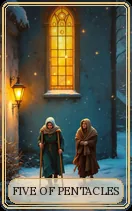 Five of Pentacles — From the cold to shelter: help that arrives after a difficult period.
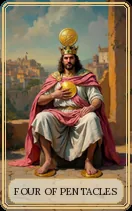 Four of Pentacles — Learning to open your hand, or hesitating between keeping and sharing.
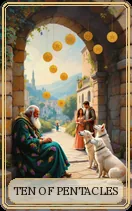 Ten of Pentacles — An inheritance or the sharing out of family assets; prosperity passed down from generation to generation.
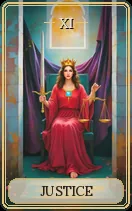 Justice — A truly fair exchange: a balanced agreement, an impartial decision about money.
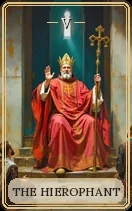 The Hierophant — Support from an institution or a mentor; organised charity, grants, benefits.
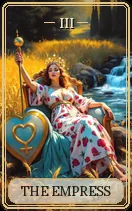 The Empress — Abundant, caring generosity; the hand that feeds.
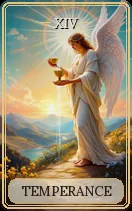 Temperance — The right measure in everything: giving without wearing yourself out, receiving without becoming dependent.
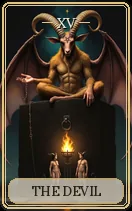 The Devil — Help with strings attached, financial dependence, a gift that binds.
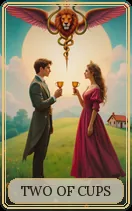 Two of Cups — Emotional reciprocity: a relationship in which both support each other equally.
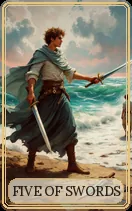 Five of Swords — An unequal exchange, someone taking advantage of another’s generosity.
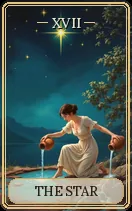 The Star — Hope renewed thanks to someone’s help; selfless generosity.
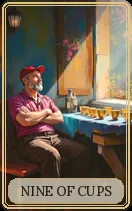 Nine of Cups — Material satisfaction and the wish to share it; a good moment to be generous.
Frequently asked questions
What does the Six of Pentacles mean in tarot?
Generosity, help and fair exchange: giving and receiving in the right measure. It is the card of relief after hardship, and of prosperity that is shared.
Is the Six of Pentacles a yes or a no?
It is a yes, above all when the question involves help, support, a payment or a request made to someone. The answer tends to be favourable and fair.
What does the Six of Pentacles mean in love?
A relationship of reciprocity and mutual support, in which both give and receive. The warning is against imbalance: one who always gives and another who only receives.
Is the Six of Pentacles reversed bad?
It is not a bad card, but it warns against rigged scales: help with strings attached, dependence, debts or generosity used to control. It asks you to rebalance your exchanges.
Does the Six of Pentacles mean money coming in?
Often, yes: a payment, support, a pay rise or a loan on good terms. But it also speaks of money going out to help others — the card is about circulation, not only about income.
No sign-up · Reading written on the spot · Free