
The Lovers: meaning and symbolism of the tarot card
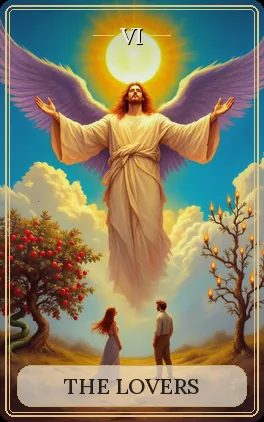
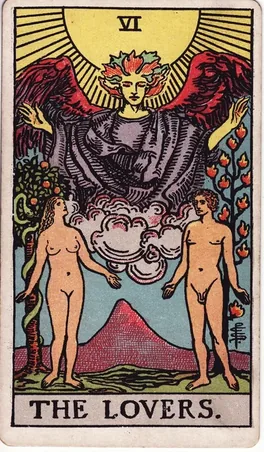
The Lovers is the sixth card of the Major Arcana and, for many people, the card of love. But anyone who looks at it closely sees more than a couple: they see two people separated by an empty space, a winged figure above them and, on either side, two different trees. In the old decks the scene was of a young man standing between two women, with a Cupid aiming an arrow at him from above. In every version the heart of the card is the same: a decision that has not yet been made.
In a spread, The Lovers speaks of union, affection and harmony — but above all of the moment when a choice must be made. Choosing a person, a path, a value, and accepting that choosing one thing means leaving another. The test of this card is the decision, not love. That is why it appears as often in questions about relationships as in questions about work, change or conscience.
The card at a glance
| Number | VI |
|---|---|
| Arcana | Major Arcana |
| Historical names | L’Amore, Gli Amanti (Italy); L’Amoureux (Marseille); The Lovers (Rider-Waite-Smith) |
| Element | Air (through the sign of Gemini) |
| Astrology | Gemini (Golden Dawn) |
| Hebrew letter | Zain (ז), according to the Golden Dawn |
| Keywords | union, the choice of the heart, trial, love, harmony, values, commitment |
| Reversed | indecision, disunity, a choice put off, imbalance, temptation, inconsistency |
| Yes or no | Yes, if the choice is made from the heart; ‘it is up to you’, if there is doubt between two paths |
The image on the card
In the Sol da Alma Tarot, a great angel fills the upper half of the card. He has enormous wings with lilac and violet feathers, long red hair and a red beard, and wears a cream-coloured tunic tied at the waist with a cord. He opens both arms, palms upwards, and behind his head a white and yellow sun shines. He hovers above white clouds, in a blue sky. Below, on a path of golden grass, stand a man and a woman, their backs to us, looking up at him. They are clothed: she, with loose red hair blowing in the wind, in a long lilac dress; he, in a pale shirt and brown trousers. On the left, behind the woman, is an apple tree laden with red apples, with a green serpent coiled around its trunk. On the right, behind the man, a leafless tree with small flames burning at the tips of its branches.
The Rider-Waite-Smith of 1909 has the same composition, and it was the starting point for the Sol da Alma painting: the angel with open arms beneath a great sun, the clouds, the man and the woman, the fruit tree with the serpent behind her, the tree of flames behind him. But in the RWS the two figures are naked and face forward, like Adam and Eve in Paradise; she looks up at the angel and he looks at her. Between them rises a mountain. The angel has red wings, a violet robe and hair that looks like flames. In the Sol da Alma the couple are clothed and seen from behind, the mountain has vanished, and the angel has gained a beard, lilac wings and a greater presence.
In the Tarot de Marseille, L’Amoureux shows a different scene, and it is the one the Sol da Alma table describes: a young man standing between two women — often read as one older and one younger — who touch him and seem to be vying for him. Above, in a sun, a winged Cupid aims an arrow at him. The young man stands still in the middle, not yet able to decide.
The symbolism, detail by detail
Everything in this card speaks of a bond and a choice — of two things meeting and of someone who has to decide. Each element adds a nuance to that idea.
- The angel
- Higher consciousness, inspiration, the blessing upon the union. He spreads his arms over the two of them: true love is greater than either of them.
- The sun
- Clarity and life. The decision the card asks for is made in the light of day, not in secret.
- The couple
- The relationship, the meeting of two people, but also the two sides of a single person — reason and heart, desire and duty — who need to come to terms.
- The space between them
- In the Sol da Alma the two stand side by side but do not touch. The union has yet to be made: it is a possibility, not a done deal.
- The apple tree and the serpent
- The tree of the knowledge of good and evil, with the serpent of Genesis: temptation, desire, and the choice that has consequences.
- The tree of flames
- In the RWS, the tree of life, with twelve flame-shaped fruits: passion, vital energy, the desire that warms. In the Sol da Alma the flames burn on a leafless branch.
- The mountain
- In the RWS, between the two: the challenge the relationship has to climb, or the goal they share. The Sol da Alma exchanged it for an open path.
- Cupid with his arrow
- In the Tarot de Marseille: love that comes from outside and strikes without asking permission. The choice, there, is provoked.
- The two women
- In the Tarot de Marseille: the two paths, the two options between which the young man hesitates. That is where the reading of this card as the card of choice comes from.
The history of The Lovers
In the Italian decks of the fifteenth century this card was L’Amore — Love. In the Visconti-Sforza, painted in Milan around 1450, it shows a couple holding hands, with a blindfolded Cupid above them. It was an image linked to courtly love and, probably, to the marriages of the families who commissioned the decks.
In the Tarot de Marseille, which took its settled form between the seventeenth and eighteenth centuries, the scene had changed: L’Amoureux — the lover, in the singular — is a young man between two women, with Cupid and his arrow above. The scene is customarily read as a choice: between two people, between two paths, between vice and virtue. It was from this image that the sense of ‘choice’ the card still carries today was born.
The Golden Dawn, at the end of the nineteenth century, assigned it the sign of Gemini and the letter Zain. In the 1909 deck, Arthur Edward Waite and Pamela Colman Smith transformed the scene completely: they removed the hesitant young man and the two women and put in their place Adam and Eve in Paradise, with the tree of life and the tree of knowledge, and an angel above. The card came to speak more of union and consciousness than of hesitation. The Sol da Alma follows this model, but the website’s card table has kept the Marseille image: that is why both readings — union and choice — live side by side on this page.
The Lovers upright: the meaning
Upright, The Lovers is the card of the choice of the heart. It says there is a decision to be made and that it should be made according to what the person truly feels and values. It is not a calculated choice: it is a choice of the soul, one that defines who you are. And it always carries the same lesson — choosing one thing means leaving another, and that is what gives the choice its worth.
It is also the card of union: affection openly declared, attraction, harmony between two people, a partnership that works. It may be a romantic relationship, but also a friendship, a business partnership, a collaboration. Wherever there are two who complete each other, the card gives its blessing.
Finally, The Lovers speaks of consistency: bringing what you think, what you feel and what you do into line. Often the choice the card asks for is an inner one — between two values, between two ways of living, between what you desire and what you know to be right.
The Lovers reversed
Reversed, The Lovers does not become its own opposite: it is the same choice, but put off. The person stays between two paths, waiting for someone to decide for them, or for time to decide. It is indecision, the ‘I’ll think about it’ that drags on, the relationship that falls apart not for lack of love but for lack of a choice.
It can also speak of imbalance in a relationship — one gives more than the other, the values do not match, communication has broken down — or of a temptation that puts a commitment in question. Sometimes it is the person themselves who is divided within. The advice is to look the decision in the face and make it, even knowing it comes at a price.
The Lovers in love
In love, The Lovers is one of the strongest cards in the deck. It speaks of attraction, affinity, a relationship in which both people choose each other. For those who are single, it can herald an important meeting, someone with whom there is an instant connection. In a relationship, it speaks of a moment of decision: taking a step forward, making a commitment, choosing to stay.
Often, however, the card appears when there is a difficult romantic choice — between two people, between love and something else, between staying and leaving. Reversed, it speaks of indecision, love triangles, relationships in which the values do not match, or a separation that happens because no one made a choice.
The Lovers in work and money
At work, The Lovers speaks of career choices: between two offers, between two paths, between security and vocation. It says the right decision is the one that fits the person’s values, not just the salary or other people’s opinions. It also favours partnerships, joint ventures and teamwork, especially when there is affinity between the people involved.
With money, it calls for conscious choices: deciding where to put your money according to what really matters. Reversed, it warns of indecision that loses opportunities, of unbalanced partnerships, or of spending driven by emotional impulse.
The Lovers in health and wellbeing
In questions about wellbeing, The Lovers speaks of balance between body and emotions and of the good that healthy relationships do. Reversed, it points to the strain of a decision put off or of a relationship in conflict. The cards are no substitute for any kind of healthcare: the reading speaks of attitude, not diagnosis.
The Lovers in spiritual life
On the inner path, The Lovers is the card of conscious choice: deciding which values you want to follow, which path you want to walk. It also speaks of inner union — an understanding between the parts of oneself that seem opposed, such as reason and heart, desire and conscience. The angel above the couple is a reminder that this choice is not made alone: there is an inspiration that guides, if the person knows how to hear it. Reversed, it can point to an inner division that has not yet found its answer.
The Lovers as advice
As advice, The Lovers says: choose, and choose with your heart. Do not let others decide for you, nor let time decide by default. Ask yourself what you truly value and be consistent with it. Accept that every choice leaves something behind — and that not choosing is also a choice.
The Lovers in the positions of a spread
- In the past
- An important choice that set the course, or a relationship that left a deep mark on the person.
- In the present
- The moment to decide: there are two paths, and the person needs to choose one of them.
- In the future
- A meeting, a union, or a decision that will arise and call for clarity of heart.
- As the obstacle
- Indecision, a temptation, an unbalanced relationship or conflicting values.
- As the outcome
- A choice made and owned; a harmonious union born of both sides.
Numerology and correspondences
Six is the passage: after the test comes relief, a fair exchange, the crossing to calmer ground. After The Hierophant’s five, which teaches the rules from outside, six asks for the choice from within. It is the number of balance between two sides — the two triangles that meet, the two who exchange as equals. The choice of The Lovers is that crossing: one leaves doubt behind for a clearer place.
In the Golden Dawn tradition the card corresponds to the sign of Gemini — an air sign, the sign of duality, communication and choices between two things — and to the Hebrew letter Zain, whose name is usually associated with the sword or weapon. A sword cuts and separates: it is the image of decision, which divides what is chosen from what is left behind.
Combinations with other cards
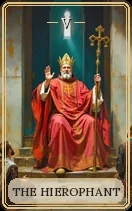 The Hierophant — Formal commitment, engagement or marriage; a recognised union.
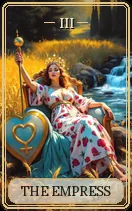 The Empress — A fertile and happy love; a relationship that blossoms and grows.
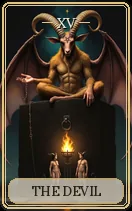 The Devil — Temptation, a passion that binds, a relationship of dependence; a choice made by desire rather than by the heart.
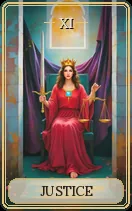 Justice — A fair and considered decision; a commitment made responsibly.
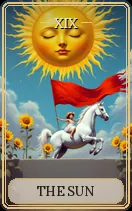 The Sun — A happy, radiant love, a union full of joy.
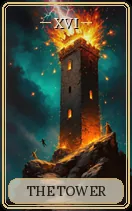 The Tower — A sudden break in a relationship; a choice forced by a shock.
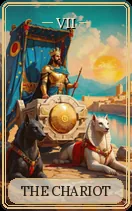 The Chariot — A decision made and set in motion; moving forward after choosing.
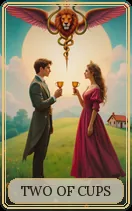 Two of Cups — A mutual and harmonious romantic bond: the classic combination of love returned.
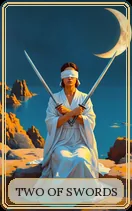 Two of Swords — Deep indecision, deadlock; refusing to see so as not to have to choose.
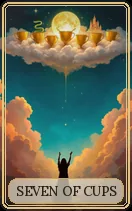 Seven of Cups — Too many options, illusions, difficulty telling what you really want.
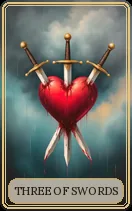 Three of Swords — Heartbreak, a love triangle, a choice that hurts.
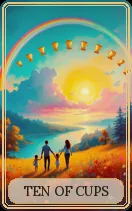 Ten of Cups — A happy family; a union that becomes a home.
Frequently asked questions
What does The Lovers mean in tarot?
Union and the choice of the heart: affection openly declared, a harmonious relationship, but above all the moment when you must decide according to what you feel and value.
Is The Lovers a yes or a no?
It leans towards yes, especially in questions about love. But the card often hands the question back to the person asking: the answer depends on a choice that has yet to be made.
What does The Lovers mean in love?
Attraction, affinity, a relationship in which both people choose each other; sometimes, a difficult romantic choice. Reversed, it speaks of indecision, love triangles or values that do not match.
Is The Lovers reversed bad?
It is not a card of misfortune. Reversed, it speaks of the same choice put off: indecision, imbalance, being stuck between two paths. It asks you to make the decision rather than wait.
Is The Lovers always about love?
No. It often speaks of a choice — professional, personal or about values — and of consistency between what you feel and what you do. Love is one of the forms that choice takes.
Why is there a man between two women in the old decks?
In the Tarot de Marseille, the card shows a young man between two women, with a Cupid above. It is customarily read as a choice between two paths. The Rider-Waite-Smith replaced this scene with Adam and Eve in Paradise.
No sign-up · Reading written on the spot · Free