
Nine of Cups: meaning and symbolism of the tarot card
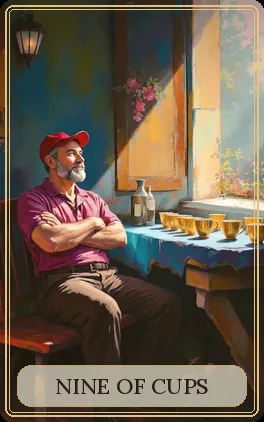
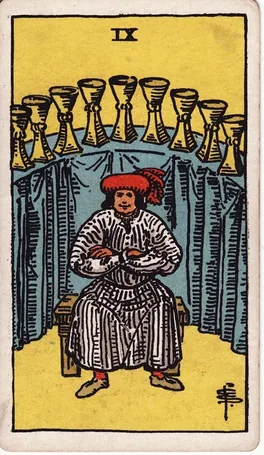
The Nine of Cups is the card of the wish fulfilled. A man sits with his arms folded and a calm smile, beside a table on which his cups are lined up. He is not asking for anything or waiting for anything: he is satisfied. It is one of the simplest cards in the tarot to read, and one of the most welcome in a spread.
But it is also a card with its subtleties. The contentment of the Nine of Cups is personal: it speaks of what the person wanted for themselves, and not necessarily of what they share with others — for that there is the Ten. And, like all the Nines, it takes the quality of the suit to its extreme, which means that pleasure can turn into excess, and satisfaction into vanity. In most readings, however, the message is clear: what you wished for is within reach, or has already arrived.
The card at a glance
| Card | Nine |
|---|---|
| Suit | Cups |
| Element | Water |
| Astrology | Jupiter in Pisces (Golden Dawn) |
| Keywords | wish fulfilled, contentment, satisfaction, comfort, pleasure, gratitude, wellbeing |
| Reversed | empty wish, satisfaction for show, excess, complacency, vanity |
| Yes or no | Yes — it is one of the most favourable cards in the deck |
The image on the card
In the Sol da Alma Tarot, the scene is a sunlit interior. A man with a grey beard, wearing a red cap, a burgundy polo shirt and dark trousers, sits on a wooden bench against a blue-green wall. His arms are folded across his chest, his head slightly raised, and he wears a serene smile; he is looking towards the window, through which the light comes in. In front of him is a table covered with a blue cloth on which the golden cups are lined up — here they are mugs with handles, set out in a row across the table — and beside them two glass bottles. On the wall hangs an iron lantern; around the window there is a vase of pink flowers and flowering plants on the sill.
In the 1909 Rider-Waite-Smith, the figure is a stout man in a red hat and white tunic, sitting on a bench with his arms folded and looking very pleased with himself. Behind him, the nine cups are arranged in an arc on a counter draped with a blue cloth, against a yellow background. The Sol da Alma follows this iconography closely — the red hat, the folded arms, the bench, the cups on a blue cloth — but brings it into an everyday, contemporary setting: a room with a window and flowers, instead of the plain background of the original, and the cups on the table in front of him instead of displayed behind his back.
In the Marseille Tarot, the Nine of Cups has no figure: it shows nine cups arranged symmetrically, with plant ornaments. The whole scene of the satisfied man comes from the Rider-Waite-Smith.
The symbolism, detail by detail
The card speaks of a satisfaction that has been achieved, and each detail tells us what kind it is.
- The folded arms
- The satisfaction of someone who no longer needs to do anything. It is also a closed gesture: what he has is his, and he keeps it. Hence the hint of complacency the card can carry.
- The smile and the gaze towards the light
- True contentment, without anxiety. In the Sol da Alma, he does not look at the cups but at the window: he is enjoying the moment, not just the having.
- The cups in a row
- What has been achieved, neatly arranged and in plain sight. They are all upright and full of light: nothing is missing.
- The everyday mugs
- In the Sol da Alma, the cups are simple mugs. The pleasure of this card is not necessarily a luxurious one; it may be that of a life in which good things have become part of every day.
- The bottles
- The pleasure of the senses, food and drink, celebration. They are also the sign of possible excess: this is where satisfaction can turn into greed.
- The red cap
- It echoes the red hat of the Rider-Waite-Smith: vitality, a taste for life, a certain joy in someone who feels comfortable in their own skin.
- The window and the flowers
- The life flourishing all around, the warmth of the sun, openness. Contentment is linked to the world outside, not only to what is on the table.
- The bench
- Well-earned rest. The figure is not on his feet fighting, nor on the road: he is sitting down; he has arrived.
- The grey beard
- The age of someone who has lived long enough to know how to appreciate what they have. The satisfaction of the Nine of Cups is mature, not that of a beginner.
The history of the Nine of Cups
In the first tarot decks, painted in northern Italy in the fifteenth century, and later in the Marseille decks, which settled into their form between the seventeenth and eighteenth centuries, the Nine of Cups was simply a pip card: nine cups in a symmetrical composition, used to play tarocchi. It had no scene and no divinatory meaning.
Today’s reading comes from the Hermetic Order of the Golden Dawn, at the end of the nineteenth century, which assigned this card Jupiter in Pisces and the title ‘Lord of Material Happiness’. Jupiter, the planet of abundance, in a Water sign: no wonder it became the card of wellbeing. Arthur Edward Waite and Pamela Colman Smith gave it form in the 1909 deck with the figure of the satisfied man before his cups, which has since become the standard image.
In everyday English-language readings, the Nine of Cups is often called the ‘wish card’, and some people make a wish as they shuffle and see whether this card turns up. In the Thoth deck, by Aleister Crowley and Frieda Harris, it is simply called ‘Happiness’. The Sol da Alma follows the iconography of the Rider-Waite-Smith, with its own painting that sets the scene in everyday life.
The Nine of Cups upright: the meaning
Upright, the Nine of Cups says that what you wanted has happened, or is about to happen. It is a card of personal fulfilment: a goal reached, a wish satisfied, a phase of comfort and pleasure. It brings the good feeling of having arrived — of being able to sit down, fold your arms and enjoy what you have.
It is also a card of sensory and emotional wellbeing: good food, good company, rest, the joy of simple things. In many readings it appears after a period of effort, as the moment when the harvest is finally gathered. It asks you to make the most of it, without guilt and without rushing on to the next thing.
What the card does not guarantee is depth. The Nine of Cups is the contentment of the self; the Ten of Cups is that of the whole household. When it appears on its own, it is an excellent card; when it appears in a question about a relationship or a family, it may be worth asking whether the satisfaction is shared or merely personal.
The Nine of Cups reversed
Reversed, the Nine of Cups does not say that the wish has failed: it says that the wish came true and did not fill you. You got what you wanted — the house, the job, the person — and, after all, something is missing. It is satisfaction revealed as a façade, contentment shown on the outside while inside there is emptiness.
It may also be excess: eating, drinking, buying, seeking pleasure after pleasure, because none is enough. Or the complacency of someone who, pleased with themselves, stops seeing others and stops growing. Sometimes it simply indicates a delay: the wish will come true, but not yet, nor exactly as imagined. The card asks you to consider what you truly wish for — and not just what you have learnt to wish for.
The Nine of Cups in love
In love, the Nine of Cups is very positive. In a relationship, it speaks of a happy period, of comfort, of shared pleasure, of feeling good with the person at your side. For someone who is single, it may announce that the wish to meet someone will come true, or speak of someone who is at ease with themselves and is not looking for anyone to complete them — which is often the best condition for a meeting.
The thing to watch out for is satisfaction on one side only: one of the two is content, while the other is not being seen. Reversed, it may indicate a relationship that looks perfect from the outside but has stopped filling either person, or the pursuit of pleasure without commitment.
The Nine of Cups in work and money
In work, it is the card of the goal achieved: a project successfully completed, recognition, a promotion, the satisfaction of doing well what you do. It favours those who work in hospitality, food, leisure and anything to do with other people’s wellbeing.
With money, it indicates a comfortable phase: there is enough, and it can be enjoyed. Reversed, it warns against spending for pleasure, against a sense of abundance that leads to carelessness, or against the idea that a material possession will fix a lack that is not material.
The Nine of Cups in health and wellbeing
In questions about wellbeing, the Nine of Cups speaks of comfort, of good spirits, of pleasure in looking after yourself. Reversed, it is a reminder of moderation: too much food, too much drink or too much sitting still. The cards are no substitute for any kind of healthcare: the reading speaks of attitudes and tendencies, not of diagnoses.
The Nine of Cups in spiritual life
On the inner path, the Nine of Cups is gratitude: stopping to acknowledge what you have received. It is a card that values simple pleasure as part of spiritual life, and not as its enemy. But it also puts a question to the seeker: is satisfaction enough? For many readers, the wish fulfilled is also the moment when one realises that desire, by itself, is not enough — and it is from there that the next search begins.
The Nine of Cups as advice
As advice, the Nine of Cups says: enjoy what you have. Acknowledge what you have already achieved, be grateful, sit down for a while. There is no need to rush straight on to the next goal. And it also says, more quietly: do not shut yourself away with your cups. Contentment grows when it is shared, and turns sour when it is shown off.
The Nine of Cups in the positions of a spread
- In the past
- A wish that came true and gave the person the situation they are in now; or a period of comfort now remembered.
- In the present
- A moment of satisfaction: what you wanted is happening. It is time to enjoy it.
- In the future
- A wish that will come true. It is one of the best cards to have in this position.
- As an obstacle
- Complacency, the comfort that keeps you from moving forward, or pleasure that has become an escape.
- As the outcome
- The matter is resolved to your satisfaction: the person gets what they wanted.
Numerology and correspondences
The Nine is the extreme of the suit: its quality taken to the limit, for better and for worse. In Cups — Water, feeling, what is received and given — the limit is the fullness of pleasure and contentment. For better, it is complete satisfaction; for worse, satiety, excess, a satisfaction closed in on itself. The Ten that follows closes the cycle by opening it up to others.
In the Golden Dawn, the card corresponds to Jupiter in Pisces. Jupiter is the planet of expansion, generosity and good fortune; Pisces, the most open of the Water signs, traditionally ruled by Jupiter itself before modern astrology gave it to Neptune. It is one of the most favourable combinations in the whole system, and it explains why the Nine of Cups is read as one of the luckiest cards in the deck.
Combinations with other cards
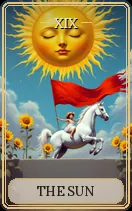 The Sun — A clear, unclouded happiness: the wish comes true and is shared.
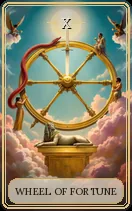 Wheel of Fortune — Luck on your side: a wish that comes true through an unexpected turn of life.
 The Empress — Abundance, pleasure, fertility of ideas and projects.
 Ten of Cups — Personal contentment extends to the family: complete happiness.
 Two of Cups — A meeting that matches exactly what you had wished for.
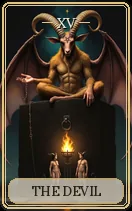 The Devil — Pleasure that becomes dependence; desire that rules the person.
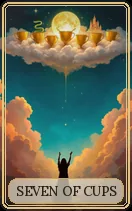 Seven of Cups — Too many wishes and choices still to make: you need to know what you really want.
 Nine of Pentacles — Material comfort and wellbeing achieved through your own effort.
 Ten of Pentacles — Lasting prosperity, security for the family.
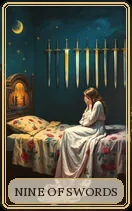 Nine of Swords — An outward satisfaction that does not quieten inner unease.
 Temperance — Pleasure in moderation: a satisfaction that lasts because it does not overdo things.
Frequently asked questions
What does the Nine of Cups mean in tarot?
The wish fulfilled: contentment, comfort, satisfaction at having got what you wanted. It is one of the most favourable cards in the deck.
Why is the Nine of Cups called the wish card?
Because it is the card of the wish come true. In everyday readings, especially in English, it is called the ‘wish card’, and some people use it to ask whether a wish will come true.
What does the Nine of Cups mean in love?
A happy, comfortable period in a relationship, or the fulfilment of the wish to meet someone. The thing to watch is that the satisfaction is shared by both.
Is the Nine of Cups a yes or a no?
Yes, and a clear yes. It only loses strength if it is reversed or surrounded by very difficult cards.
Is the Nine of Cups reversed bad?
It is not a disaster: it is the same wish that did not fill you, or that has not arrived yet. It speaks of satisfaction for show, of excess or of complacency, and asks you to work out what you truly wish for.
No sign-up · Reading written on the spot · Free