
Eight of Cups: meaning and symbolism of the tarot card
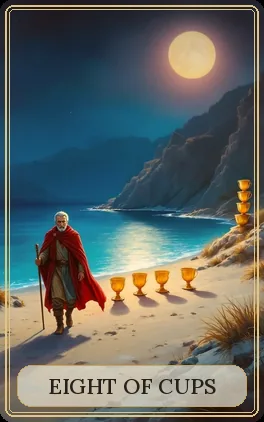
The Eight of Cups is the card of someone who walks away. A man in a red cloak, staff in hand, slowly moves off from the cups he has left lined up on the sand. There is no anger in the scene, and no headlong flight: there is someone who looked at what he had, realised it was no longer enough, and decided to move on. It is one of the quietest cards in the deck, and one of the most serious.
In a spread, the Eight of Cups speaks of letting go and of searching. What is left behind is not necessarily bad — the cups are whole, upright, neatly arranged — but it has stopped giving meaning. The card does not judge what is being abandoned; it only asks whether it is time to leave. And it reminds us that some departures come not from lack, but from an excess of clarity.
The card at a glance
| Card | Eight |
|---|---|
| Suit | Cups |
| Element | Water |
| Astrology | Saturn in Pisces (Golden Dawn) |
| Keywords | departure, leaving behind, letting go, search for meaning, weariness of what no longer serves, inner turning point |
| Reversed | hesitating to leave, return, clinging to what is spent, aimless escape |
| Yes or no | No to what you have now; yes to what you will go and look for |
The image on the card
In the Sol da Alma Tarot, the scene takes place on a beach, at night. A grey-haired man with a white beard, his red cloak fastened at the shoulder with a round clasp, walks towards the viewer, leaning on a wooden staff. He has left the water’s edge and the cups behind him, and his face is grave, his gaze fixed ahead; there are marks of footsteps in the sand. Behind him are the eight golden cups: four in a row on the sand, and another four stacked one on top of the other, in a narrow column, on a rock to the right. A large, yellowish full moon lights up the dark blue sky and draws a path of light on the water. On the right, tall cliffs rise; in the foreground there are tufts of dry dune grass and stones.
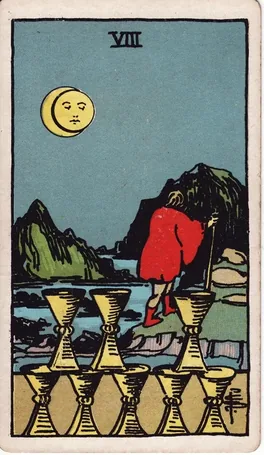
The 1909 Rider-Waite-Smith conveys the same idea in another way. There, the eight cups are in the foreground, five below and three above, with an empty space between them, as if one were missing. The man, also in a red cloak and with red boots, has his back to the viewer and is already climbing over stony ground towards dark mountains, beside a river, staff in hand. In the sky, the moon is a disc with a crescent and a face in profile, its eyes closed. The Sol da Alma painting keeps the red cloak, the staff, the night, the moon and the cups left behind, but shows the man from the front, walking towards the viewer, swaps the mountains for the sea and splits the cups into two groups — a row on the ground and a tower on the rock — instead of the single stack of the original.
In the Marseille Tarot, as in all the numbered Minors of that deck, there is no scene: only eight cups arranged symmetrically, interlaced with stylised branches and flowers. The figure of the traveller turning his back is an invention of the Rider-Waite-Smith, and almost all the meaning given to the card today was born from it.
The symbolism, detail by detail
Everything in this card speaks of one and the same thing: the distance one takes from what one had. Each detail adds a nuance.
- The cups at his back
- In the Sol da Alma, the man walks towards the viewer and the cups are behind him: he is no longer facing what he has left. His face is grave and his gaze is fixed ahead. The decision has been made; what remains is the road.
- The whole cups
- None is broken or spilt. What is being abandoned is not a ruin — it is something that even worked, but that has stopped giving meaning. This is what sets this card apart from the Five of Cups, where there are cups knocked over.
- The cups split into two groups
- In the Sol da Alma, four on the sand and four in a tower on the rock: what was gathered on the ground of life and what was piled up with effort. Neither holds him back.
- The red cloak
- Life, blood, the will that still exists. Whoever leaves does not leave empty: they take with them the warmth the cups no longer gave them.
- The staff
- The support of someone setting out on a long road. It is a considered departure, not a dash.
- The grey hair
- In the Sol da Alma, we see his face: grey hair, white beard. The traveller is not a young man; he is someone with a past. The card often speaks of a departure made with experience, after a long time of trying.
- The moon
- Night, inner time, the intuition that guides when there is no clear light any more. The decision to leave is rarely made in daylight; it ripens in the dark.
- The path of light on the water
- A direction that is not firm like a road, but that can be seen. In the Sol da Alma it lies behind the man, beside the cups: he is no longer walking towards the water, but away from it, onto firm ground.
- The footprints in the sand
- The marks left by the road already travelled. The tide will wash them away: the past does not disappear, but it stops being in charge.
- The cliffs and the sea
- The place the man is leaving: the water, feeling, what was familiar. In the Rider-Waite-Smith the traveller heads for the mountains; here he turns his back on the sea and the cliffs and walks towards a road we cannot yet see.
The history of the Eight of Cups
The suit of Cups is as old as the tarot. The first decks, painted in northern Italy in the fifteenth century — those of Milan, made for the Visconti and the Sforza around 1450, are the best known — already had the four Latin suits: cups, coins, swords and batons. In those decks, and later in the Marseille decks, which settled into their form between the seventeenth and eighteenth centuries, the Eight of Cups was just that: eight cups drawn on the card, with no figure and no story. It was used to play tarocchi, not to tell fortunes.
The sense of ‘departure’ is modern. It came from the Hermetic Order of the Golden Dawn, at the end of the nineteenth century, which gave each numbered Minor a title and a planet in a sign. The Eight of Cups was given Saturn in Pisces and the title ‘Lord of Abandoned Success’: a success that is let go, something achieved that is left behind. Arthur Edward Waite and Pamela Colman Smith, who came from that circle, turned the idea into an image in the 1909 deck — the first widely circulated deck with scenes on all the minor cards. The red-cloaked traveller climbing towards the mountains is their work.
In the Thoth deck, by Aleister Crowley and Frieda Harris, the same card is called ‘Indolence’: a harsher reading, which stresses weariness and stagnation rather than departure. Most modern decks, including the Sol da Alma, have followed the image of the Rider-Waite-Smith and the reading of the quiet departure.
The Eight of Cups upright: the meaning
Upright, the Eight of Cups is the card of leaving behind. It speaks of a moment when a person realises that what they have invested in — a relationship, a job, a place, a way of living — no longer nourishes them, and decides to go. Not out of anger, nor because of a sudden crisis, but out of a kind of lucid weariness: they tried, they gave what they could, and the time has come.
It is a card of searching. The man is not running away from something; he is going in search of something else, even if he does not yet quite know what. It often appears when outer life is in order and yet meaning is missing: work goes well but says nothing, the house is full but empty, the friends are the same but the conversations are no longer enough. The Eight of Cups is the courage to admit this.
It is not an easy card. Leaving is hard, especially when what is left behind has value in other people’s eyes. That is why it is also a card of chosen solitude: the traveller goes alone, at night, with no witnesses. But it is a solitude that opens a way. In the philosophy of the Eight — the number of movement, of the thing that goes forward — this is Water set walking: feeling that no longer stays still.
The Eight of Cups reversed
Reversed, the Eight of Cups does not say the opposite — ‘stay, everything is fine’. It says that the same departure is being held back. The person knows they ought to go, and does not: out of fear, habit, guilt, or not knowing where to go. They stay beside the cups, gazing at the moon, staff in hand. It is the hesitation of someone who has already left on the inside but still lives in the same place.
It can also indicate a return: going back to a relationship, a place or a project that had been left. Sometimes it is a sensible return — one realises one left too soon. Other times it is a relapse into what one had got out of, for lack of an alternative. And there is also the excess: leaving everything, always, without ever staying long enough for anything to bear fruit. In any of these cases, the card calls for an honest question — what is it that is really holding me back, or pushing me?
The Eight of Cups in love
In love, the Eight of Cups often speaks of drifting apart. In a relationship, it may be the moment when one of the two realises they no longer feel the same and begins to withdraw, slowly and without fuss — sometimes without having said anything yet. It can also be a calm separation, with no one to blame: two people who have given what they had and go their separate ways. It does not always speak of the end of the relationship; sometimes it speaks of the end of a phase of it, of a way of being together that has run its course and needs to be left behind.
For someone who is single, the card asks them to let go of the past before looking for someone new: an old love that still takes up space, a hope that no longer makes sense. Reversed, it is clinging to someone who is no longer available, or the back-and-forth of a relationship in which people leave and come back without anything changing.
The Eight of Cups in work and money
In work, it is the classic card of someone leaving a job that works but does not satisfy. It speaks of a change of career, of a project abandoned after a great deal of effort, of a company left behind in search of something more meaningful. In a question about staying or leaving, it leans towards leaving — but asks that the exit be prepared, with a staff and not empty-handed.
With money, it may indicate giving up some security in exchange for freedom or meaning: earning less to live better, letting go of an investment that does not pay off. Reversed, it warns against staying somewhere just for the salary, until the inner cost is greater than the gain, or against leaving without having thought about what comes next.
The Eight of Cups in health and wellbeing
In questions about wellbeing, the Eight of Cups speaks of emotional tiredness and of the need to step away from what wears you down: an environment, a routine, a constant demand. It may suggest a retreat, rest, time alone, a trip for a change of scene. The cards are no substitute for any kind of healthcare: here, as with any card, the reading speaks of attitudes and tendencies, not of diagnoses.
The Eight of Cups in spiritual life
On the inner path, the Eight of Cups is the card of someone who leaves ready-made answers behind to go in search of their own. It may be stepping away from a practice, a group or a belief that no longer speaks to the person; it may be the beginning of a more solitary and more genuine search. The moon over the sea is a reminder that, in this phase, one walks more by intuition than by certainty, and that this is not a flaw of the path: it is its nature.
The Eight of Cups as advice
As advice, the Eight of Cups says: do not stay out of habit. If it no longer nourishes you, you have the right to go — without drama, without blaming anyone, without destroying what remains. It also says: go carefully. Take your staff, choose your moment and, once you have decided, look ahead. And accept that leaving is a loss, even when it is the right decision.
The Eight of Cups in the positions of a spread
- In the past
- A departure that changed everything: a relationship, a home or a job that was left, whose emptiness is still felt — or whose freedom is still a source of gratitude.
- In the present
- The person is moving away from something, or already knows they have to. The moment is one of letting go.
- In the future
- A way out on its way: what still holds you today will stop holding you.
- As an obstacle
- Difficulty letting go, or, on the contrary, the tendency to leave everything before giving it time.
- As the outcome
- The matter is resolved by leaving. It is not the end of the search: it is the beginning of another.
Numerology and correspondences
The Eight is the number of work and movement: the thing that goes forward, the hand that repeats. In Cups — the suit of Water, of feeling and of bonds — that movement is the movement of feeling itself, which stops staying still in the same place and sets out on its way. After the Seven, in which one dreams alone before many cups, the Eight is the real step: to stop choosing between illusions and to leave.
In the Golden Dawn, the card corresponds to Saturn in Pisces. Saturn is the planet of limits, of time and of the end of things; Pisces, the most open and most diffuse of the Water signs, the sign of dissolution and of the search for what lies beyond. Together they describe the scene well: a limit reaching feeling, a structure let go in order to follow something that has no shape yet.
Combinations with other cards
 The Hermit — A withdrawal inwards: time alone, a search for meaning, a voluntary retreat from the noise.
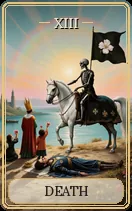 Death — A true and accepted ending: what is left behind does not come back, and the road is clear.
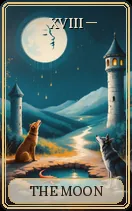 The Moon — Leaving without seeing clearly where to; trust your intuition, but beware of the illusions along the way.
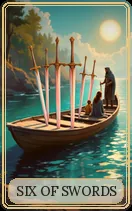 Six of Swords — A move of house, town or country: the crossing to calmer ground.
 Ten of Cups — Leaving a harmony that only existed in the family portrait any more; or leaving home to build one’s own.
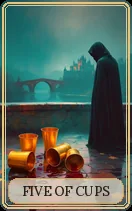 Five of Cups — After mourning, the decision to move on: what was lost stays behind and what remains goes with you.
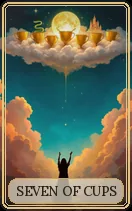 Seven of Cups — Letting go of illusions and endless possibilities to go after one single thing.
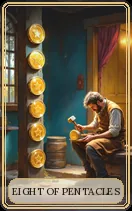 Eight of Pentacles — A change of trade: leaving one line of work to learn another with more meaning.
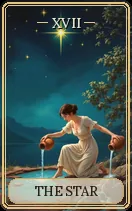 The Star — A departure that brings hope: the new road is brighter than it looks.
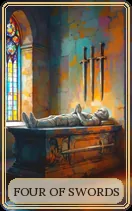 Four of Swords — Pausing before leaving: resting, thinking and preparing the way out.
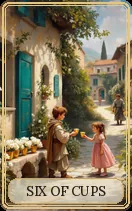 Six of Cups — A return to a person or a place from the past — or the need to leave nostalgia behind.
Frequently asked questions
What does the Eight of Cups mean in tarot?
The quiet departure: leaving behind a situation that no longer nourishes you, even if it is still standing. It is a card of letting go and of searching for meaning.
What does the Eight of Cups mean in love?
Often a drifting apart: someone slowly leaving a relationship, or a calm separation. It can also ask you to let go of an old love before beginning a new one.
Is the Eight of Cups a yes or a no?
It leans towards no regarding what you have now, and towards yes regarding looking for something else. In a question about staying or leaving, it leans towards leaving.
Is the Eight of Cups reversed bad?
It is no worse than the upright card: it is the same departure held back. It speaks of hesitation, of a return or of constant leaving, and asks you to understand what is really holding you back or pushing you.
What is the difference between the Eight of Cups and the Five of Cups?
In the Five there are spilt cups and someone mourning a loss. In the Eight the cups are whole: one does not leave because of a loss, but because what exists has stopped giving meaning.
No sign-up · Reading written on the spot · Free