
Page of Swords: meaning and symbolism of the tarot card
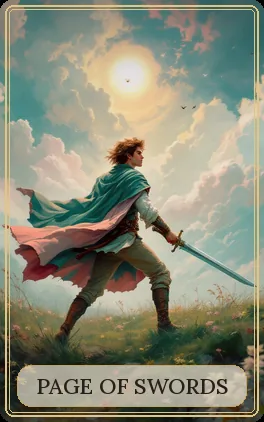
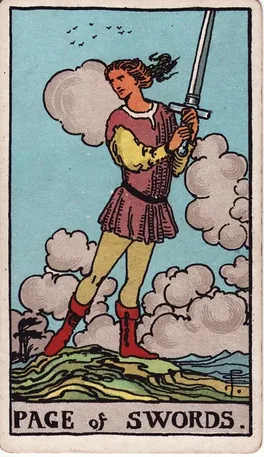
The Page of Swords is the figure of the watchful eye. A young man stands on top of a windswept hill, sword in hand, gazing into the distance, towards the horizon. He does not attack, he does not flee: he keeps watch. He is ready to act, but first he wants to understand what is going on. He is the young mind of the suit of Air — curious, quick, wary, learning to use the blade in his hand.
In a spread, the Page of Swords speaks of observation, of vigilance and of news that calls for care. It may represent a person — someone young, clever, who notices everything — or an attitude the situation calls for: staying alert, getting informed, thinking before reacting. Its risk is that of the suit itself: the sharp mind that, without maturity, becomes suspicious, indiscreet or cutting.
The card at a glance
| Card | Page |
|---|---|
| Suit | Swords |
| Element | Air |
| Astrology | Varies between schools |
| Keywords | observation, vigilance, curiosity, news, a lively mind, frankness, learning |
| Reversed | spying, gossip, careless words, suspicion, a sharp tongue, speaking before thinking |
| Yes or no | Maybe — you need to know more before deciding |
The image on the card
In the Sol da Alma Tarot, a young man with auburn-brown hair tousled by the wind stands in a high meadow of green grass and wild flowers in pink, yellow and white. He wears a white shirt with full sleeves, a dark waistcoat, olive-coloured trousers and tall brown leather boots; he has leather bracers on his forearms and a wide belt. Over his shoulders, a turquoise-green cloak lined with pink is lifted by the wind and billows out behind him. He stands on guard, his weight on one leg and the other forward, and holds a long sword in his right hand, stretched out forwards and downwards, on a diagonal. He looks away to the right, in profile, into the distance. The sky is bright, full of white and pinkish clouds; the sun shines high behind them, and a few birds fly through the air.
In the 1909 Rider-Waite-Smith, the Page also stands on high, undulating ground, his hair in the wind, and holds his sword raised with both hands, pointing at the sky. He wears a short purplish tunic, yellow stockings and red boots. Behind him are restless clouds, a flock of birds and, in the distance, trees bent by the wind. The Sol da Alma follows the same iconography — the young man on high ground, the wind, the clouds, the birds, the sword — but changes his attitude: instead of being raised aloft, the sword is lowered in a guard position, and the young man, in profile, stares into the distance. The billowing cloak and the flowering meadow give the scene a more open and brighter air than the original.
In the Marseille Tarot, the Valet d’Épée is a standing, full-length figure with the sword, with no landscape or sky. The hill, the clouds and the wind are contributions of the Rider-Waite-Smith.
The symbolism, detail by detail
The card speaks of a young mind, alert and still learning. Each detail adds a nuance.
- The gaze into the distance
- Vigilance and curiosity. The Page observes before acting; he wants to know what is coming, what is going on, what others are doing.
- The sword on guard
- The mind ready to defend itself and to cut, but which has not yet attacked. In the Sol da Alma, the blade is low and extended: it is the caution of someone judging the distance.
- The stance
- One foot forward, the weight balanced, the body turned: the Page is on the alert, ready to move in any direction.
- The wind
- The suit’s element, Air, in motion: ideas, news, words travelling back and forth. It tousles his hair and lifts his cloak — the Page stands right in the middle of it.
- The billowing cloak
- Youth and speed, but also instability: the Page’s ideas change with the wind.
- The hilltop
- The vantage point. Whoever stands on high sees further, and the Page has chosen a place from which everything can be watched.
- The clouds
- Thoughts, uncertainties, what is not yet clear. The sky is full of them, but it is bright: clarity is on its way.
- The birds
- Messages, news on the wing, the mind that ranges far. They are also the freedom of thought.
- The flowering meadow
- Youth and freshness. In the Sol da Alma, the ground beneath the Page is still a place of life and beginnings, not a battlefield.
- The leather bracers
- Preparation: the Page knows he may have to fight, and protects himself. He is an apprentice, but he is not naive.
The history of the Page of Swords
The page has been one of the tarot’s court figures since the first decks, painted in northern Italy in the fifteenth century. He was the page boy, the young man in service at court, the lowest rank among the figures of each suit. In the Marseille decks, which took their settled form between the seventeenth and eighteenth centuries, he is called the Valet d’Épée and appears standing, with his sword.
At the end of the nineteenth century, the Hermetic Order of the Golden Dawn reorganised the court cards of the Minors and gave them other names: the Page became a Princess, which was later kept in the Thoth deck by Aleister Crowley and Frieda Harris. Arthur Edward Waite and Pamela Colman Smith, in the 1909 deck, went back to the traditional name and gave the card the scene of the young man on high ground, sword raised and the wind all around, which became the reference image.
In cartomancy, pages have long been associated with messages and with young people. The Page of Swords inherited an ambiguous reputation: he is as much the keen observer as the spy, as much useful news as gossip. The astrological and elemental attributions of the court cards vary between schools, and none of them is universally agreed.
The Page of Swords upright: the meaning
Upright, the Page of Swords is the card of keen observation. It speaks of being alert, of noticing the details, of wanting to understand before acting. In a confusing situation, it says you need to gather information, ask questions, listen more than you speak. The Page does not decide yet: he observes, weighs things up, prepares himself.
It is also the card of news that calls for care. It may announce a message, a new piece of information, an important conversation — not necessarily bad, but one that calls for attention and discernment. Sometimes it is a truth that arrives without beating about the bush and forces you to think.
It also speaks of a lively, curious mind: the wish to learn, to study, to debate, to discover. The Page of Swords is the student, the researcher, the young person who asks the awkward questions. He has frankness, quick thinking and a certain taste for argument.
What he lacks is experience. His sword is sharp, but the hand that holds it does not yet quite know when to cut. The card therefore asks for attention without haste: be vigilant, yes, but without letting vigilance turn into suspicion.
The Page of Swords reversed
Reversed, the Page of Swords does not lose his cleverness: he loses his sense of measure. Vigilance turns sour and becomes spying, curiosity becomes indiscretion, frankness becomes a sharp tongue. It may speak of gossip, of secrets let out, of someone watching with ill intent, or of words spoken before thinking that hurt needlessly.
It can also be suspicion of everything and everyone: seeing threats where there are none, reading ulterior motives into every gesture, living permanently on guard. Or the young mind that scatters itself — many ideas, little action, a lot of talk, little substance. The card asks that the sword be put back on guard, rather than waved about in the wind.
The Page of Swords in love
In love, the Page of Swords speaks of observation and caution. It may point to someone who is still weighing up the relationship, who will not commit without first understanding the other person; or a phase in which you need to talk clearly and call things by their name. For someone who is single, it may announce a meeting with someone intelligent and fun, easy to talk to — but not much given to sentimentality.
Reversed, it warns against jealousy, excessive watching over the other person, the temptation to check their messages, or the acid words that hurt. It can also speak of gossip surrounding the relationship.
The Page of Swords in work and money
In work, it is a favourable card for anyone who studies, researches, analyses, writes or communicates. It often announces a period of learning, a new intellectual challenge, or an important piece of information arriving. It asks for attention to details, to contracts, to office gossip. It may represent a young, perceptive and ambitious colleague.
In money, it asks for vigilance: read the small print, compare, be wary of anything that looks too easy. Reversed, it warns against information leaks, conflicts sparked by rumours, or decisions taken on the basis of incomplete information.
The Page of Swords in health and wellbeing
In questions about wellbeing, the Page of Swords speaks of a very active mind that finds it hard to switch off, and of the need to balance thinking with the body — fresh air, movement, breaks. It may also ask you to pay attention to the signals your body is giving. The cards are no substitute for any kind of health care: the reading speaks of attitude and tendency, not of diagnosis.
The Page of Swords in spiritual life
On the inner path, the Page of Swords is the seeker who asks questions. He accepts nothing on faith: he wants to understand, to compare, to put things to the test. It is a precious quality, as long as it does not turn into sterile scepticism. The card also invites attentiveness — the inner vigilance of someone who observes their own thoughts instead of being swept along by them.
The Page of Swords as a person
When it represents someone, the Page of Swords is traditionally a young person — or young at heart — intelligent, curious, quick to think and to speak. They notice everything, ask a lot of questions, enjoy debating and are rarely fooled. They may be a student, a researcher, a journalist, someone who deals with information. Their faults are suspicion, a tendency towards gossip or cutting criticism, and some difficulty in taking other people’s feelings into account.
The Page of Swords as advice
As advice, the Page of Swords says: observe. Get informed, ask questions, pay attention to the details before deciding. And it also says: keep the sword on guard. Thinking clearly is not the same as distrusting everyone, and speaking frankly is not the same as wounding.
The Page of Swords in the positions of a spread
- In the past
- A piece of news or a discovery that changed the way the situation was seen; or a period of vigilance and suspicion.
- In the present
- It is time to observe and gather information. Or someone is watching — for good or ill — what the person is doing.
- In the future
- A message or a piece of information that will arrive and call for care; an intellectual challenge.
- As an obstacle
- Suspicion, gossip, hasty words, or a lack of information.
- As the outcome
- The matter is cleared up through attention and intelligence; the truth comes to the surface.
The Page and its correspondences
The Page is the one who learns and the one who announces: the youth of the suit, full of eagerness and not yet a master of the craft. In Swords, the suit of Air — thought, the word, decision and conflict — this youth is that of a mind discovering its power to cut and to clarify, and still learning how to use it. That is why the Page of Swords is, of all the pages, the most watchful and the sharpest.
The suit’s element is Air. The elemental and astrological sub-attributions of the court cards vary between schools, and none is universally agreed; what matters is that the Page represents Air at its beginning — the breeze that changes direction, the idea that has not yet settled — before the movement of the Knight, the inwardness of the Queen and the rule of the King.
Combinations with other cards
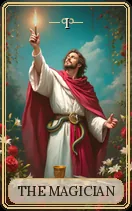 The Magician — An ingenious and skilful mind; learning fast, communicating well.
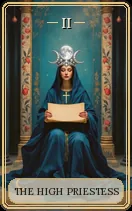 The High Priestess — A secret to uncover; watching in silence in order to understand.
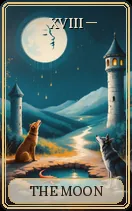 The Moon — Suspicion and misunderstandings; do not believe everything you hear.
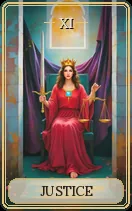 Justice — An investigation, a legal process, a truth coming to light.
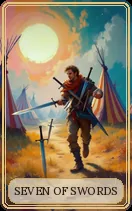 Seven of Swords — Spying or cunning; beware of anyone acting behind your back.
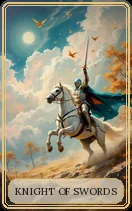 Knight of Swords — From observation to action: the news that sets off a swift movement.
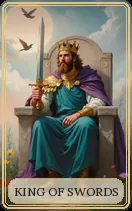 King of Swords — The apprentice and the master: a young person learning from a demanding authority.
 Three of Wands — News from afar; keep an eye out for opportunities on the way.
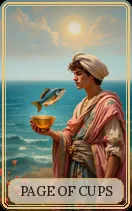 Page of Cups — A message between head and heart; saying clearly what you feel.
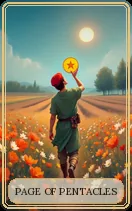 Page of Pentacles — Study and practical application; learning a trade.
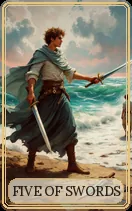 Five of Swords — Words that wound, gossip, conflicts caused by a sharp tongue.
Frequently asked questions
What does the Page of Swords mean in tarot?
Keen observation and a young, sharp mind: vigilance, curiosity, news that calls for care. It asks you to observe and get informed before acting.
What does the Page of Swords mean in love?
Caution and clear conversation: someone still weighing up the relationship, or the need to call things by their name. Reversed, it warns against jealousy, excessive watchfulness and acid words.
Is the Page of Swords a yes or a no?
It leans towards ‘maybe’: the answer depends on information that is still missing. It is a card that asks you to know more before deciding.
Is the Page of Swords reversed a bad sign?
It is not the opposite of the card: it is the same cleverness without measure — gossip, indiscretion, suspicion, hasty words. It asks you to rein in your tongue and your gaze.
Does the Page of Swords represent a person?
It can: traditionally, a young, intelligent and curious person who notices everything. But it can also simply be a piece of news or the watchful attitude the situation calls for.
No sign-up · Reading written on the spot · Free