
Page of Cups: meaning and symbolism of the tarot card
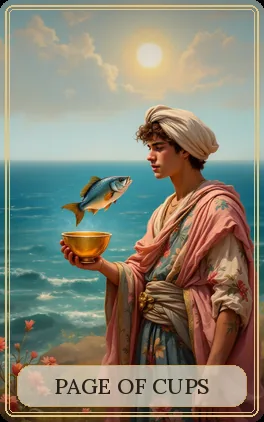
The Page of Cups is the card of messages from the heart. A young man, by the sea, holds a golden cup from which a fish leaps, and he looks at it with surprise and tenderness. No one knows where the fish came from: it simply appeared, the way new emotions, unexpected ideas and messages no one was waiting for appear. It is the card of feeling at its beginning — fragile, spontaneous, full of possibilities.
Like all the Pages, it is a figure of the apprentice and the messenger. It may be news — an invitation, a declaration, a piece of good news in matters of the heart — it may be a young person, or someone young at heart, or it may be a part of the querent themselves: their sensitivity, their imagination, the child who still lets themselves be surprised. What decides it is the question and the cards around it.
The card at a glance
| Card | Page |
|---|---|
| Suit | Cups |
| Element | Water |
| Astrology | Varies between schools |
| Keywords | message from the heart, tender news, invitation, sensitivity, imagination, intuition, emotional beginning |
| Reversed | hurt sensitivity, muddled message, emotional immaturity, fantasy, sulking |
| Yes or no | Yes, gently — an answer that comes through affection |
The image on the card
In the Sol da Alma Tarot, the Page is a boy with dark, curly hair and a cream-coloured turban wound around his head. He wears a pale blue tunic printed with flowers, a cream sash fastened at the waist with a gold clasp, and over it a wide pink shawl falling from his shoulders. He has a gold chain around his neck. He stands in profile, facing the sea, and in his outstretched hand he holds a wide golden cup without a stem, like a bowl; out of it a blue and silver fish leaps, in mid-air, and the young man looks at it with a half-smile. Behind him are the turquoise sea with white-crested waves, a clear sky with clouds, and the sun. In the lower corner, pink flowers grow on a slope.
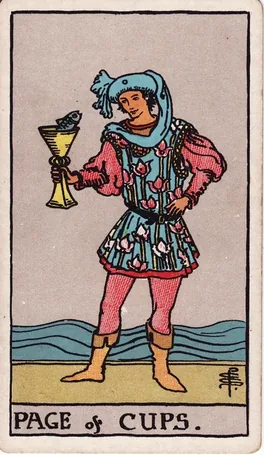
In the 1909 Rider-Waite-Smith, the scene is very close: a page stands by a sea of stylised waves, wearing a blue turban-like hat and a blue tunic printed with lotus flowers, pink hose and boots, and holds a golden chalice from which a fish peeps out and looks at him. The Sol da Alma painting keeps the young man, the turban, the flowered tunic, the sea and the fish in the cup, but has the fish leap out instead of just peeping, swaps the tall-stemmed chalice for a wide bowl, and adds the pink shawl, the sky with the sun, and the flowers. The young man is no longer facing the viewer: he is completely absorbed in what the cup is showing him.
In the Marseille Tarot, the Page of Cups is a standing, full-length figure with the cup in his hand, with no landscape and no fish. The image of the fish rising from the cup is a creation of the Rider-Waite-Smith.
The symbolism, detail by detail
The card speaks of a feeling that is being born and does not yet know what it is. Each detail adds a nuance.
- The fish leaping from the cup
- The emotion, idea or intuition that arises without warning. The fish lives in water, and water is the element of Cups: it is the inner world suddenly showing itself in the light.
- The gaze at the fish
- The surprise and tenderness of someone receiving. The Page does not try to grab the fish; he watches it. This is the openness the card asks for.
- The wide, stemless cup
- In the Sol da Alma, it is a bowl, open and simple. The Page does not yet have the solemn chalice of the older figures: he has a vessel for receiving.
- The sea
- The source the fish came from: emotions, the unconscious, the imagination. The Page stands at its edge, without going in yet.
- The turban
- It comes from the Rider-Waite-Smith and gives the figure the air of a traveller or a dreamer. It gathers the head in, like someone setting their thoughts aside to let the heart speak.
- The flowered tunic
- Sensitivity, beauty, a taste for what is delicate. In the Rider-Waite-Smith, the flowers are lotuses, a flower linked to water.
- The pink shawl
- Tenderness, affection, the youth of feeling. It is a softer colour than the red of passion.
- The sun among the clouds
- Fair weather, though not without clouds. What the Page announces is, as a rule, bright.
- The flowers on the slope
- Things beginning to open: affections, projects, talents still to be developed.
The history of the Page of Cups
Since the first tarot decks, painted in northern Italy in the fifteenth century, each suit has had four court figures — page, knight, queen and king — one more than in today’s ordinary playing cards, which have no knight. The page was the ‘fante’, the servant or squire, the youngest and lowest-ranking figure. In the Marseille decks, which settled into their form between the seventeenth and eighteenth centuries, he is called Valet de Coupe and appears standing, cup in hand.
At the end of the nineteenth century, the Hermetic Order of the Golden Dawn reorganised the court figures and gave them other names: the page became the Princess. The Thoth deck, by Aleister Crowley and Frieda Harris, kept this name. Arthur Edward Waite and Pamela Colman Smith, in the 1909 deck, went back to a traditional name — Page — and gave it the scene of the young man by the sea with the fish in the cup, which became the standard image.
In Portuguese, the card is usually called ‘Valete de Copas’; it is also known as ‘Pajem’. The astrological and elemental attributions of the court cards vary between schools, and none is universally agreed. The Sol da Alma follows the iconography of the Rider-Waite-Smith, with its own painting.
The Page of Cups upright: the meaning
Upright, the Page of Cups announces a message from the heart: tender news, an invitation, a declaration, a call or a message from someone you care about. It is often a card of good news in matters of the heart, small but sincere — a message that makes you smile, an affectionate gesture, the first sign of someone’s interest.
It also speaks of sensitivity and imagination. It is the card of someone who is beginning to feel something new, to dream, to create; of someone discovering an artistic talent, a vocation, an intuition. The fish leaping from the cup may be a creative idea that arises from who knows where, and that deserves attention.
Like all the Pages, it is a beginning, not a finished work. The feeling it announces is young, delicate, and does not yet quite know what it is. The card asks you to receive it with openness — without clutching at it too hard, and without dismissing it for being small.
The Page of Cups reversed
Reversed, the Page of Cups does not lose its sensitivity: it is the same sensitivity, hurt, led astray or excessive. The person takes everything to heart, is hurt by little, sulks. Or imagination takes the place of reality, and one dreams of a relationship, a project, a person, without taking a single concrete step.
It can also indicate a garbled message: something misunderstood, news that arrives late or distorted, a sign read where there is none. Or an emotional immaturity — in the querent or in someone else — that makes relationships unstable. The card asks you to check before drawing conclusions, and to take a real step towards what so far exists only in the dream.
The Page of Cups in love
In love, the Page of Cups is a very sweet card. It announces a beginning — an interest, a message, an invitation to go out, a shy declaration. For someone who is single, it says that someone is drawing near, or that the heart is ready to feel again. In a relationship, it speaks of tenderness, of affectionate gestures, of rediscovering the lightness of the early days.
Its fragile side is immaturity: a love that is more fantasy than reality, a platonic crush, a very sensitive person who is easily hurt. Reversed, it warns against idealising someone you barely know, or against reading signs of love into gestures that do not carry them.
The Page of Cups in work and money
In work, the Page of Cups favours what is creative and what is human: the arts, writing, music, design, care work, teaching, anything that deals with emotions and imagination. It may announce good news, a pleasant offer, the start of a course of training, or a new idea worth developing. It asks you to listen to your intuition.
With money, it is a modest card: small sums coming in, a gift, a pleasant piece of news. Reversed, it warns against decisions taken on emotional impulse, or against projects that stay at the dreaming stage and never bring anything in.
The Page of Cups in health and wellbeing
In questions about wellbeing, the Page of Cups speaks of the link between what you feel and your general wellbeing, and suggests activities that nourish sensitivity: art, music, being near the sea, contact with nature. Reversed, it is a reminder that emotions kept inside also weigh on you. The cards are no substitute for any kind of healthcare: the reading speaks of attitudes and tendencies, not of diagnoses.
The Page of Cups in spiritual life
On the inner path, the Page of Cups is the awakening of intuition. It is the card of someone who begins to pay attention to dreams, to coincidences, to the images that arise in meditation — to the fish leaping from the cup. It asks for curiosity and humility: what appears is still small, and needs to be welcomed before it is interpreted.
The Page of Cups as a person
When it represents someone, the Page of Cups is traditionally a young person, or someone young at heart: sensitive, affectionate, imaginative, a little dreamy, with an artistic side. This is someone who feels a great deal and says what they feel, who is easily moved, who likes to give and receive affection. It may also be a messenger — someone bringing word from another person. Their flaw is fragility: they are easily hurt and sometimes escape into fantasy when reality is hard.
The Page of Cups as advice
As advice, the Page of Cups says: let yourself be surprised. Welcome what your heart shows you, send the tender message, say what you feel, make room for imagination. And it also says: do not mistake the fish for the sea. A new emotion deserves attention, but it is not yet a certainty — give it time to show what it is.
The Page of Cups in the positions of a spread
- In the past
- An emotional beginning, a message or a feeling that set the situation in motion.
- In the present
- Tender news, a new feeling, or a phase of great sensitivity.
- In the future
- A message from the heart on its way: an invitation, a declaration, someone getting in touch.
- As an obstacle
- Touchiness, fantasy or emotional immaturity.
- As the outcome
- A delicate and promising beginning: the matter opens up through affection.
The Page and its correspondences
The Page is the one who learns and the one who announces: the young age of the suit, full of eagerness and not yet skilled in any trade. In Cups — the suit of Water, of feeling and of bonds — it is feeling at its beginning: the first emotion, the first intuition, the first affectionate gesture. It has everything still to learn, and that is why it lets itself be surprised.
The element of the suit is Water. Some schools also give the court figures an elemental or astrological sub-attribution, but these attributions vary from system to system; what matters is that the Page represents Water in its youngest and most receptive state, before it is set in motion by the Knight.
Combinations with other cards
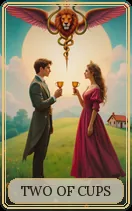 Two of Cups — A declaration or a first date: the beginning of a relationship.
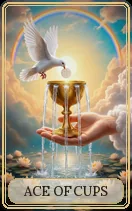 Ace of Cups — A new and very sincere feeling; an invitation from the heart worth accepting.
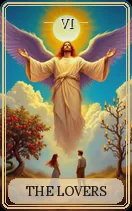 The Lovers — A message of love that calls for a choice.
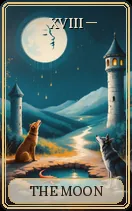 The Moon — Fantasy, illusion or misunderstanding: check before you believe.
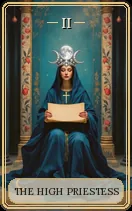 The High Priestess — Strong intuition, dreams that are saying something, a knowing that comes from within.
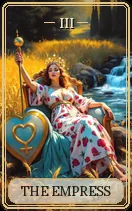 The Empress — Fertile creativity; an artistic project being born.
 Page of Wands — Exciting news, an invitation to something new.
 Page of Swords — A message that brings misunderstandings, or a sensitivity wounded by words.
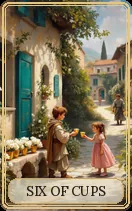 Six of Cups — A sweet memory, someone from the past getting in touch, the tenderness of childhood.
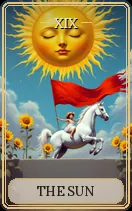 The Sun — Happy news; simple, sincere joy.
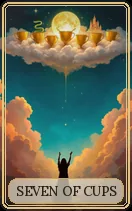 Seven of Cups — Daydreaming: many possibilities imagined and few made real.
Frequently asked questions
What does the Page of Cups mean in tarot?
A message from the heart: tender news, an invitation, a new emotion. It can also represent a young, sensitive person, or the querent’s own sensitivity.
What does the Page of Cups mean in love?
A sweet beginning: an interest, a message, a declaration. For someone who is single, someone drawing near; in a relationship, tenderness and lightness.
Is the Page of Cups a yes or a no?
It leans towards yes, especially in matters of the heart. It is a gentle yes, which still needs time to be confirmed.
Is the Page of Cups reversed bad?
No. It is the same sensitivity, hurt or led astray: touchiness, fantasy, a misunderstood message. It asks you to check before drawing conclusions.
What does the fish in the Page of Cups’ cup represent?
The emotion, idea or intuition that rises from the inner world without warning. The Page watches it with openness, which is the attitude the card asks for.
No sign-up · Reading written on the spot · Free