
Ten of Cups: meaning and symbolism of the tarot card
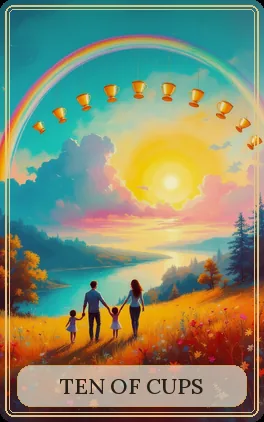
The Ten of Cups is the fullest card in the suit of feeling. A family walks hand in hand across a flowering meadow, towards a sunlit river, and above them a rainbow holds ten golden cups. There is nothing to conquer and nothing to wait for: it is the image of happiness lived with others, at home and in everyday life.
Where the Nine of Cups speaks of one person’s wish fulfilled, the Ten speaks of what is fulfilled together. It is the card of home, of belonging, of peace among those who live together. In a spread about love or family, it is one of the best cards that can come up. But it is also a card that shows an ideal — and, like any ideal, it can become a pretty picture hiding a worn-out bond.
The card at a glance
| Card | Ten |
|---|---|
| Suit | Cups |
| Element | Water |
| Astrology | Mars in Pisces (Golden Dawn) |
| Keywords | harmony, family, home, shared happiness, peace, belonging, emotional fulfilment |
| Reversed | apparent harmony, fraying bond, tensions at home, an ideal of family that weighs heavy |
| Yes or no | Yes — especially in matters of love, home and family |
The image on the card
In the Sol da Alma Tarot, the family — a man, a woman and two little girls in pale dresses — has its back to the viewer, in a line holding hands, walking across a meadow of golden grass dotted with red, orange and pink flowers. Ahead of them opens a valley with a wide river, trees in autumn foliage on the left and dark pines on the right. The sun, large and white, sits low on the horizon and lights up the clouds in pink and yellow. Above it all, a rainbow crosses the sky from side to side, and along it hang the ten golden cups, held by fine threads.
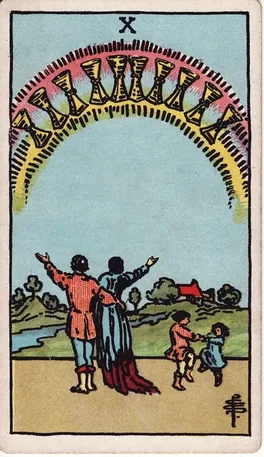
In the 1909 Rider-Waite-Smith, the composition is different, though with the same elements. A man and a woman, their arms around each other’s waists, each raise one arm towards the rainbow bearing the ten cups; beside them, two children dance hand in hand. In the background there is a river, trees and a red-roofed house on a hill. The Sol da Alma keeps the couple, the two children, the river and the rainbow with the cups, but has the family walking together instead of standing still to contemplate, and swaps the house for an open landscape at sunset. There is no house drawn: home is the group itself.
In the Marseille Tarot, the Ten of Cups has no figures: it shows ten cups set out ornamentally among stylised branches. The scene of the family beneath the rainbow is a creation of the Rider-Waite-Smith.
The symbolism, detail by detail
Everything in the card speaks of what is shared. Each detail adds a nuance to the idea of harmony.
- The rainbow
- The covenant, peace after the storm, the promise kept. It is an ancient image of reconciliation between heaven and earth — and here it covers the whole family.
- The ten suspended cups
- Everything the suit could give has been given, and it hangs above everyone, not in the hands of just one person. The happiness of this card cannot be possessed: it is a shared roof.
- The threads holding the cups
- In the Sol da Alma, the cups hang from fine threads. The harmony exists, but it is delicate: it has to be held, not taken for granted.
- The joined hands
- The bond. No one walks alone, and no one goes ahead of the others. It is the simplest image of belonging.
- The turned backs
- The family looks in the same direction. They are not posing for the viewer: they are living their life, facing what lies ahead.
- The two children
- Continuity, the future, what is born of the bond. They do not necessarily speak of children: they may be projects, affections, anything created together.
- The river
- The Water of the suit, feeling that flows and nourishes the land. A fertile valley is the right place for a family.
- The low sun
- The end of the day, the hour of coming home. It is quiet happiness, not the exaltation of midday.
- The flowering meadow
- Simple abundance: flowers of many colours, ripe grass. No luxury — just a land that gives.
The history of the Ten of Cups
In the fifteenth-century Italian decks — the cradle of the tarot, in the courts of northern Italy — and in the Marseille decks, which settled into their form between the seventeenth and eighteenth centuries, the Ten of Cups was a pip card: ten cups in an ornamental composition, used to play tarocchi. The meaning we give it today is much more recent.
It was the Hermetic Order of the Golden Dawn, at the end of the nineteenth century, that assigned each numbered Minor a planet in a sign and a title. The Ten of Cups was given Mars in Pisces and the title ‘Lord of Perfected Success’. Arthur Edward Waite and Pamela Colman Smith, in the 1909 deck, gave it the image of the family beneath the rainbow, which fixed the domestic and emotional reading of the card.
In the Thoth deck, by Aleister Crowley and Frieda Harris, the same card is called ‘Satiety’, and it stresses the other side of the Ten: that of someone who has everything and, for that very reason, begins to feel the end of the cycle. Two readings that complete each other — fullness and its weight. The Sol da Alma follows the image of the Rider-Waite-Smith, and its reading of harmony.
The Ten of Cups upright: the meaning
Upright, the Ten of Cups is the card of shared happiness. It speaks of a home at peace, of a united family, of a relationship that has become a home. It is emotional fulfilment in the fullest sense: not only loving someone, but building with that person — or with a group of people — a life in which everyone feels at home.
It can announce concrete events: a move to a new home, a family gathering, a reconciliation, a celebration, the strengthening of a relationship. It can also describe a state: that of someone who feels at peace with their loved ones and with the life they have. In many readings it appears as an answer to a worry — it says that what is feared will not happen, that the bond will hold.
The family of the Ten of Cups does not have to be the traditional one. It may be a couple without children, a group of friends, a community, the family one has chosen. What matters is the bond and the peace among those who share it.
The Ten of Cups reversed
Reversed, the Ten of Cups does not say that the family has fallen apart. It says that the harmony is being lived on the outside, not on the inside: the picture looks fine, but the bond is fraying. It may speak of tensions at home that no one names, of a relationship that keeps up appearances, of a family that gets together for celebrations but no longer really talks.
It may also be the weight of the ideal itself: the expectation of a perfect family that prevents one from accepting the real one, or the pressure to live up to an image of happiness that is not the person’s own. Sometimes it simply indicates a delay — the home, the union, the reunion will come, but they need more time or more work. The card asks you to look after the bond, not the picture.
The Ten of Cups in love
In love, the Ten of Cups is one of the best cards in the deck. It speaks of a stable, happy relationship with a future: living together, marrying, starting a family, or simply reaching the point where the other person is home. For someone who is single, it may announce a meeting with someone with whom they can build something, not merely live a passion.
In a relationship going through difficulties, it can indicate reconciliation and peace. Reversed, it warns against a relationship kept up for show, against problems hidden so as not to spoil the image, or against excessive idealisation of the partner or of life as a couple.
The Ten of Cups in work and money
In work, it speaks of a good atmosphere: a close-knit team, colleagues who get on, a company where the person feels part of something. It favours family businesses, teamwork and professions linked to care, the home and people. It can also indicate that a balance has been found between work and personal life.
With money, it indicates stability for the family, shared assets, a home being bought or improved. It is not a card of wealth — that is more the Ten of Pentacles — but of quiet sufficiency. Reversed, it may speak of disagreements over money within the family.
The Ten of Cups in health and wellbeing
In questions about wellbeing, the Ten of Cups speaks of the support of others, of peace at home and of the emotional balance that help one get through any phase. It suggests the good that comes from being with the people you love. The cards are no substitute for any kind of healthcare: the reading speaks of attitudes and tendencies, not of diagnoses.
The Ten of Cups in spiritual life
On the inner path, the Ten of Cups is a reminder that spiritual life is also lived in community and at home. It is the card of harmony between the person and those around them, of gratitude for one’s bonds, of the peace felt when one stops fighting for love and starts living it. The rainbow over the family is an image of blessing: heaven is not far away, it is right above everyday life.
The Ten of Cups as advice
As advice, the Ten of Cups says: look after your own. Give time to your family, your relationship, the friends who are home to you. Value what you have in common with others more than what you have on your own. And it also says: do not trade the bond for the picture — true harmony can survive a difficult conversation; the kind kept up for show cannot.
The Ten of Cups in the positions of a spread
- In the past
- A solid emotional foundation: a childhood, a home or a relationship that gave the person security.
- In the present
- A moment of peace and togetherness; or the central question is home and family.
- In the future
- Harmony on its way: a reconciliation, a home, a relationship that grows stronger.
- As an obstacle
- Idealising the family or the relationship, or the fear of spoiling the harmony that stops you saying what needs to be said.
- As the outcome
- A happy, shared ending. The matter is resolved in peace, and together with others.
Numerology and correspondences
The Ten is the end of the cycle: everything the suit could give has been given, with the abundance and the weight this brings. In Cups, the suit of Water and of bonds, it is the point at which feeling is fulfilled in its entirety — not in one person alone, as in the Nine, but in the group. It is fullness; and, being fullness, it is also an end, after which the cycle begins again with an Ace.
In the Golden Dawn, the card corresponds to Mars in Pisces. It is a curious combination for the most peaceful card in the suit: Mars, the planet of action and effort, in a Water sign. It can be read as energy put at the service of the affections — the work of sustaining a home and a bond, which do not hold themselves up. The title ‘Lord of Perfected Success’ stresses achievement; Crowley’s name, ‘Satiety’, is a reminder that fullness can also be tiring.
Combinations with other cards
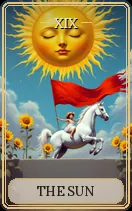 The Sun — Joy in the family, children, a bright and shared happiness.
 The Lovers — A union chosen by the heart, which becomes a home.
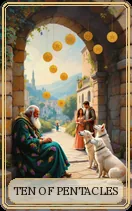 Ten of Pentacles — A prosperous, stable family; an inheritance, a family home, security for several generations.
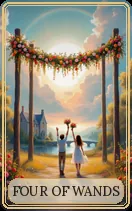 Four of Wands — A celebration at home, a wedding, a move to a new home.
 Two of Cups — A relationship that is beginning and has everything it needs to become a family.
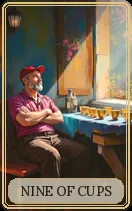 Nine of Cups — The personal wish comes true and is shared: complete happiness.
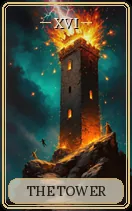 The Tower — A sudden upheaval in the harmony of the home, which forces a rebuilding on truer foundations.
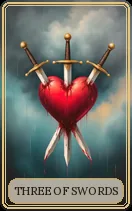 Three of Swords — A hurt within the family or the relationship, behind an appearance of peace.
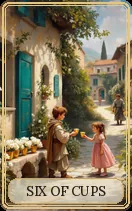 Six of Cups — Childhood memories, family reunions, coming home.
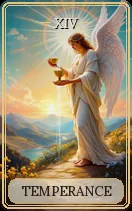 Temperance — Harmony built with patience and balance among everyone.
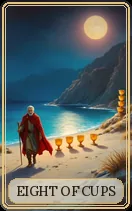 Eight of Cups — Leaving home to build one’s own, or leaving a harmony that was only for show.
Frequently asked questions
What does the Ten of Cups mean in tarot?
Harmony at home: a united family, a happy relationship, peace among those who live together. It is the fullest card in the suit of Cups.
What does the Ten of Cups mean in love?
A stable relationship with a future — living together, marrying, starting a family, or feeling that the other person is home. For someone who is single, a meeting with someone to build a life with.
Is the Ten of Cups a yes or a no?
Yes, especially in questions about love, home and family. It is one of the most positive cards in the deck.
Is the Ten of Cups reversed bad?
It does not indicate a break-up: it indicates a harmony more apparent than real, unspoken tensions, or an ideal of family that weighs heavy. It asks you to look after the real bond.
What is the difference between the Nine and the Ten of Cups?
The Nine is personal satisfaction — one person’s wish fulfilled. The Ten is shared happiness, lived as a family or as a couple.
Does the Ten of Cups speak of children?
It may, but not necessarily. The children on the card represent everything born of a bond — projects, affections, continuity. The card is not a prediction of pregnancy.
No sign-up · Reading written on the spot · Free