Seven of Cups: meaning and symbolism of the tarot card
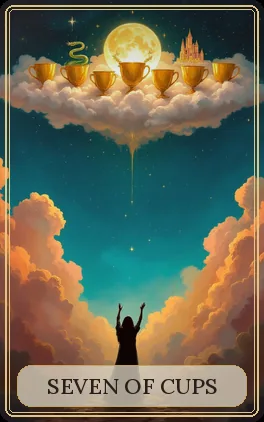
The Seven of Cups is the card of mirages. Seven golden cups float on a row of clouds in the night sky, and out of some of them come marvellous things — a serpent, sprigs of laurel, a castle. Down below, a figure with raised arms looks up at them. They all seem within arm’s reach, and none of them is.
In a spread, the Seven of Cups speaks of imagination, of desires and of choices: many possibilities at once, all of them lovely, and the difficulty of knowing which ones are real. It is the card of daydreams, of plans that have not yet got off the page, of seductive illusions. It does not say dreaming is bad — it says you have to choose, and that in order to choose you have to tell desire apart from reality.
The card at a glance
| Card | Seven |
|---|---|
| Suit | Cups |
| Element | Water |
| Astrology | Venus in Scorpio (Golden Dawn) |
| Keywords | mirages, imagination, choices, fantasy, dreams, scattered energy, illusion, desire |
| Reversed | clarity, mirage dispelled, a choice made, or an escape into dreams that gets worse |
| Yes or no | ‘Not yet’: first you need to see clearly what you want |
The image on the card
In the Sol da Alma Tarot, the sky is a deep blue-green, sprinkled with stars. High up, on a bank of pale clouds, seven golden cups stand in a row, all with handles. Behind the middle cup shines a large golden full moon. From the second cup from the left rises a coiled green serpent; from the central cup come two small golden sprigs of laurel; and from the sixth rises a pink castle with pointed towers, resting on a golden glow. The other four cups show nothing. From the cloud falls a thread of golden light, like a drop trickling downwards. At the bottom of the card, among large orange and pink clouds, a long-haired figure, seen from behind and in silhouette, raises both arms towards the cups.
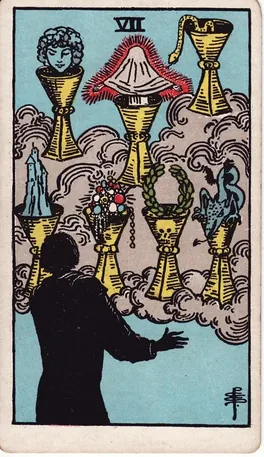
In the 1909 Rider-Waite-Smith, the idea is the same, and it was the starting point for the Sol da Alma painting: a black figure, seen from behind, stretches out a hand before seven cups floating on grey clouds, and from each cup comes a different vision — a head, a veiled, radiant figure, a serpent, a castle, a heap of jewels, a laurel wreath and a dragon. In the 1909 deck, the seven cups are in two rows and each holds something; in the Sol da Alma they are in a single row, only three show a vision, and the scene takes place at night, with the moon at the centre. The figure, who in the Rider-Waite-Smith seems to draw back or hesitate with one hand outstretched, in the Sol da Alma raises both arms like someone who longs or pleads.
In the Marseille Tarot, the numbered cards have no scene: the Seven of Cups shows seven cups arranged among leafy ornaments. The visions in the clouds are a creation of the Rider-Waite-Smith.
The symbolism, detail by detail
Everything on this card is in the sky, and almost nothing is on the ground. That is its lesson: what is desired has nowhere yet to settle.
- The seven cups
- Possibilities, desires, imagined paths. There are many of them, and they all look equally golden — that is what makes the choice difficult.
- The clouds
- Imagination, dreams, what is not yet real. The cups are not on a table: they are resting on nothing.
- The serpent
- Temptation, desire, and also hidden wisdom. It may be the choice that seduces and deceives, or the one that forces you to grow.
- The sprigs of laurel
- Victory, glory, recognition. In the Rider-Waite-Smith, the laurel wreath appears on a cup marked with a skull — success that may come at a high price.
- The castle
- Security, home, wealth, the dream of getting somewhere. It is the castle in the air of the popular saying: beautiful and without foundations.
- The empty cups
- Unique to the Sol da Alma painting: four of the seven cups show nothing. Many of the options that shine have no content — only the golden shape of desire.
- The full moon
- Night, intuition, and also illusion. By moonlight, everything looks lovelier and less sharp than it really is.
- The figure with raised arms
- Someone who desires and has not yet chosen. They look up at what they cannot reach, and they stand among clouds: not even their feet can be seen planted on the ground.
The history of the Seven of Cups
The tarot was born in northern Italy in the fifteenth century as a card game, with the four Latin suits — cups, swords, batons and coins. In the oldest decks, such as those painted for the Visconti and Sforza in Milan around 1450, and in the Marseille decks, which settled into their form between the seventeenth and eighteenth centuries, the numbered cards showed only the suit symbols. The Seven of Cups was an arrangement of seven cups, with no visions and no clouds.
The scene was born with the Rider-Waite-Smith, drawn by Pamela Colman Smith under the direction of Arthur Edward Waite and published in 1909 — the first widely circulated deck with figures on all the Minors. Waite calls the cups strange chalices of vision, and gives the card the meanings of imagination, sentiment and reflection — things seen in the glass of contemplation — warning that nothing in them is permanent or substantial.
The Hermetic Order of the Golden Dawn, to which Waite belonged, had given it at the end of the nineteenth century Venus in Scorpio and the title ‘Lord of Illusionary Success’: a success that seems to have been achieved and then dissolves, or that is not what it seemed. The visions in the cups translate that idea into images, and this is the scene most modern decks follow, the Sol da Alma included.
The Seven of Cups upright: the meaning
Upright, the Seven of Cups is the card of many options and the confusion they bring. The person has several paths before them, several desires, several people or several projects, and does not know which to choose — or wants them all at once. The card says that not everything that shines has anything inside: some of the cups are empty.
It is also the card of imagination. On the good side, it speaks of creativity, of dreams that inspire, of visions that open up horizons — everything that begins by being imagined before it exists. On the more difficult side, it speaks of fantasy, of illusion, of promises that will not be kept, of magical thinking, of putting reality off while waiting for a solution to fall from the sky.
Seven is the number of what one does alone, without support or rule any more, at the doer’s own risk. In the Seven of Cups, that risk is losing touch with the ground. The card does not ask you to stop dreaming: it asks you to choose one dream, and to work to make it real.
The Seven of Cups reversed
Reversed, the Seven of Cups does not become its own opposite: it is the same choice becoming clearer. In most readings, it is the mirage dispelled — the person realises what was illusion, finally sees which of the cups had something in it, decides and focuses. It can be a useful disenchantment: a fantasy is lost, a goal is gained.
It can also speak of the same confusion turned inwards and made worse: escaping into dreams so as not to face reality, indecision that becomes chronic, difficulty in telling desire apart from what is possible. The neighbouring cards tell you whether the mist is lifting or thickening.
The Seven of Cups in love
In love, the Seven of Cups speaks of idealisation: imagining someone as you would like them to be, not as they are; living a relationship more in your head than in reality; dreaming of a perfect love that no real person can match. It can also indicate several people in the picture, or indecision between two or more relationships.
For someone who is single, it warns against appearances and easy promises — not every suitor is what they seem. Reversed, it is clarity arriving: you understand what you feel and what you want, and stop waiting for what is not going to happen.
The Seven of Cups in work and money
In work, the Seven of Cups describes a phase of many ideas and few decisions: several projects half finished, different offers, the temptation to change field without a plan. It favours the creative professions — the arts, design, writing, advertising — but asks you to move from the idea to putting it into practice.
With money, it is a clear warning against promises of easy profit, schemes that look too good to be true and purchases made out of desire. Before signing or investing, it is wise to see what is really inside the cup. Reversed, it indicates a sensible decision: the realistic path is chosen and the rest is let go.
The Seven of Cups in health and wellbeing
In questions about wellbeing, the Seven of Cups speaks of scattered energy, of racing thoughts, of difficulty concentrating, and of the need to get your feet back on the ground — simple routines, rest, concrete things. It also asks you to be wary of miracle cures. The cards are no substitute for any kind of healthcare; the reading speaks of attitudes and tendencies, not of diagnoses.
The Seven of Cups in spiritual life
On the inner path, the Seven of Cups is the card of visions and imagination — which can just as easily open the door to a deeper understanding as trap a person in a world of fantasies. Many traditions warn against the fascination of extraordinary experiences: what matters is not seeing marvellous things, but what you do with what you see. The card asks for discernment.
The Seven of Cups as advice
As advice, the Seven of Cups says: choose. Look at the options one by one and ask what each of them really holds. Keep your feet on the ground, do the sums, ask the opinion of someone who sees things from outside. Hold on to the dream that is worth it — and let the others go, so that you can give the chosen one the attention it deserves.
The Seven of Cups in the positions of a spread
- In the past
- An illusion that fell apart, or a choice put off that left the matter unresolved.
- In the present
- Many possibilities, little clarity; a moment of dreaming or indecision.
- In the future
- Several options will appear; it is wise to examine them carefully before choosing.
- As an obstacle
- Fantasy, indecision, scattered energy, or an illusion that stops you seeing reality.
- As the outcome
- The matter stays open until a choice is made; or a success that is less than it seemed.
Numerology and correspondences
The Seven is what one does alone: without support or rule any more, at the doer’s own risk. In the suit of Cups — the suit of Water, of feeling and of memory — that solitary path runs through imagination and desire. After the quiet consolation of the Six, the person looks ahead again, but what they see are still only images: it is up to them to decide which deserve to take shape.
In the Golden Dawn tradition, the Seven of Cups corresponds to Venus in Scorpio and bears the title ‘Lord of Illusionary Success’. Venus is the planet of desire and beauty; Scorpio, a Water sign, is the sign of intense passions and of what is hidden. Together they give the card its fascination and its deception: strong desire that makes everything it touches more beautiful.
Combinations with other cards
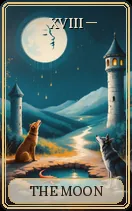 The Moon — Illusion reinforced; confusion, deceptions, things that are not what they seem.
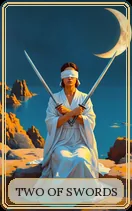 Two of Swords — Complete indecision; the choice put off for fear of getting it wrong.
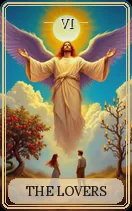 The Lovers — A difficult romantic choice, between two or more people or paths.
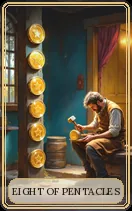 Eight of Pentacles — Moving from dreaming to working: an idea that takes shape through effort.
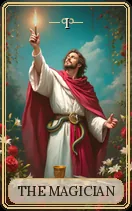 The Magician — A creative idea that has what it takes to become reality.
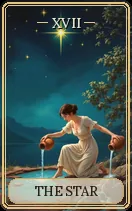 The Star — An inspiring dream that deserves to be followed.
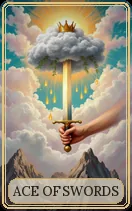 Ace of Swords — Sudden clarity: the illusion cut through, the decision made.
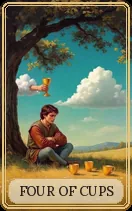 Four of Cups — Dissatisfaction with real life and refuge in fantasy.
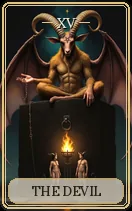 The Devil — Temptations, desires that trap you, misleading promises.
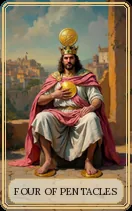 Four of Pentacles — Choosing security over fantasy; holding on to what you already have.
Frequently asked questions
What does the Seven of Cups mean in love?
Idealisation or indecision: imagining someone as you would like them to be, living the relationship more in your head than in reality, or hesitating between several people. Reversed, it is clarity arriving.
Is the Seven of Cups a yes or a no?
It leans towards ‘not yet’: first you need to see clearly what you want and what is possible. Reversed, the answer begins to become clear.
Is the Seven of Cups reversed good?
Often it is: it speaks of the mirage dispelled, of a decision made, of a return to reality. Sometimes, however, it describes an escape into dreams that is getting worse.
What do the cups in the Seven of Cups represent?
Possibilities and desires: the serpent (temptation), the laurel (glory), the castle (security or wealth) and, in the Sol da Alma painting, empty cups that are a reminder that not everything that shines has anything inside.
Is the Seven of Cups a card of deception?
It can be, especially next to The Moon or the Seven of Swords. But more often it speaks of self-deception — of one’s own imagination — than of someone deceiving on purpose.
No sign-up · Reading written on the spot · Free