
The High Priestess: meaning and symbolism of the tarot card
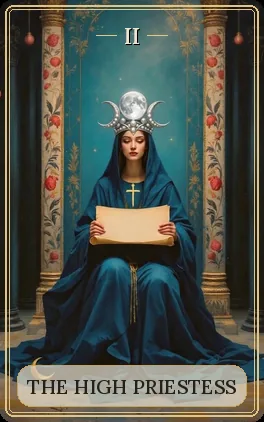
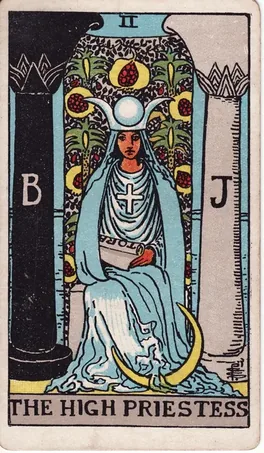
The High Priestess is the second card of the Major Arcana and the first female figure in the sequence. A woman sits, perfectly still, with a book or an open scroll in her hands and a veil behind her. She does not speak and she does not move; she keeps. Where The Magician acts and shows himself, she gathers in and waits. The two cards form a pair: the will that does, and the knowledge that knows when not to.
In a spread, The High Priestess speaks of intuition, study, secrecy and patience. She says there are things not yet known, or known without being explicable, and that the moment calls for attention rather than haste. It is not a card of refusal or coldness: it is a fertile withdrawal, the time in which things ripen away from prying eyes. Whoever draws it usually knows the answer already — they just have not heard it clearly yet.
The card at a glance
| Number | II |
|---|---|
| Arcana | Major Arcana |
| Historical names | La Papessa (Italy); La Papesse (Marseille); The High Priestess (Rider-Waite-Smith) |
| Element | Water (through its link to the Moon, in the common reading) |
| Astrology | Moon (Golden Dawn) |
| Hebrew letter | Gimel (ג), according to the Golden Dawn |
| Keywords | veiled knowledge, intuition, fertile silence, study, patience, discretion, mystery |
| Reversed | barren secrecy, detachment, knowledge held back, mistrust, coldness, intuition ignored |
| Yes or no | ‘Not yet’ — the answer is still ripening, or something remains to be known |
The image on the card
In the Sol da Alma Tarot, The High Priestess is a young woman with lowered, almost closed eyes, wrapped in a great dark-blue hooded cloak that spreads across the floor around her. On her head is a silver crown set with pearls: a full moon in the centre, between two crescents facing outwards. On her breast, a golden cross. She holds in both hands an open scroll of pale parchment on which nothing can be read. She sits between two tall pillars, both pale, painted with foliage and red flowers or fruit, and topped with golden capitals. Behind her is a blue-green wall decorated with golden tracery and a small star; at the sides hang dark curtains, and above, two red lanterns. On the floor, beside her cloak, a small golden crescent moon gleams.
The Rider-Waite-Smith of 1909 has the same structure, and it is the starting point for the Sol da Alma painting: the woman seated between two pillars, with the blue cloak, the crown with the full moon between two crescents, the cross on her breast, the scroll in her hands and the crescent at her feet. But there are important differences. In the RWS one pillar is black and the other white, marked with the letters B and J; behind her a veil is stretched between the pillars, decorated with pomegranates and palm leaves; and on the scroll, half hidden, the word ‘TORA’ can be read. In the Sol da Alma the two pillars are the same colour and bear no letters, and the veil has given way to an ornate wall; the scroll is fully open and blank.
In the Tarot de Marseille the card is called La Papesse: a woman wearing the papal tiara with its three crowns, seated, with a large book open on her lap and a veil or curtain behind her head. It is the same scene the Sol da Alma table describes — the woman who does not speak and who keeps. There is no moon there, nor any black and white pillars: there is a female religious authority studying in silence.
The symbolism, detail by detail
Almost everything in this card speaks of what is hidden and of what is revealed to those who know how to wait. Each element adds a nuance to that idea.
- The silence and the lowered eyes
- Attention turned inwards. The High Priestess does not observe the world: she listens to it. It is the card of someone who perceives more than they say.
- The scroll or the book
- Knowledge, study, the written law. In the RWS it reads ‘TORA’, the law; in the Sol da Alma the scroll is blank — what she knows is not written down, or has yet to be written.
- The crown of three moons
- The Moon waxing, full and waning: cycles, time that changes things without hurry, the intuition that follows the phases of life.
- The crescent at her feet
- The Moon, the card’s heavenly body: the world of emotions, dreams and the unconscious. It lies at her feet because she knows it and does not let herself be swept away by it.
- The two pillars
- In the RWS, one black and one white: the opposites — day and night, active and passive, what is shown and what is hidden. The letters B and J are the initials of Boaz and Jachin, the pillars of Solomon’s temple. In the Sol da Alma, the matching pillars put the emphasis on the threshold rather than on opposition.
- The veil, or the ornate wall
- What lies beyond, not yet seen. In the RWS the pomegranates on the veil speak of hidden fertility; in the Sol da Alma the golden tracery on the blue carries the same sense: there is life behind.
- The cross on her breast
- Balance and the link between above and below. It is also a mark of the religious authority the card had in the old decks.
- The blue cloak
- Water, calm, depth. It spreads across the floor like a lake: everything around her is still.
- The lanterns
- A detail of the Sol da Alma’s own: small, sheltered lights that illuminate without exposing.
The history of The High Priestess
In the Italian decks of the fifteenth century this card was La Papessa — the Popess, a woman in a religious habit and papal tiara. In the Visconti-Sforza deck, painted in Milan around 1450, she appears with a book and a cross. No one knows for certain what she meant to those who painted her: some link her to the medieval legend of Pope Joan, the woman said to have become pope disguised as a man, and others see in her an allegorical figure of the Church or of Faith. None of these readings has been proven.
In the Tarot de Marseille, which took its settled form between the seventeenth and eighteenth centuries, the card is called La Papesse and keeps the tiara, the open book and the veil. For a long time she was an awkward figure: in some later decks, to avoid trouble with religious authority, the Popess and the Pope were replaced by other characters.
It was the occultists of the eighteenth and nineteenth centuries who made the Popess a priestess of ancient mysteries, moving her away from the Church. The Golden Dawn associated her with the Moon and the letter Gimel, and gave her the role of guardian of hidden knowledge. In the 1909 deck, Arthur Edward Waite and Pamela Colman Smith named her The High Priestess and drew her with the lunar crown, the temple pillars and the scroll of the law. The Sol da Alma painting starts from that model.
The High Priestess upright: the meaning
Upright, The High Priestess is the card of knowledge that does not yet show itself. She says there is something hidden in the situation — a fact that has not come to light, a feeling that has not been spoken, an answer still taking shape. She asks the person not to force things: to observe, to listen, to let them ripen. Whatever needs to be revealed will be revealed in its own time.
Above all, it is the card of intuition. It speaks of what we know without being able to explain it, of impressions that are confirmed later, of dreams that give clues. In a spread, it suggests the person should trust their inner perception more than outside opinions.
It also speaks of study, discretion and reserve. It can point to a phase of quiet learning, a secret best kept, a wise and quiet person who knows more than they let on. The silence of this card is not empty: it is fertile. It is the time of the seed beneath the soil.
The High Priestess reversed
Reversed, The High Priestess does not become her own opposite: it is the same silence that has stopped keeping anything safe. Withdrawal turns into distance, discretion into coldness, and the secret stops protecting and starts to weigh. It can speak of someone who shuts themselves away and lets no one near, of information held back out of fear or calculation, of knowledge never put to the test.
Often it speaks of the person’s own relationship with their intuition: they know what they feel but do not want to hear it; or they have stopped trusting themselves and look outside for answers that can only be found within. It can also point to secrets about to rise to the surface. The advice is to start listening again — and, if need be, to finally say what has gone unsaid.
The High Priestess in love
In love, The High Priestess speaks of a discreet, deep and often silent bond. It may be a feeling not yet declared, an attraction left unspoken, a relationship lived away from other people’s eyes. For those who are single, it suggests patience: the right person may already be close by, but the moment has not yet come. It can also describe someone reserved, mysterious, hard to read.
In a relationship, it asks for listening and intuition: sensing what the other person does not say. Reversed, it warns against emotional distance, secrets between the couple, coldness, or a hidden relationship that is starting to weigh on those living it.
The High Priestess in work and money
At work, The High Priestess favours study, research, analysis and every profession that calls for discretion, listening or deep knowledge: teaching, research, counselling, therapies, archives, writing. In a decision, it asks you not to act before you have all the information — there is data that has not yet come to light. It can point to negotiations under way that are best not revealed too soon.
With money, it is a card of prudence and reserve: saving, not exposing, not making hasty decisions. Reversed, it warns of information hidden in a deal, of a clause that has not been read, or of a decision put off out of fear of facing the figures.
The High Priestess in health and wellbeing
In questions about wellbeing, The High Priestess speaks of rest, sleep, rhythms and listening to the body: noticing the signals before they become a nuisance. Reversed, it points to tiredness that goes ignored or a tendency to keep everything to yourself. The cards are no substitute for any kind of healthcare: the reading speaks of attitude, not diagnosis.
The High Priestess in spiritual life
On the inner path, The High Priestess is perhaps the most important card in the deck. She represents the knowledge that comes from silence: meditation, contemplation, prayer, slow reading, dreams, everything that is learnt without noise. She is the doorway to what lies beyond the veil — not by force, but by patience. She says the answers are already within and that the task is to learn to hear them. Reversed, she can point to a practice done in a hurry, or to a mistrust of one’s own intuition.
The High Priestess as advice
As advice, The High Priestess says: wait and listen. Do not force an answer, do not expose what is still taking shape, do not speak too soon. Trust what you feel, even if you cannot explain it. And keep to yourself what concerns only you: not everything has to be shared in order to be true.
The High Priestess in the positions of a spread
- In the past
- A period of withdrawal or study that prepared the present moment, or an old secret that still weighs.
- In the present
- A phase of active waiting: there are things not yet known, and intuition knows more than reason.
- In the future
- A revelation on its way, or a time of learning and introspection.
- As the obstacle
- A lack of information, a secret, someone’s distance, or the refusal to listen to one’s own intuition.
- As the outcome
- Understanding: what was hidden becomes clear, and the person grasps what they needed to grasp.
Numerology and correspondences
Two is the pair and the choice: two things set face to face, balancing or measuring each other. After The Magician’s one, which affirms, two receives and reflects. That is why The High Priestess sits between two pillars: it is the place of balance between opposites, where nothing has yet been decided. She does not choose a side; she keeps both.
In the Golden Dawn tradition she corresponds to the Moon — the heavenly body of cycles, tides, emotion and memory — and to the Hebrew letter Gimel, whose name is usually associated with the camel, the animal that crosses the desert carrying the water it needs within itself. The image suits the card well: The High Priestess is the one who crosses time with her reserves stored away inside her.
Combinations with other cards
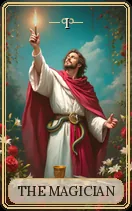 The Magician — Knowledge and action: it is time to put into practice what was learnt in silence — or to listen before acting.
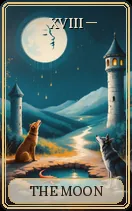 The Moon — Very strong intuition, meaningful dreams; or secrets and illusions that need to be told apart.
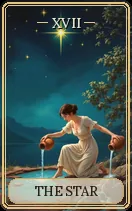 The Star — An intuition that brings hope; trusting what you feel leads to a safe harbour.
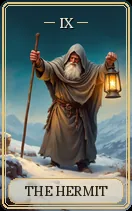 The Hermit — Retreat, study, a deep inner search; a time to be alone.
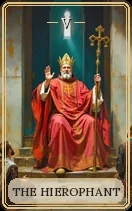 The Hierophant — Inner knowledge and handed-down knowledge: formal study, an initiation, a teacher.
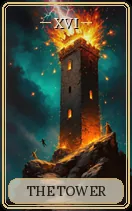 The Tower — A secret that suddenly comes to the surface; a revelation that shakes things up.
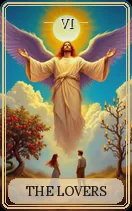 The Lovers — A love not yet declared, an attraction kept silent.
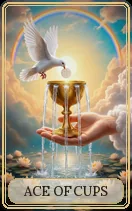 Ace of Cups — A new and deep emotion that has not yet been spoken.
 Seven of Swords — Hidden information, a game of secrets; it is wise not to trust everything you hear.
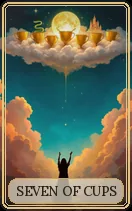 Seven of Cups — Imagination and fantasy: telling true intuition apart from illusions.
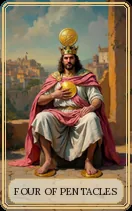 Four of Pentacles — Too much reserve: keeping everything to yourself, out of prudence or fear of loss.
Frequently asked questions
What does The High Priestess mean in tarot?
Intuition, guarded knowledge, silence and patience. It says there is something not yet known or still ripening, and that it is time to listen rather than force things.
Is The High Priestess a yes or a no?
It leans towards ‘not yet’. The answer is still taking shape, or information is missing. If the question is about trusting your intuition, it is a yes.
What does The High Priestess mean in love?
A deep and discreet feeling, an attraction not yet declared, or a reserved person. Reversed, it speaks of distance, coldness or secrets in the relationship.
Is The High Priestess reversed bad?
It is not a card of misfortune. Reversed, it speaks of the same silence having closed in: distance, secrets that weigh, intuition ignored. It asks you to start listening again and, sometimes, to speak.
What is the difference between The High Priestess and the Popess?
They are the same card. In the old decks, such as the Marseille, she was called the Popess; the occultists and the Rider-Waite-Smith gave her the name High Priestess and moved her away from the image of the Church.
What do the letters B and J on the pillars mean?
In the Rider-Waite-Smith they are the initials of Boaz and Jachin, the two pillars of Solomon’s temple. In the Sol da Alma Tarot the pillars bear no letters.
No sign-up · Reading written on the spot · Free