
Knight of Cups: meaning and symbolism of the tarot card
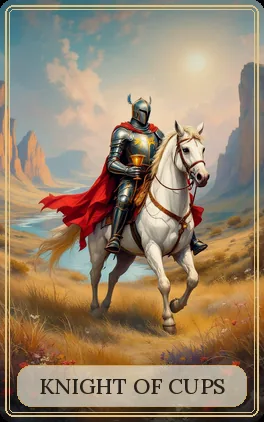
The Knight of Cups is the suit of feeling set on its way. A knight in armour rides slowly forward on a white horse, with a golden cup held close to his chest, like someone bringing a gift. He does not charge, he does not hurry, he bears no weapon: he comes to offer. He is the classic figure of the lover, the idealist, the one who sets out in quest of something he loves.
In a spread, the Knight of Cups speaks of proposals and invitations — in love, but also in work and in creative life. He brings charm, sensitivity and good intentions. His risk is the risk of all idealists: promising more than he can sustain, falling in love more with the idea than with the reality. What decides the reading is whether the cup he brings is full, or merely shines.
The card at a glance
| Card | Knight |
|---|---|
| Suit | Cups |
| Element | Water |
| Astrology | Varies between schools |
| Keywords | quest, romantic proposal, invitation, idealism, charm, a cause embraced, sensitivity in motion |
| Reversed | empty seduction, ungrounded ideal, shaky promise, jealousy, mood swings |
| Yes or no | Yes, if the proposal has solid ground; ‘maybe’ if it is only a promise |
The image on the card
In the Sol da Alma Tarot, the Knight wears a full suit of dark steel armour, with a golden crest on the chest, and a closed helmet topped with small blue plumes. A red cloak billows in the wind behind him. In his right hand, close to his chest, he holds a small golden cup. He rides a white horse with a pale mane and leather harness, walking towards the viewer. The landscape is a wide valley of dry, golden grass, with red and violet wild flowers in the foreground, a winding river in the middle distance, and on either side great cliffs of ochre and pinkish rock. The sun, veiled, is high on the right.
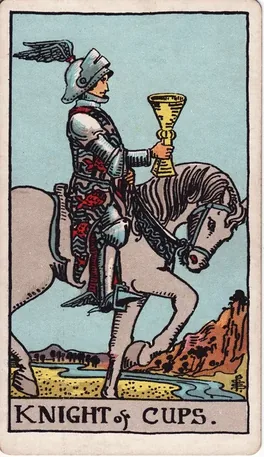
In the 1909 Rider-Waite-Smith, the Knight also rides slowly forward on a horse — a grey one there — and holds the cup out in front of him. He has wings on his helmet and at his heels, and the tunic over his armour is printed with red fish. The landscape is flat ground with a river and a rocky hill. The Sol da Alma keeps the walking horse, the armour, the cup and the river, but swaps the wings for blue plumes, the grey horse for a white one, the tunic with fish for a red cloak, and brings the knight to face us, instead of the profile of the original. The cup has moved too: it is not held out, but kept close to the chest.
In the Marseille Tarot, the Cavalier de Coupe is a mounted figure with a cup in his hand, with no developed landscape. The scene of the valley with the river, and the details of the wings and the fish, come from the Rider-Waite-Smith.
The symbolism, detail by detail
The card speaks of a feeling that is setting itself in motion. Each detail tells us how.
- The cup close to the chest
- An offering that comes from the heart, quite literally. The Knight carries what he feels as one carries a gift, and he protects it.
- The walking horse
- Unlike the other knights, this one does not gallop. Water moves slowly: the Knight of Cups arrives, but without haste, with courtesy.
- The white horse
- Purity of intention, the ideal, the dream. It is the horse of fairy tales, the one ridden by the prince who comes from afar — with all that is beautiful and unreal about that.
- The armour
- The discipline and protection of someone committed to a quest. It may also be the defence of a very sensitive person, who covers themselves in steel in order to be able to feel.
- The closed helmet
- In the Sol da Alma, the face cannot be seen. The Knight of Cups may be an ideal more than a person: we see what he offers, not who he is.
- The blue plumes
- They stand in for the wings of the Rider-Waite-Smith, which many readers associate with Mercury, the messenger: imagination, thought taking flight, the message.
- The red cloak
- The passion and warmth that go with the quest. Behind the armour, there is someone burning.
- The river
- The element of the suit, flowing Water: emotions in motion, the road the Knight follows.
- The cliffs
- The obstacles that stay to either side. The valley opens a way between them — the Knight passes through the middle, without confronting them.
- The dry grass and the flowers
- A land in need of water. The Knight brings what is missing: feeling, beauty, dreams.
The history of the Knight of Cups
The knight has been one of the four court figures of each suit since the first tarot decks, painted in northern Italy in the fifteenth century. He is the figure the tarot kept and that today’s ordinary playing cards do not have. In the Marseille decks, which settled into their form between the seventeenth and eighteenth centuries, he is called Cavalier de Coupe.
At the end of the nineteenth century, the Hermetic Order of the Golden Dawn reorganised the court figures of each suit, and the names do not always match from one system to another: in the Golden Dawn, the mounted figure was the highest in the suit, and the Thoth deck, by Aleister Crowley and Frieda Harris, calls it the Knight and places it above the Queen. Arthur Edward Waite and Pamela Colman Smith, in the 1909 deck, returned to the traditional order — Page, Knight, Queen, King — and gave the Knight of Cups the scene of the rider with the winged helmet, at a walk, holding out the cup.
The figure of a knight bearing a cup easily calls to mind tales of chivalry and of the quest; many modern readers make that association, but it is not found in the old decks. The astrological and elemental attributions of the court cards vary between schools. The Sol da Alma follows the iconography of the Rider-Waite-Smith, with its own painting.
The Knight of Cups upright: the meaning
Upright, the Knight of Cups is the card of proposals that come from the heart. An invitation, a declaration, a request, an offer made with feeling. It is also the card of someone who embraces a cause, pursues an ideal, follows a dream — an artistic vocation, a humanitarian project, a person. It brings beauty, charm, romance.
After the Page, who receives the new emotion, the Knight sets it on its way: he no longer simply feels, he acts on what he feels. He does so gently, without violence and without haste — he is the kindest of the four Knights. He often announces the arrival of something or someone that brings joy, inspiration or affection.
His weaker side lies in his very nature: idealism. The Knight of Cups sees the world as he would like it to be, and sometimes finds it hard to accept it as it is. The card is favourable, but it asks you to see what is inside the cup before accepting it.
The Knight of Cups reversed
Reversed, the Knight of Cups does not lose his charm: he loses his footing. It is the ideal that rests on nothing, the pretty promise that is not kept, the seduction that enchants but does not commit. It may indicate a person who says everything you want to hear and then disappears, or a project that lives on enthusiasm and dies at the first difficulty.
It can also be feeling turned inwards: mood swings, jealousy, melancholy, the tendency to escape into dreams when reality disappoints. Or delay — the proposal comes, but it takes its time, or arrives in a different form from the one expected. The card asks you to tell the dream apart from the plan, and to ask the ideal to show some results.
The Knight of Cups in love
In love, the Knight of Cups is the card of the romantic suitor: someone who arrives, courts, declares himself, proposes. It may announce an invitation, a date, a request to start going out or a marriage proposal. For someone in a relationship, it speaks of renewed romance, of lovely gestures, of an attentive partner.
The thing to watch out for is idealisation — on the part of the querent or the other person. The Knight of Cups can fall in love with being in love, and lose interest once the relationship settles into everyday life. Reversed, it is often the warning of someone seductive but unreliable, of promises with no follow-through, or of jealousy and mood swings.
The Knight of Cups in work and money
In work, it announces proposals and invitations, especially in creative, artistic or people-centred fields. It favours those who work at what they love, those who follow a vocation, those who give themselves to a cause. In a question about a job offer, it says the offer comes with good intentions — but asks you to read the terms carefully.
With money, it is not a card of great rigour: the Knight of Cups decides with his heart. It may indicate an interesting proposal, but also impulse spending or deals accepted out of goodwill. Reversed, it warns against promises of easy gain and against investments made out of enthusiasm.
The Knight of Cups in health and wellbeing
In questions about wellbeing, the Knight of Cups speaks of gentle movement, of activities that bring pleasure, of the importance of feeling inspired. Reversed, it is a reminder that ups and downs of mood and escaping into dreams are tiring too. The cards are no substitute for any kind of healthcare: the reading speaks of attitudes and tendencies, not of diagnoses.
The Knight of Cups in spiritual life
On the inner path, the Knight of Cups is the pilgrim: someone who sets out in search of an ideal, a meaning, an experience that touches the heart. It is devotion set on its way. His challenge is not to confuse the emotion of seeking with what is being sought — and to accept that the ideal, when it is found, takes the humble shape of real life.
The Knight of Cups as a person
When it represents someone, the Knight of Cups is traditionally a young man, or a person of any age with a romantic spirit: charming, sensitive, idealistic, with a love of beauty and art, gentle in manner. This is someone who gives, who courts, who gets enthusiastic about people and causes. His flaw is inconstancy: he falls in love as easily as he loses interest, and sometimes promises more than he can deliver.
The Knight of Cups as advice
As advice, the Knight of Cups says: follow what your heart asks of you, and offer it gently. Make the invitation, the proposal, the gesture. Do not be ashamed of your idealism. But it also says: keep your horse’s hooves on the ground. An ideal is only worth something if it gets somewhere — check whether the cup you are offering, or being offered, has anything in it.
The Knight of Cups in the positions of a spread
- In the past
- A proposal or a passion that started the situation; an ideal that was followed.
- In the present
- An invitation, a courtship, a cause that stirs the heart. Someone is approaching with an offer.
- In the future
- A proposal on its way — in love, in work or in a creative project.
- As an obstacle
- Idealisation, promises without foundation, the tendency to escape into dreams.
- As the outcome
- An offer that arrives and brings joy; the matter moves forward through the heart.
The Knight and its correspondences
The Knight is the one who sets out: the suit set in motion, on its way somewhere, with the urgency and courage of someone who goes. In Cups, however, there is little urgency. Water moves like a river — it goes around, it persists, it arrives. It is feeling that is no longer only lived inwardly but has come to be offered, carried to others.
The element of the suit is Water. The elemental and astrological sub-attributions of the court cards vary between schools, and none is universally agreed; what matters is that the Knight represents Water in motion, between the discovery of the Page and the mature inwardness of the Queen.
Combinations with other cards
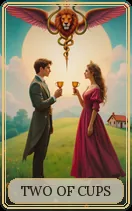 Two of Cups — A proposal of love returned; a relationship beginning.
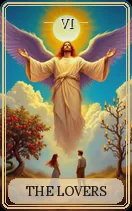 The Lovers — A declaration that calls for a choice; an intense romance.
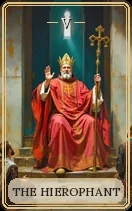 The Hierophant — A marriage proposal or a request for formal commitment.
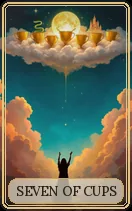 Seven of Cups — Too many promises and fantasies: the dream needs to be separated from reality.
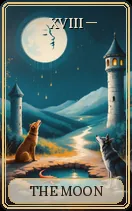 The Moon — Illusion, deceptive seduction; someone who is not what they seem.
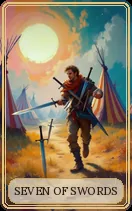 Seven of Swords — Beware of promises that hide other intentions.
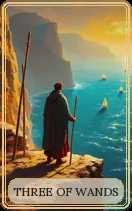 Three of Wands — A proposal that comes from far away; an invitation to travel or to expand.
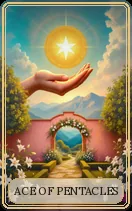 Ace of Pentacles — A job or business proposal that brings concrete gain.
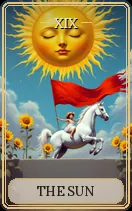 The Sun — A joyful, sincere romance; an offer that brings happiness.
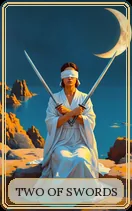 Two of Swords — A proposal you are unsure whether to accept: indecision of the heart.
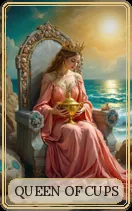 Queen of Cups — A relationship with depth: idealism meets someone who knows how to receive it.
Frequently asked questions
What does the Knight of Cups mean in tarot?
The romantic quest: someone pursuing an ideal and offering it with the heart. A proposal, an invitation, a cause embraced.
What does the Knight of Cups mean in love?
A romantic suitor, a declaration, an invitation or a proposal. In a relationship, renewed romance. The thing to watch is not to idealise too much.
Is the Knight of Cups a yes or a no?
It leans towards yes, especially in matters of love and proposals. But it is a yes that needs confirming: the promise has to have solid ground beneath it.
Is the Knight of Cups reversed bad?
It is not a card of misfortune: it is the same ideal with no ground beneath it. It speaks of promises not kept, of empty seduction or of mood swings, and asks you to see what is inside the cup.
Does the Knight of Cups represent a person?
Often: traditionally a young man, or a romantic, sensitive person of any age. But it can also simply be the proposal or the ideal that arrives.
No sign-up · Reading written on the spot · Free