Four of Wands: meaning and symbolism of the tarot card
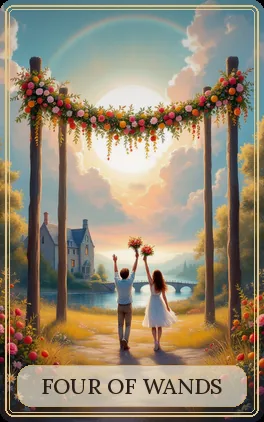
The Four of Wands is the card of celebration. Four tall posts hold up a garland of flowers, and beneath it two people pass with their arms in the air, branches in their hands, heading towards a house by the water. It is the moment when the effort of the suit’s first numbers bears its first visible fruit: there is a place, there is a finished work, there is reason to celebrate.
In a spread, it speaks of joy, of stages completed, of celebrations, of home and family, of a sense of belonging. It is one of the warmest cards in the tarot, and one of the simplest to read: it says there are reasons to be glad, and that it is worth pausing for a moment to acknowledge them.
The card at a glance
| Card | Four |
|---|---|
| Suit | Wands |
| Element | Fire |
| Astrology | Venus in Aries (Golden Dawn: ‘the Lord of Perfected Work’) |
| Keywords | celebration, house raised, happy threshold, harmony, welcome, stage completed, festivity |
| Reversed | party postponed, fragile foundations, unstable harmony, tension at home, restrained joy |
| Yes or no | Yes — one of the most joyful yeses in the deck |
The image on the card
In the Sol da Alma Tarot, four tall wooden posts, two on each side, are driven into the ground and hold between them a lavish garland of pink roses, orange and red flowers and green foliage from which small fruits hang. Beneath the garland, a couple walk away from us along a dirt path: he in a white shirt and light trousers; she in a white dress, with long brown hair. Both raise their arms and hold up bunches of flowers. On the left, a stone manor house with chimneys and slate roofs stands beside a lake; an arched stone bridge crosses the water further on. The sky is luminous: a large, pale sun in the centre, rosy clouds and a rainbow arching across the top of the card. Along the edges of the path there is golden grass and roses in bloom.
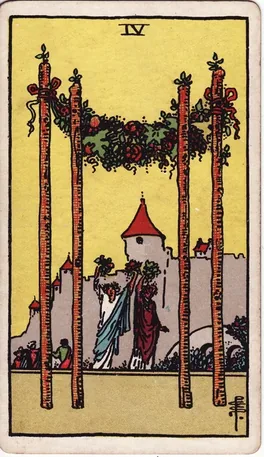
In the 1909 Rider-Waite-Smith, the scene has the same elements in a flatter composition: four wands planted in the foreground hold up a garland of flowers and fruit tied with red ribbons; behind, two figures in long robes raise bunches of flowers, and further back stands a castle with grey walls and a red-roofed tower, with a bridge and a few people. The background is yellow, with no sky drawn in. The Sol da Alma kept the four wands, the garland, the two figures with flowers, the house and the bridge, but made the scene more intimate and closer to hand — a couple, a country house by a lake, the sun and the rainbow — where the original has a more ceremonial, castle-like atmosphere.
In the Marseille Tarot, the Four of Wands has no scene: it shows only the four staffs, crossed in a geometric pattern, with foliage ornaments. The celebration beneath the garland is a creation of Waite and Smith’s deck.
The symbolism, detail by detail
Everything in this card speaks of a threshold: a happy passage from one stage to another. Each detail underlines one side of that idea.
- The four posts
- Structure: for the first time in the suit, the energy of Fire rests on four firm points. It is a work that stands, and not merely an idea.
- The garland
- Celebration, shared joy, the festivity that marks a stage. Hung between the posts, it forms a gateway to pass through.
- The gateway
- The threshold. Passing beneath the garland is entering a new phase — a home, a union, a completed project, a return.
- The couple with flowers
- Joy that is shared. In the Sol da Alma they are two people side by side, arms raised: it is the card of community, family, friends, of the bonds that make victory sweet.
- The house by the water
- Home, the place of belonging, security that has been won. It is not a fortress: it is an open house, a place to arrive at.
- The bridge
- The link between two places, two times, two people. What was separate comes together.
- The rainbow
- A detail unique to the Sol da Alma: calm after effort, a promise of fair weather. It says the celebration is not only deserved, but also a favourable sign.
- The flowers and fruit
- The abundance of the harvest, life in full season. Venus, the card’s planet, is the planet of beauty, harmony and the pleasure of living.
The history of the Four of Wands
In the fifteenth-century Italian decks and in the Marseille Tarot, which settled into its form in the seventeenth and eighteenth centuries, the Four of Wands was simply a design of four staffs, with no figures. The numbered cards of the tarot were playing cards, and their meaning in cartomancy was given to them later, based on number and suit.
At the end of the nineteenth century the Golden Dawn assigned this card Venus in Aries and the title ‘Lord of Perfected Work’ — that is, of work finished and complete. It is the third of the Aries cards in the suit of Wands, and it closes the first cycle of Fire: after the plan and the departure, the work accomplished.
It was the deck of Arthur Edward Waite and Pamela Colman Smith, in 1909, that gave it the image of celebration. In his book on the deck, Waite described four great staves with a garland suspended from them, two female figures raising bunches of flowers and, beside them, a bridge over a moat leading to an old manorial house. He read the card as a kind of domestic harvest-home — repose, concord, harmony, prosperity, peace. The Sol da Alma made the bridge and the manor house, which almost disappear in Smith’s drawing, the main background of the painting.
The Four of Wands upright: the meaning
Upright, the Four of Wands is the card of celebration. It announces a happy moment: a stage completed, a project finished, a change that went well, a party, a gathering of family or friends. It says there are reasons to be glad and that the joy is shared — this is not a solitary success, but a victory celebrated with others.
It is also one of the cards of home. It speaks of moving to a new place, doing up the house, coming home, building a home. More broadly, it speaks of the feeling of belonging: being somewhere you are welcome, surrounded by people who want you there. Many readings associate it with weddings, engagements, family celebrations and reunions.
Being a Four, it has a dimension of stability: what has been built is standing. But Fire never stays still, and the garland is a gateway, not a wall. The Four of Wands is not the end of the road, it is a well-earned rest at one stage of it — and the card asks you to enjoy that moment rather than rushing straight on to the next task.
The Four of Wands reversed
Reversed, the Four of Wands does not lose its joy: it loses its footing. The party has been arranged, but is postponed; the house exists, but does not yet hold; harmony is there, but it is fragile. It can point to a celebration that did not happen as hoped, a house move beset by delays, a family atmosphere with some tension beneath the surface.
Sometimes it speaks of a joy kept inside — contentment without the wish or the means to share it — or of someone who does not feel at home where they are. It can also point to the haste of someone who does not know how to stop and celebrate, and moves from one stage to the next without acknowledging what they have achieved. The card asks you to strengthen the foundations, to deal with the small tensions, and to make room for contentment.
The Four of Wands in love
In love, the Four of Wands is one of the best cards in the deck. It speaks of stable, happy relationships, of commitments celebrated, of living together, of engagements and weddings, of introducing someone to the family. For someone who is single, it may announce a meeting at a party or among friends, or simply a joyful phase in which relationships flow easily.
In a relationship, it says the couple have a solid base and moments to celebrate. Reversed, the card speaks of a good but still insecure relationship, of plans postponed — moving in together, a wedding — of tensions with the families, or of a couple who get on well but have not yet found their place.
The Four of Wands in work and money
In work, it announces the completion of a project, a target reached, a launch, an opening, a good team atmosphere. It is the card of work that is celebrated: the end-of-project party, collective recognition, the feeling of having built something with others. It also favours those who work with events, houses, spaces, hospitality.
With money, it points to stability and a degree of comfort, often linked to the home — buying, renting, renovating, decorating. It is a card of reasonable security, more about wellbeing than wealth. Reversed, it warns against overspending on celebrations, or against a financial base that is still fragile and calls for caution before taking big steps.
The Four of Wands in health and wellbeing
In questions about wellbeing, the Four of Wands speaks of balance, of rest after effort, of good company, of surroundings that do you good. Reversed, it points to the importance of stopping and of looking after the space you live in. As always, the cards are no substitute for any kind of healthcare: the reading speaks of attitudes, not of diagnoses.
The Four of Wands in spiritual life
On the inner path, the Four of Wands is gratitude. It is the moment to acknowledge what has already been achieved, to celebrate small victories, to find a community that shares the same search. It is a reminder that spiritual life also has its festivals, and that joy is a way of acknowledging what one has received.
The Four of Wands as advice
As advice, the Four of Wands says: celebrate. Stop for a moment to acknowledge what you have already built, gather the people you love, celebrate the stage you have completed before beginning the next. And look after your home — the one made of stone and the other one, made of the bonds that turn a place into a home.
The Four of Wands in the positions of a spread
- In the past
- A happy phase, a celebration or a completed stage that laid the foundations for the present situation.
- In the present
- A moment of joy, stability and harmony: there is reason to celebrate.
- In the future
- A party, a house move, a commitment or a happy conclusion on its way.
- As an obstacle
- Comfort that keeps you from moving on, or foundations that are still fragile and need care.
- As the outcome
- A happy conclusion: the matter resolves well, and with reason to celebrate.
Numerology and correspondences
The Four is settlement: what has taken shape, closes itself and is kept — and can therefore also get stuck. In the suit of Wands, however, the Four gets stuck very little: Fire cannot stand still for long, and what settles here is a joy rather than a possession. It is the first complete work of the suit, the moment when the energy of the Ace has become a home.
In the Golden Dawn tradition, the card corresponds to Venus in Aries. Venus is the planet of harmony, beauty and bonds; in Aries, the sign of Mars, her gentleness meets impulse and frankness. Hence the tone of the card — a lively, outgoing joy, more an open-air party than inner quiet. It closes the sequence of the three Aries cards in the suit of Wands: Mars decides, the Sun launches, Venus celebrates.
Combinations with other cards
 Two of Cups — A union celebrated: an engagement, a wedding, the decision to live together.
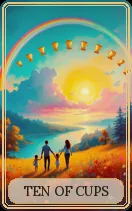 Ten of Cups — Family happiness, a home full of affection, a big family celebration.
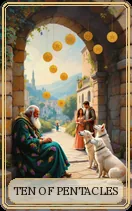 Ten of Pentacles — A solid, prosperous home; a family asset, a legacy of stability.
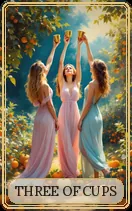 Three of Cups — Parties, good company, friends: a moment of shared celebration.
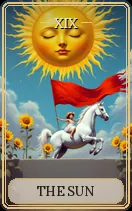 The Sun — Great joy, shared success, a very happy event.
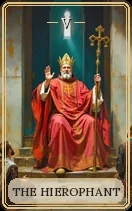 The Hierophant — A traditional ceremony: a wedding, a christening, a rite celebrated in community.
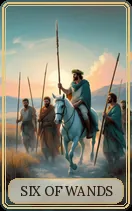 Six of Wands — A victory celebrated in public, a triumphant return.
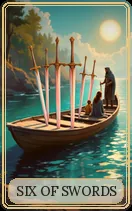 Six of Swords — A house move, the crossing to a calmer place.
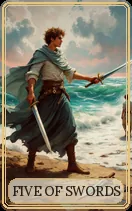 Five of Swords — Tension beneath the festivities: the harmony is more apparent than real.
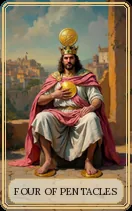 Four of Pentacles — Stability that closes in on itself: security won, but little room for the new.
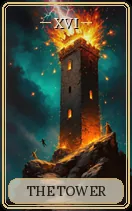 The Tower — Foundations shaken: the home or the celebration is put to the test by a sudden change.
Frequently asked questions
What does the Four of Wands mean in tarot?
Celebration, home, harmony and stages completed. It is the card of the well-earned party, of home and of the sense of belonging.
What does the Four of Wands mean in love?
Stable, happy relationships, commitments celebrated, engagements, weddings, living together. It is one of the most favourable cards for love.
Is the Four of Wands a yes or a no?
Yes, and one of the most joyful in the deck. It says the matter has a good conclusion and reason to celebrate.
Is the Four of Wands reversed bad?
No. Reversed, it is the same joy held back: a postponed party, foundations still fragile, some tension at home. It asks you to strengthen the foundations, not to give up.
Does the Four of Wands speak of marriage?
Often, yes. The garland and the couple beneath it link it to weddings, engagements and family celebrations, especially alongside Cups such as the Two or the Ten.
No sign-up · Reading written on the spot · Free