
Six of Wands: meaning and symbolism of the tarot card
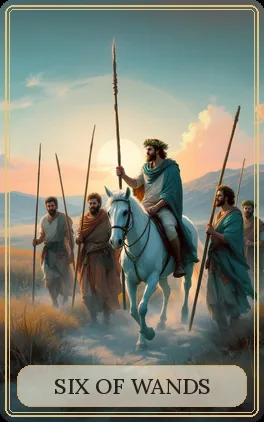
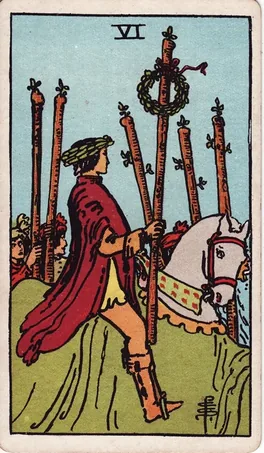
The Six of Wands is the card of victory. A man crowned with laurels rides forward on a white horse, his staff raised, and around him walk other men, also holding staffs. It is the return of someone who has won: the struggle of the Five lies behind him, and now there is a winner, and there are people who accompany him and acknowledge him.
In a spread, it speaks of success, good news, public recognition, well-earned confidence. It is one of the most clearly positive cards in the suit of Wands. But, like every card of victory, it carries a quiet question: what will be done with it — and whether the laurel on one’s head might not grow too heavy.
The card at a glance
| Card | Six |
|---|---|
| Suit | Wands |
| Element | Fire |
| Astrology | Jupiter in Leo (Golden Dawn: ‘the Lord of Victory’) |
| Keywords | victory acknowledged, good news, success, recognition, confidence, leadership, triumphant return |
| Reversed | victory without an echo, wounded pride, recognition slow to come, vanity, fragile success |
| Yes or no | Yes — and with recognition |
The image on the card
In the Sol da Alma Tarot, a man with a brown beard and hair and a laurel wreath on his head rides a white horse with bluish highlights, walking along a dirt track and raising a little dust. He wears a pale tunic and a blue-green cloak over his shoulders, and in his right hand he carries a tall staff, pointed at the tip like a lance, held upright beside his body. There is no ornate saddle or cloth: the horse wears only its reins. Around him, four men on foot, in tunics of rough fabric in shades of cream, orange and blue-green, walk with him, each with his own long staff; the one furthest to the right also has a wreath of leaves on his head. There are six staffs in all. Behind them are bluish hills, dry golden grass and a low, large, pale sun among rosy clouds.
In the 1909 Rider-Waite-Smith, the scene is essentially the same: a laurel-crowned rider in a red cloak sits on a white horse covered with a green cloth, holding a staff to which a second laurel wreath is tied with a red ribbon. Around him is a crowd on foot, of which only heads and staffs can be seen. The Sol da Alma kept the crowned rider, the white horse, the six staffs and the procession on foot, but changed the cloak to blue-green, removed the wreath tied to the staff, gave the companions faces and full bodies, and set the scene in an open landscape under a low sun.
In the Marseille Tarot, the Six of Wands has no scene: it is an arrangement of six crossed staffs, with foliage ornaments. The victor’s procession is a creation of Waite and Smith’s deck.
The symbolism, detail by detail
Everything in this card speaks of a victory that can be seen. Each detail says something about what it means to win — and about what that demands.
- The laurel wreath
- The ancient sign of victory, given to the winners of games and battles. It says the success is recognised and deserved.
- The white horse
- Strength tamed and placed at the service of its rider. The white speaks of a clean victory, without a shadow of cheating.
- The raised staff
- The will that won, held up for all to see. In the Sol da Alma it has a lance point: the victory was won, not handed over.
- The companions on foot
- Those who accompany and acknowledge the victor. The victory of the Six is public: there are witnesses, there is a team, there is support. Nobody wins alone.
- The wreath on the man on the right
- A detail of the Sol da Alma: one of the companions also wears laurels. The merit is shared, and the victor is not the only one to be recognised.
- The track and the dust
- The return. The procession is coming from somewhere, after a struggle; it moves at a walk, unhurried — it is the time for reaping the effort.
- The rider’s position
- Higher than everyone else. It is leadership, confidence, authority earned; and it is also the risk of rising above others and ceasing to see them.
- The low sun
- The end of a day’s journey. Victory marks the end of a stage; what comes after is another story, which the Seven of Wands will tell.
The history of the Six of Wands
In the fifteenth-century Italian decks and in the Marseille Tarot, which settled into its form in the seventeenth and eighteenth centuries, the Six of Wands was simply an arrangement of staffs, with no figures. Like all the numbered cards, it belonged to the game of tarocchi, and its cartomantic meaning was given to it later.
At the end of the nineteenth century the Golden Dawn assigned it Jupiter in Leo and the title ‘Lord of Victory’. Jupiter is the planet of expansion and good fortune; Leo is the sign of fixed Fire, of pride and personal brilliance. It is the second of the three Leo cards in the suit of Wands: between the struggle of the Five and the defence of the Seven comes victory.
Arthur Edward Waite and Pamela Colman Smith, in the 1909 deck, gave it the scene of the laurel-crowned rider, with a second wreath tied to his staff and men on foot around him. In his book on the deck, Waite read the card as the victor triumphing, and also as great news, of the kind the king’s messenger might carry in state — hence the sense of good news that the card still has today. The Sol da Alma follows this iconography with its own painting.
The Six of Wands upright: the meaning
Upright, the Six of Wands is the card of acknowledged success. The effort has paid off, and this time others can see it: a promotion, an award, a good appraisal, a project going well in full view, a dispute won. It also brings good news — the answer you were waiting for, arriving in your favour, the result of a competition, a confirmation.
It is also the card of confidence. Whoever draws it feels surer of themselves, and rightly so: they have proved their worth. They may be taking on a leadership role, being followed, inspiring others. The Six of Wands speaks of someone who has gained authority through what they have done, not through the title they hold.
The victory of this card is public and shared. The rider is not alone: there is a procession around him, and without it the victory would not exist. That is why the card asks you also to acknowledge those who helped — and to enjoy the moment with gladness, without false modesty, but without forgetting either that the laurel is to be worn lightly.
The Six of Wands reversed
Reversed, the Six of Wands is the same victory, but without an echo. You won, and nobody noticed; you did good work, and someone else got the credit; recognition is slow to come or smaller than expected. It can bring a sense of injustice or wounded pride, and the temptation to belittle your own effort.
In other readings, it speaks of excess: the vanity of someone who thinks themselves above others, the arrogance of the victor, dependence on applause. Or of a fragile victory, which may not last, because it was won in haste or rests more on appearance than on work. The card asks you to recognise your own worth without needing everyone’s confirmation, and to keep the humility of someone who knows that victories pass.
The Six of Wands in love
In love, the Six of Wands brings confidence and good news. It can point to a conquest — someone who finally returns your feelings, a relationship that goes public, an important step taken together. For someone who is single, it announces a phase of high self-esteem, in which the person feels attractive and self-assured, and draws attention because of it.
In a relationship, it speaks of mutual pride, of a couple who support each other and celebrate each other’s victories, or who have come through a difficult phase. Reversed, it may describe a relationship in which one of the two always needs to be on top, a disguised competition between partners, or someone who feels undervalued by the other.
The Six of Wands in work and money
In work, it is one of the most favourable cards in the deck: promotion, recognition, success in a project, a competition won, good professional news. It favours leadership, public roles, professions where visibility counts. It says the work done is being seen, and that it is a good moment to ask for what you deserve.
With money, it points to gains linked to merit — a pay rise, a bonus, a business that is doing well. It is a card of a good spell rather than of a great fortune. Reversed, it warns against spending to impress others, against overconfidence after a success, and against a delay in a payment or in recognition that was due.
The Six of Wands in health and wellbeing
In questions about wellbeing, the Six of Wands speaks of good spirits, of confidence, of goals achieved — finishing a race, keeping up a habit, feeling your body grow stronger. Reversed, it is a reminder that tiredness also comes after victories. The cards are no substitute for any kind of healthcare, and this reading speaks of attitudes, not of diagnoses.
The Six of Wands in spiritual life
On the inner path, the Six of Wands speaks of a stage overcome: a difficulty surmounted, a practice that has borne fruit, a moment of clarity. It asks, however, that the victory should not turn into spiritual pride. The laurel serves to acknowledge the road travelled, not to set oneself above the others who are still walking on foot.
The Six of Wands as advice
As advice, the Six of Wands says: acknowledge what you have achieved. Show your work, accept the praise, take on the leadership you have earned. And share the victory with those who made it possible. The procession matters as much as the rider.
The Six of Wands in the positions of a spread
- In the past
- A victory or recognition that gave confidence and opened doors.
- In the present
- A phase of success, good news and public recognition.
- In the future
- Good news on its way: a victory, a favourable answer, merit recognised.
- As an obstacle
- Pride, vanity or the need for applause getting in the way of everything else.
- As the outcome
- Success: the matter is resolved in favour of the person asking, and in full view of everyone.
Numerology and correspondences
The Six is the passage: after the test comes relief, fair exchange, the crossing to calmer ground. In the suit of Wands, the passage is victory — the struggle of the Five has been resolved, and someone has come out of it the winner. It is balance found again after friction, now with a clear hierarchy: some ride and some walk, and all go in the same direction.
In the Golden Dawn tradition, the card corresponds to Jupiter in Leo. Jupiter is the planet of expansion, generosity and good fortune; Leo is the sign of brilliance, pride and leadership. Together they give victory with recognition, natural authority, the joy of being seen. The risk of the combination is the excess of both: vanity, the love of being admired. It is the second of the three Leo cards in the suit, between the struggle of the Five and the defence of the Seven.
Combinations with other cards
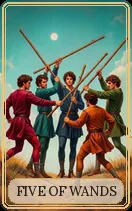 Five of Wands — A victory after a hard competition: the contest has been won.
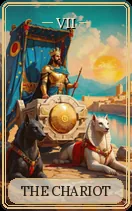 The Chariot — Triumph, progress, success won through determination.
 The Sun — Great success, joy and recognition: one of the most positive combinations in the deck.
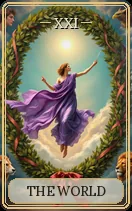 The World — A victory that closes a cycle with complete success.
 Eight of Wands — Good news arriving quickly.
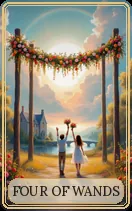 Four of Wands — A victory celebrated with others, a glorious homecoming.
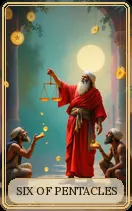 Six of Pentacles — A well-deserved reward, a prize or a pay rise.
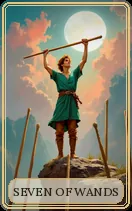 Seven of Wands — After victory, the need to defend the position you have won.
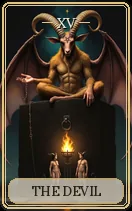 The Devil — Success that goes to your head: vanity, dependence on applause.
 Five of Swords — A victory that costs relationships; winning at the expense of others.
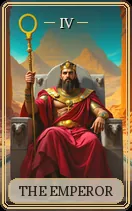 The Emperor — Leadership recognised; a position of authority won on merit.
Frequently asked questions
What does the Six of Wands mean in tarot?
Victory, recognition and good news: the effort has paid off and others can see it. It is one of the most positive cards in the suit.
What does the Six of Wands mean in love?
Confidence, conquest, good news in love, a relationship that goes public. Reversed, it may speak of competition between partners or of a lack of recognition.
Is the Six of Wands a yes or a no?
Yes, and a clear one. It is a yes with success and with recognition.
Is the Six of Wands reversed bad?
No. Reversed, it is victory without an echo: recognition is slow to come, or pride spoils the moment. It calls for humility and confidence in your own worth.
Does the Six of Wands speak of news?
Yes. Since Waite it has also been read as good news — a favourable answer, a result, a confirmation.
No sign-up · Reading written on the spot · Free