
Five of Wands: meaning and symbolism of the tarot card
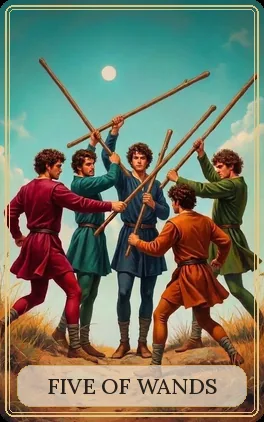
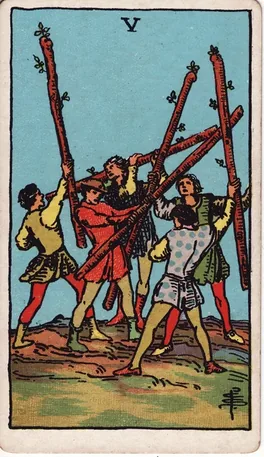
The Five of Wands is the card of friction. Five young men raise their staffs on top of a hill and cross them with one another, and it is hard to tell whether they are fighting, playing or practising. Nobody is hurt, nobody is on the ground. There is strength, there is confusion, there is noise — and above all there are several wills trying to occupy the same space.
In a spread, it speaks of competition, disagreements, debates, rivalries, a situation in which many people are pulling in different directions. It is not always bad: often it is friction that makes everyone give their best. The question the card leaves is whether that contest is building something, or is merely noise.
The card at a glance
| Card | Five |
|---|---|
| Suit | Wands |
| Element | Fire |
| Astrology | Saturn in Leo (Golden Dawn: ‘the Lord of Strife’) |
| Keywords | fruitful rivalry, trial of strength, competition, debate, challenge, friction, practice |
| Reversed | sterile friction, pointless dispute, conflict avoided or dragged out, wear and tear, pettiness |
| Yes or no | Maybe — it depends on winning the contest or on giving up competing |
The image on the card
In the Sol da Alma Tarot, five curly-haired young men stand together on top of a hill of dry, golden grass. They wear tunics of different colours, fastened with leather belts — crimson, blue-green, blue, rust and olive green — with close-fitting hose and leather boots, their legs bound with strips of cloth. Each holds a long wooden staff, and the five staffs cross in the air above their heads in a tangle of lines. The young man in the middle, in the blue tunic, faces us; the one in the rust-coloured tunic, in the foreground, has his back to us; the others turn towards one another. Their faces are intent, but none seems angry or hurt. The sky is turquoise blue, with a few pale clouds on the right, and in it shines a pale disc, like a daytime moon.
In the 1909 Rider-Waite-Smith, the scene is essentially the same: five young men, each dressed differently — one in a spotted tunic, another in red, another in yellow — brandish staffs at one another on uneven ground under a plain blue sky. The gestures are more disorderly and look more aggressive, with the staffs pointing in every direction. The Sol da Alma kept the five young men, the five staffs, the differently coloured clothes and the blue sky, but gave the scene a tidier, almost choreographed composition, and added the pale disc in the sky and the dry grass on the hill.
In the Marseille Tarot, the Five of Wands has no scene: it shows the staffs crossed in a pattern, with a vertical staff in the centre, and ornamental foliage. The fight of the five young men is a creation of Waite and Smith’s deck.
The symbolism, detail by detail
This is a card about what happens when several forces meet. Each element of the image says something about the nature of that encounter.
- The crossed staffs
- Wills measuring themselves against one another. No staff strikes a body; they all strike other staffs. It is a conflict of ideas, projects, ambitions — and not, as a rule, of people who wish each other harm.
- The five young men
- The energy of the suit split five ways. Each has his own strength and his own reasons; none has authority over the others. That is why the contest does not end.
- The differently coloured clothes
- The diversity of viewpoints, temperaments and interests. The card speaks of different people trying to occupy the same space.
- Youth
- A contest with something of a game about it, of practice, of challenge. The young men are testing their strength rather than trying to destroy one another.
- The calm faces
- A detail of the Sol da Alma painting: nobody is angry. Competition can be healthy, and here it looks more like concentration than rage.
- The hill
- The disputed ground. Everyone wants to be at the top, and the top has little room.
- The dry grass
- Fire and Saturn together: ground that burns quickly. A quiet warning that friction, if it is not well managed, can catch fire.
- The pale disc in the sky
- A daytime moon, or a veiled sun. Nobody looks at it: they are all too busy with their staffs to see the light above them.
The history of the Five of Wands
In the fifteenth-century Italian decks and in the Marseille Tarot, which settled into its form between the seventeenth and eighteenth centuries, the Five of Wands had no figures: it was an arrangement of five staffs, and served the game of tarocchi. Its cartomantic meanings came later, based on number and suit.
At the end of the nineteenth century the Golden Dawn gave it Saturn in Leo and the title ‘Lord of Strife’. It is the first of the three Leo cards in the suit of Wands, and it opens a sequence that reads well in order: the struggle, in the Five; victory, in the Six; the defence of one’s position, in the Seven.
Arthur Edward Waite and Pamela Colman Smith, in the 1909 deck, gave it the image of the five young men with staffs in the air. In his book on the deck, Waite described them brandishing their staves ‘as if in sport or strife’ and called the scene mimic warfare — a fight that looks like a fight but perhaps is not one. That ambiguity between game and conflict has remained at the heart of every modern reading of the card, and it is also the Sol da Alma’s, which stresses the side of practice and fair contest.
The Five of Wands upright: the meaning
Upright, the Five of Wands is the card of the trial of strength. It speaks of competition — in a contest, an application, a market, a sport — of clashes of ideas within a team, of disagreements in the family, of an environment where everyone wants to be right. It describes a restless situation, full of energy, in which it is hard to reach a consensus.
But the Five of Wands is not, as a rule, a card of war. It is the friction that makes you grow: the debate that forces you to think better, the competition that forces you to work better, the rival who forces you to train harder. Whoever draws it is often in a moment of testing, and the card says they can come out of it stronger — if they know how to use the conflict as a spur, and not as an end in itself.
It also asks you to understand what contest you are in. Not all of them deserve the energy you give them. The challenge is knowing when it is worth raising your staff, when it is enough to hold your position, and when it is better to leave the hill and let the others fight.
The Five of Wands reversed
Reversed, the Five of Wands is the same friction, but sterile. Arguments repeat themselves without getting anywhere, competition has turned petty, energy is spent on rivalries nobody remembers the reason for. It is the wear and tear of a workplace where everyone contradicts everyone else, or of a family where every conversation ends in a quarrel.
In other readings, it speaks of conflict turned inwards or avoided: tensions left unspoken, disagreements swallowed, an apparent peace that hides irritation. It can also point to the weariness of someone who no longer wants to compete, or to the end of a dispute — the person realises it is not worth it and puts down their staff. The card asks you to choose: either say what needs to be said, clearly, or leave the fight for good.
The Five of Wands in love
In love, the Five of Wands speaks of arguments, small rivalries, recurring disagreements. It is not necessarily a crisis: many couples live well with a bit of spark and a bit of competition. But the card asks you to watch the tone — whether the arguments bring you closer and clear the air, or only wear you down. It can also point to interference from others, such as family or friends with strong opinions.
For someone who is single, it may describe a phase of many interests at once, or competition for attention — several people interested in the same person. Reversed, it speaks of unspoken conflicts, accumulated resentment, or the relief of someone who stops fighting for a relationship that was no longer worth it.
The Five of Wands in work and money
In work, it is the card of competition: selection processes, interviews with several candidates, contested markets, teams with differing opinions, heated meetings. It says you have to fight for your place, present your ideas well, stand up for the project. It favours those who enjoy challenges and work well under pressure, but asks you to keep your focus on the goal and not on personal rivalries.
With money, it points to a phase in which earning takes effort, with no easy options — price competition, tough negotiations, money that does not come in without a struggle. Reversed, it warns against financial disputes that drag on, conflicts over money in the family or between business partners, and against spending energy competing over things that do not pay.
The Five of Wands in health and wellbeing
In questions about wellbeing, the Five of Wands speaks of energy that needs an outlet — sport, healthy competition, intense physical activity. Reversed, it points to the wear and tear of a tense environment or of restlessness that never stops. The cards are no substitute for any kind of healthcare; the reading offers attitudes, not diagnoses.
The Five of Wands in spiritual life
On the inner path, the Five of Wands is the conflict between different parts of oneself: desires pulling in different directions, ideas that contradict one another, the difficulty of finding a single direction. It can also speak of debates with other people about beliefs and paths. The card asks you to listen to the different voices without letting any of them prevail by force, and to look for what unites them.
The Five of Wands as advice
As advice, the Five of Wands says: accept the challenge, but pick your battles. Use competition to grow, defend your ideas with energy, do not be afraid of debate. And know when to stop once the contest is no longer building anything — not every staff has to be raised.
The Five of Wands in the positions of a spread
- In the past
- A period of conflict or competition that left its mark, or that forced the person to grow.
- In the present
- A restless situation: several interests at stake, dispute, debate, competition.
- In the future
- A challenge on its way — a competition, a negotiation, a disagreement to be managed.
- As an obstacle
- Rivalries, arguments that go nowhere, energy spent on side conflicts.
- As the outcome
- The matter will not be resolved without a struggle; it asks you to hold your position or change ground.
Numerology and correspondences
The Five is the test: the form of the Four breaks, and there is loss, friction or lack. It is the step that forces movement. In the suit of Wands, the celebration of the Four gives way to contest — the energy that had settled is stirred up again, and each will wants its place. It is an uncomfortable moment, but a necessary one: without it, Fire would fall asleep in the house of the Four.
In the Golden Dawn tradition, the card corresponds to Saturn in Leo. Leo is the sign of fixed Fire, of pride and self-assertion; Saturn is the planet of limits, difficulty and testing. Together they describe the card’s friction well: each person’s pride running up against the limits of others. It is the first of the three Leo cards in the suit, followed by the victory of the Six and the defence of the Seven.
Combinations with other cards
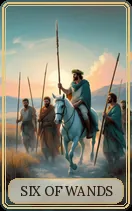 Six of Wands — The contest ends in victory: after the competition, recognition.
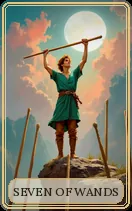 Seven of Wands — Defending your position against many; standing firm in a competitive environment.
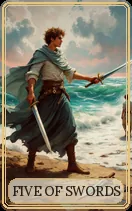 Five of Swords — A conflict that degenerates: winning at any cost, with losses for everyone.
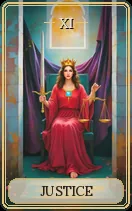 Justice — A dispute settled fairly, with clear rules or through legal channels.
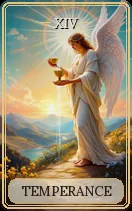 Temperance — The friction calms down: the different wills can be reconciled.
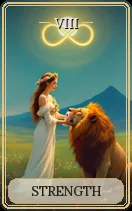 Strength — Courage and self-mastery in the midst of conflict; winning through composure, not force.
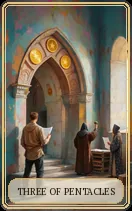 Three of Pentacles — A team with differing opinions that nonetheless works well together.
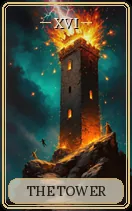 The Tower — A conflict that explodes and changes everything at once.
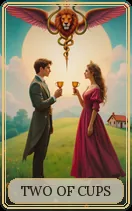 Two of Cups — Couple’s arguments that, well handled, bring you closer rather than pushing you apart.
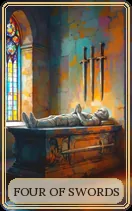 Four of Swords — Withdrawing from the fight to recover strength and think.
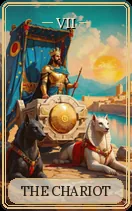 The Chariot — A competition won through determination and control.
Frequently asked questions
What does the Five of Wands mean in tarot?
Competition, rivalry, debate and a trial of strength: several wills contesting the same ground. It may be friction that helps you grow or conflict that wears you down.
What does the Five of Wands mean in love?
Arguments, small rivalries or recurring disagreements, and sometimes interference from others. It is not necessarily a crisis, but it asks you to watch the tone.
Is the Five of Wands a yes or a no?
It is a maybe. It says the matter will call for a struggle or negotiation; the outcome depends on winning the contest or on choosing to step out of it.
Is the Five of Wands reversed bad?
It is no worse than upright. Reversed, it speaks of sterile or avoided conflicts, but also, at times, of the end of a dispute. It calls for clarity or withdrawal.
Is the Five of Wands a card of fighting?
It is a card of friction, not necessarily of violence. In the image, the staffs strike one another, not the people: it is competition, debate and challenge.
No sign-up · Reading written on the spot · Free