
Two of Wands: meaning and symbolism of the tarot card
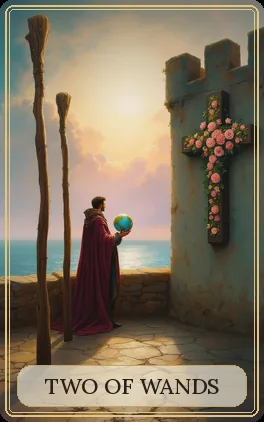
The Two of Wands is the card of someone who has already won something and is looking beyond it. A man stands high on a rampart, his back to us, a small globe in his hand and the sea before him. He has somewhere to stand and the means to leave — and he is deciding whether to go, and where. The Ace provided the spark; the Two asks what is going to be done with it.
In a spread, it is the card of planning and choice: the moment to think before acting, to size up the horizon, to decide on a direction. It brings ambition and vision, but also a certain restlessness — that of someone who feels the place where they stand is no longer enough. It is a card of preparation, not yet of the journey itself.
The card at a glance
| Card | Two |
|---|---|
| Suit | Wands |
| Element | Fire |
| Astrology | Mars in Aries (Golden Dawn: ‘the Lord of Dominion’) |
| Keywords | choosing a horizon, plan drawn up, vision, dominion, decision, ambition, preparation |
| Reversed | hesitation, narrow horizon, fear of leaving, plan that goes nowhere, dissatisfaction |
| Yes or no | Yes, if a decision is made; while you hesitate, ‘not yet’ |
The image on the card
In the Sol da Alma Tarot, a man with a short beard and dark hair stands on a stone terrace at the top of a fortified building, facing the sea. He wears a large wine-coloured cloak that falls to the ground, with an embroidered stole over his shoulders and a turquoise-blue garment underneath. In his outstretched hand he holds a small terrestrial globe, blue and green, and he looks past it, towards the horizon. The sea shimmers in the light of late afternoon or dawn, with the sky in shades of pink and gold. On the left, two tall, rough, knotted staffs stand upright on the terrace, one in the foreground, bound with ropes, the other further back; neither is in his hand. On the right, on the wall of a crenellated tower, hangs a wooden cross covered in pink roses.
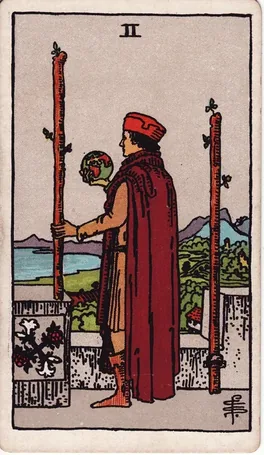
In the 1909 Rider-Waite-Smith, the scene is essentially the same: a man in a red cap and cloak stands on the terrace of a castle, with a globe in one hand and a staff in the other; the second staff is fixed to the wall on the right. Ahead lies a landscape of sea, fields and mountains. On the left-hand wall there is an emblem of crossed roses and lilies, in the shape of a St Andrew’s cross. The Sol da Alma kept the red cloak, the globe, the two staffs, the terrace and the cross with roses, but removed the lilies, left the man without a cap and without a staff in his hand, and opened the view onto the sea alone, with no land ahead.
In the Marseille Tarot there is no scene: the Two of Wands shows only two long staffs crossed in an X, with ornaments of leaves and flowers in the spaces between them. The image of the man gazing at the world is a creation of Waite and Smith’s deck.
The symbolism, detail by detail
This is the card of someone standing between what they already have and what they still want. Each detail of the image says something about that position.
- The globe in the hand
- The world sized to fit the hand: the feeling that anything is possible, and that one can choose. It is also ambition — wanting more than can be seen from the terrace.
- The gaze towards the horizon
- Vision, planning, imagination turned to the future. The man is not looking at the globe, he is looking into the distance: he is thinking about the road, not only about the desire.
- The fortified terrace
- What has already been won. He is in a safe, high, protected place. The card is not about someone who has nothing, but about someone who has a base and is beginning to feel it is too small.
- The two staffs
- The two possibilities, or the two forces being weighed against each other: staying and leaving, what one has and what one wants. In the Sol da Alma they stand upright, loose, waiting to be picked up.
- The open sea
- The unknown, foreign lands, distance. It is where the plan points, and it is the territory of the next card, the Three of Wands, where the ships have already set sail.
- The cross with roses
- In the Rider-Waite-Smith, the emblem of roses and lilies suggests that ambition can unite desire (the rose) and purity of intention (the lily). In the Sol da Alma only the roses remain: the passion that goes with the project, and a reminder that it, too, has thorns.
- The red cloak
- The Fire of the suit, the authority and energy of someone who is master of his own ground. It is the colour of Mars, the card’s planet.
- The low light
- A sun close to the line of the sea, which may be rising or setting. It is the hour of decision: yesterday is over, and tomorrow has not yet begun.
The history of the Two of Wands
For almost the whole history of the tarot, the Two of Wands was just that: two wands. In the fifteenth-century Italian decks and in the Marseille Tarot, which settled into its form in the seventeenth and eighteenth centuries, the numbered Minor cards showed only the suit symbols, arranged in a pattern — in the case of Wands, long intersecting staffs with ornamental foliage. Whoever read them had to count and remember the meaning of each number.
At the end of the nineteenth century the Golden Dawn gave each card from 2 to 10 a planet in a sign and a title. The Two of Wands received Mars in Aries — the planet of action in its own sign, the first of the zodiac — and the name ‘Lord of Dominion’. This is not the dominion of someone who rules, like the King’s, but that of someone who is beginning to impose his will on the world.
It was the deck of Arthur Edward Waite and Pamela Colman Smith, in 1909, that gave this card the scene everyone knows today: the lord on the castle terrace, globe in hand. In his book on the deck, Waite admitted that the card has two readings that are hard to reconcile — on the one hand riches, fortune, magnificence; on the other, a kind of weariness or disgust — and he compared it to the sadness of Alexander amid the grandeur of this world’s wealth: to have everything and feel it is not enough. That restlessness has stuck to the card, and it is present in most modern readings.
The Sol da Alma Tarot follows this iconography with its own painting, and keeps the meaning the website’s table gives the card: the horizon sized up, the plan drawn up before setting out.
The Two of Wands upright: the meaning
Upright, the Two of Wands speaks of planning and decision. The person already has a base — a job, a home, a project that went well — and is starting to look further afield. There is an idea of expansion, of change, of travel or of a new project, and the card says it is time to think it through seriously: to survey the ground, weigh up the options, draw up a plan.
It is also the card of ambition and of confidence in one’s own strength. Mars in Aries gives it initiative and the will to conquer; the globe in the hand gives it the feeling that the world is within reach. But the Two of Wands is not yet the departure: it is the moment before it. The strength has been gathered; the direction has not yet been chosen.
That is why the card often appears as a choice between two things: staying with what is safe or risking what is greater, this road or that one. It says both are possible, and that the decision lies with the person asking. The advice is to decide with your eyes on the horizon — and not to stay on the terrace for ever, simply gazing at it.
The Two of Wands reversed
Reversed, the Two of Wands is the same choice, but held back. The plan exists and goes nowhere; the horizon calls and the person does not leave the terrace. It may be fear of the unknown, attachment to security, or simply the habit of putting off big decisions. On the outside everything looks stable; on the inside grows the dissatisfaction of someone who knows they wanted more.
In other readings, it speaks of a horizon that has shrunk: a plan so prudent, so full of precautions, that it is no longer worth following; an ambition that has dwindled to whatever is comfortable. It can also point to badly measured plans made in a hurry, or to a dominion that turns into control — wanting to hold the world in your hand without letting it move. The card asks you to look into the distance again, and to choose one step, however small, towards that horizon.
The Two of Wands in love
In love, the Two of Wands speaks of decisions and plans made as a couple: thinking about the future of the relationship, deciding whether to move house or city, whether to take a more serious step. It can also point to a moment of taking stock, when one of the two asks whether the relationship is enough or whether they want something else. For someone who is single, it usually speaks of a person who has to choose — between two people, between staying and leaving, between security and adventure.
It is a more rational card than a passionate one: it says the heart is being thought over. Reversed, it may describe a relationship that stays in the same place, plans that are always postponed, or the fear of risking a new feeling because one does not want to let go of what is familiar. Sometimes it speaks of a long-distance relationship, or of someone whose mind is elsewhere.
The Two of Wands in work and money
In work, it is an excellent card for anyone making plans: an expansion project, opening a business, a change of field, an opportunity abroad, a partnership. It favours strategic planning, market analysis, fundamental decisions. It says the person has the resources and the competence to go further, and that what remains is to decide where. In questions about two offers, the card asks you to choose according to the long-term vision, and not according to what seems safest today.
With money, it points to a stable situation, with room to invest or take risks, provided it is done with a plan. It is a good card for thinking about investments, saving towards a goal, projects that require capital. Reversed, it warns against paralysis — money left idle out of fear — and against poorly researched financial decisions taken to escape boredom.
The Two of Wands in health and wellbeing
In questions about wellbeing, the Two of Wands asks for planning: thinking about a routine, setting a goal, choosing a path and sticking to it. Reversed, it speaks of the restlessness of someone who feels trapped, or of energy that stays stuck through indecision. The cards are no substitute for any kind of healthcare; here, as always, the reading speaks of attitudes and not of diagnoses.
The Two of Wands in spiritual life
On the inner path, the Two of Wands is the moment when one realises that the known world is small. It may be the wish to study another tradition, to make a meaningful journey, to give life a deeper direction. The card asks that the search be made with intention: knowing what you are seeking before you set out, so as not simply to swap one terrace for another.
The Two of Wands as advice
As advice, the Two of Wands says: make the plan, and then decide. Look into the distance, weigh up what you have and what you want, and choose a direction. Do not wait for the horizon to come to you. The safety of the terrace is good for thinking, not for living in for ever.
The Two of Wands in the positions of a spread
- In the past
- A fundamental decision that has already been taken, or a plan that set the current course.
- In the present
- A moment of choice: the person has a base and is deciding where to go.
- In the future
- A plan that will take shape; an opportunity for expansion or change that will call for a decision.
- As an obstacle
- Hesitation, fear of leaving familiar territory, or a plan that is too narrow.
- As the outcome
- A direction chosen: the matter is resolved with a clear plan and the first step outwards.
Numerology and correspondences
The Two is the pair and the choice: two things placed face to face, balancing or measuring each other. In the suit of Wands, the two things are two wills, or two paths for the same will — what one has and what one desires, staying and leaving. The Fire of the Ace, which was pure energy, here begins to have to choose a form.
In the Golden Dawn tradition, the card corresponds to Mars in Aries. Mars is the planet of action, courage and conflict; Aries is the sign of beginnings, and it is the home of Mars. It is a very direct, impatient combination of energy, which explains the card’s restlessness: whoever has this strength cannot stand still for long. The first three numbers of Wands after the Ace — the Two, the Three and the Four — all belong to Aries, the sign that opens the zodiac, and together they tell the story of a beginning: the plan, the departure and the first home.
Combinations with other cards
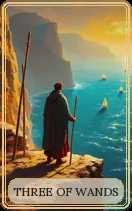 Three of Wands — From plan to action: what was thought through starts to be set in motion, often far away.
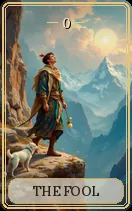 The Fool — Planning before leaping: the horizon is there, but the route still needs mapping so you do not set off blindly.
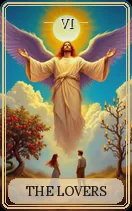 The Lovers — An important choice, personal or romantic, that asks to be made with both heart and head.
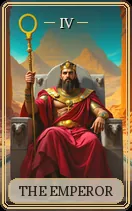 The Emperor — Authority and vision together: a large, well-structured project with firm leadership.
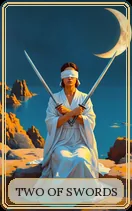 Two of Swords — A decision being avoided: the person knows they must choose, but closes their eyes.
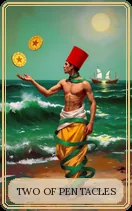 Two of Pentacles — Two options that balance each other; managing two fronts at once before choosing one.
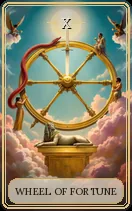 Wheel of Fortune — An opportunity that arises just as the plan is being made: it is time to seize it.
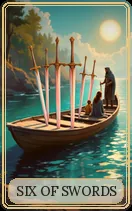 Six of Swords — A move to another country or city, a journey planned towards new ground.
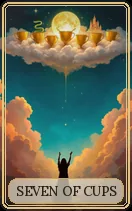 Seven of Cups — Too many options and too little clarity: the plan gets lost in fantasy and the horizon blurs.
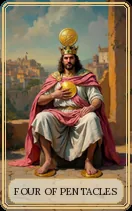 Four of Pentacles — Fear of risking what has been won prevents you from going further.
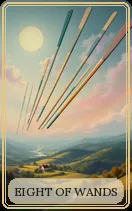 Eight of Wands — A decision that sets everything racing: a journey or a project that suddenly takes off.
Frequently asked questions
What does the Two of Wands mean in tarot?
It is the card of planning and choice: the person already has a base and is looking further afield, deciding where to go. It speaks of vision, ambition, planning and decision.
What does the Two of Wands mean in love?
Plans and decisions made as a couple, or a moment of taking stock when someone wonders whether the relationship is enough. It is more a card of the head than of passion.
Is the Two of Wands a yes or a no?
It leans towards yes, provided a decision is made. If the question is about moving forward, it says yes, but with a plan; if the person keeps hesitating, the answer is ‘not yet’.
Is the Two of Wands reversed bad?
It is not bad: it is the choice held back. It speaks of hesitation, fear of leaving the familiar or plans that are too narrow. It asks you to decide and take the first step.
What is the difference between the Two and the Three of Wands?
In the Two, the man is still on the terrace, planning; in the Three, the ships have already sailed and their return is awaited. The Two is the decision; the Three is what has been launched.
No sign-up · Reading written on the spot · Free