
Judgement: meaning and symbolism of the tarot card
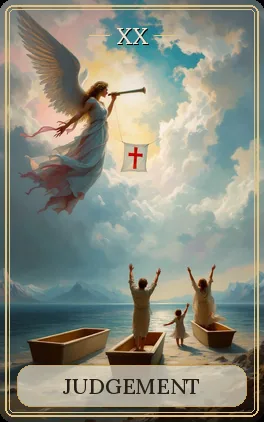
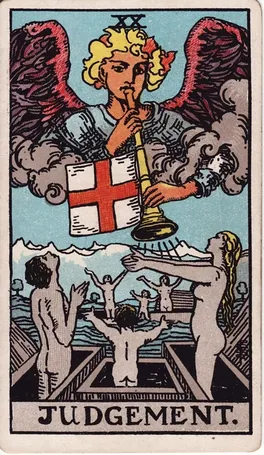
Judgement is the twentieth card of the Major Arcana, the last but one in the series. An angel appears in the sky and sounds a trumpet, and below, from open coffins, people rise with their arms raised towards it. The scene comes from the Christian image of the Last Judgement, but what the card shows is not a sentence: it is an awakening. Someone calls, and those who were lying down get up.
In a spread, Judgement speaks of a calling — a vocation, a decision that can no longer be put off, an inner voice that becomes impossible to ignore. It also speaks of the reckoning of a whole cycle, of forgiveness, and of the rebirth of something thought to be over. It is the card of second chances — but of earned ones, those received after doing the work of looking back honestly.
The card at a glance
| Number | XX |
|---|---|
| Arcana | Major Arcana |
| Historical names | L'Angelo, Il Giudizio (Italy); Le Jugement (Marseille); Judgement (Rider-Waite-Smith) |
| Element | Fire |
| Astrology | Fire (Golden Dawn); Pluto, in the modern reading |
| Hebrew letter | Shin (ש), according to the Golden Dawn |
| Keywords | calling, rebirth, reckoning, decision, forgiveness, second chance, awakening |
| Reversed | deafness to the call, judgement deferred, remorse, self-doubt, a past not yet laid to rest |
| Yes or no | Yes — above all when the question is about going back, starting again or deciding |
The image on the card
In the Sol da Alma Tarot, an angel with wavy blond hair and white robes, great wings spread and pink veils streaming in the wind, flies in the upper left corner of a sky full of luminous clouds in shades of blue, pink and gold. The angel blows a long trumpet, from which hangs a white banner with a red cross. Below, on a beach by a calm sea, with snowy mountains on the horizon, are three open wooden coffins. In one, a man in a pale tunic stands with his back to us, arms raised towards the angel; in another, a woman in pale robes does the same; between them, a child standing on the sand also lifts their arms. The third coffin, on the left, is empty.
In the Rider-Waite-Smith of 1909, the angel appears face-on at the top of the card, among clouds, with red wings and blond hair, blowing a golden trumpet with a red-cross banner. Below, coffins float on a grey sea, with white mountains in the background, and from them rise naked, greyish figures with open arms — in the foreground, a man, a woman and a child. The Sol da Alma follows this composition — the angel, the trumpet with the cross, the family in the coffins, the water and the mountains — but changes its light: the figures are clothed and full of colour, the angel flies in from the side, and the coffins rest on a beach beneath a dawn sky.
In the Tarot de Marseille, Le Jugement shows an angel emerging from a cloud, blowing a trumpet with a small cross banner. Below, a figure seen from behind rises from a tomb, between a man and a woman who join their hands in prayer. The structure — the angel above, the open tomb and the figures rising — has been the same since the early decks.
The symbolism, detail by detail
Almost everything in this card speaks of hearing and responding. Each detail adds a nuance to that idea.
- The angel
- The messenger, the voice that calls from outside — or from within. It neither judges nor punishes: it summons. It is the conscience that wakes a person up to what they already know.
- The trumpet
- The call that cannot be ignored. The sound passes through everything and reaches everyone: it is the moment when you can no longer pretend you did not hear.
- The banner with the cross
- The crossing of two axes, the meeting of heaven and earth, and, in the Christian tradition, the sign of the resurrection. Here it marks a commitment: answering the call means taking a stand.
- The open coffins
- The past and everything that seemed dead or finished: projects, relationships, parts of oneself. The lid is open — what was shut away can come back to life.
- The empty coffin
- Unique to the Sol da Alma: someone who has already risen and gone. It is a reminder that awakening is a process, and that each person answers in their own time.
- The raised arms
- Response, openness, acceptance. The figures neither flee nor hide: they welcome the call.
- The man, the woman and the child
- A whole family awakening: the masculine, the feminine and the new life born of them. The card often speaks of decisions that involve those closest to us.
- The water
- The threshold between two states, the place of emotions and passages. In the Rider-Waite-Smith the coffins float; in the Sol da Alma they lie on the shore — already on firm ground.
- The snowy mountains
- The heights reached after awakening, the horizon of a new life. They are far away, but in sight.
- The dawn sky
- In the Sol da Alma, the clouds open into pink and golden light: it is the beginning of a day, not the end of the world.
The history of Judgement
Judgement has been one of the trumps since the Italian decks of the fifteenth century, and its image comes straight from Christian art of the Last Judgement: angels sound their trumpets and the dead rise from their graves. In the Visconti-Sforza decks painted in Milan around 1450, there are two angels with trumpets, a figure of God above, and below, people rising from a sepulchre. In some early Italian lists, the card appears simply as L'Angelo — The Angel.
In the Marseille decks, which took their settled form between the seventeenth and eighteenth centuries, it took the name Le Jugement and the form still known today: a single angel with a trumpet and a banner, and three figures below. At that time, and in the most common orders of trumps, it was the last card but one, just before The World.
At the end of the nineteenth century, the Golden Dawn associated it with the element of Fire and the Hebrew letter Shin, and modern astrology added Pluto, the planet of transformation. In 1909, Arthur Edward Waite and Pamela Colman Smith kept the essence of the scene, setting the coffins afloat on a sea with mountains behind and placing a man, a woman and a child in the foreground. It is this version that the Sol da Alma follows, with a light of its own.
Judgement upright: the meaning
Upright, Judgement is the card of the calling. It says the time has come to answer something that has been put off: a decision, a change of life, a vocation, a truth that must be owned. It is a card of awakening — the person sees clearly what they did not see before, and knows what they must do.
It is also the card of reckoning. You look back over a whole cycle and weigh up what you have done, what you have learnt, what remains unresolved. It is not judgement in the sense of condemnation, but of discernment: separating what you take with you from what you leave behind. Often this reckoning brings relief, and forgiveness — of others and of yourself.
Finally, Judgement is the card of rebirth and second chances. Something thought to be over may return: a relationship, a project, a contact, a part of yourself you had abandoned. But it comes back in a different form, because the person receiving it has changed too. It is a second chance that has been earned — the fruit of the road travelled.
Judgement reversed
Reversed, Judgement does not stop calling: it is the person who does not answer. The trumpet sounds, but they pretend not to hear — out of fear, doubt or convenience. The reckoning is deferred, the decision pushed back, the vocation shut away in a drawer.
It can also speak of judgement turned inwards, to excess: remorse, guilt, self-criticism that is far too harsh, dwelling on the past without laying it to rest. The person judges themselves so much that they cannot allow themselves to be reborn. Or, on the contrary, they judge others too much. In every case, the card asks the same thing: listen to the call honestly, make peace with what has passed, and take the step you know to be right.
Judgement in love
In love, Judgement speaks of decisions and reckonings. In a relationship, it may indicate the moment to decide the future — to take a step forward or to recognise that the cycle has ended. Often it heralds a renewal: a relationship reborn after a crisis, with more truth. It can also speak of reunions, of someone from the past who returns, of a second chance.
For someone who is single, it asks you to take stock of past relationships, to forgive and leave the past in peace, so that you can receive something new. Reversed, it may indicate difficulty letting go of an old relationship, guilt or resentment that prevents you from moving on, or a romantic decision that keeps being put off.
Judgement in work and money
At work, Judgement is the card of vocation: discovering what you truly want to do, or having the courage to change course to get there. It can herald an appraisal, an answer, a return to a former field, an opportunity that comes round again. It is favourable to anyone awaiting the result of a process — the answer comes, and it is fair.
With money, it asks you to do the sums: a reckoning, the settling of outstanding matters, financial decisions made with a clear head. It can also indicate the return of money thought to be lost. Reversed, it warns against putting off issues that need to be faced.
Judgement in health and wellbeing
In questions about wellbeing, Judgement speaks of renewal and awakening: the moment to change habits, to listen to your body and to recover your energy. Reversed, it asks you not to put off the care you know you need. The cards are no substitute for any kind of healthcare: the reading speaks of attitudes and tendencies, not of diagnoses.
Judgement in spiritual life
On the inner path, Judgement is the awakening of consciousness: the moment when you hear a call and know it to be true. Many readers see in this card the experience of a spiritual vocation, or of an inner transformation that changes the way one sees the whole of life. It is also the card of forgiveness — not as forgetting, but as release from the weight of the past.
Judgement as advice
As advice, Judgement says: answer. Listen to what is calling you and put it off no longer. Take stock honestly, without condemning yourself or making too many excuses. Forgive what must be forgiven, close what must be closed. And if an old door opens, look at it with today’s eyes — it may be the second chance you were waiting for.
Judgement in the positions of a spread
- In the past
- A decision or an awakening that changed the person’s course, and that still gives meaning to the present.
- In the present
- A calling under way: it is the moment to decide, to take stock, to respond.
- In the future
- A second chance, a return, or an important decision drawing near.
- As an obstacle
- Guilt, the fear of judging or of being judged, or the refusal to listen to what one already knows.
- As the outcome
- A renewal: the situation comes to a fair close and opens the way to a new phase.
Numerology and correspondences
The number XX reduces to 2 (2 + 0), the number of The High Priestess: if The High Priestess keeps knowledge in silence, Judgement proclaims it out loud, to the sound of the trumpet. In the Golden Dawn tradition, the card corresponds to the element of Fire — the fire that purifies and transforms — and to the Hebrew letter Shin, whose shape recalls three flames. Modern astrology associates it with Pluto, the planet of symbolic death and rebirth and of deep transformation.
Combinations with other cards
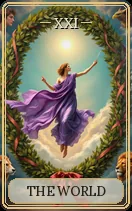 The World — A cycle coming full circle: the reckoning made, the work completed, the passage to another stage.
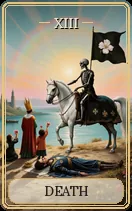 Death — Rebirth after an ending; what has finished opens the way to a new life.
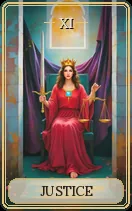 Justice — A fair decision; a legal process or an assessment with a balanced result.
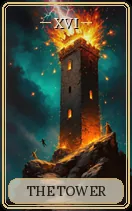 The Tower — An awakening triggered by an upheaval; the crisis that forces you to rethink everything.
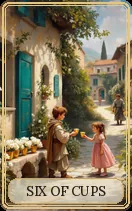 Six of Cups — Someone or something from the past returning; a reunion.
 Eight of Cups — Leaving behind what no longer makes sense, in answer to an inner calling.
 Six of Swords — A necessary transition; moving out of a difficult phase into a calmer one.
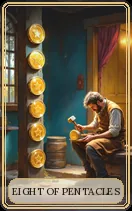 Eight of Pentacles — A vocation discovered or refined through work.
 Eight of Wands — Swift, decisive news; an answer that arrives.
 The Hermit — A reckoning made in solitude; listening to the inner voice before deciding.
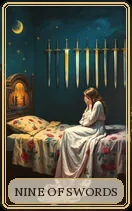 Nine of Swords — Guilt or remorse that prevents moving forward; judging yourself too harshly.
Frequently asked questions
What does Judgement mean in tarot?
A calling, a reckoning and a rebirth. It marks the moment to make an important decision, to take stock of a cycle and to seize a second chance.
What does Judgement mean in love?
Decisions and renewal: a relationship reborn, a reunion with someone from the past, or the moment to decide the future of a relationship. Reversed, it may speak of guilt or of difficulty letting go of the past.
Is Judgement a yes or a no?
It leans towards yes, especially in questions about going back, starting again or deciding. It does ask, however, that the decision be made with awareness.
Is Judgement reversed bad?
It is not a bad card, but it is a warning: there is a call that is not being heard, a reckoning deferred or an excess of self-criticism. It asks for honesty and the courage to take the step.
Does Judgement mean punishment?
No. Despite its name and the image of the Last Judgement, the card speaks of awakening and discernment, not condemnation. The angel calls; it does not punish.
No sign-up · Reading written on the spot · Free