
Seven of Swords: meaning and symbolism of the tarot card
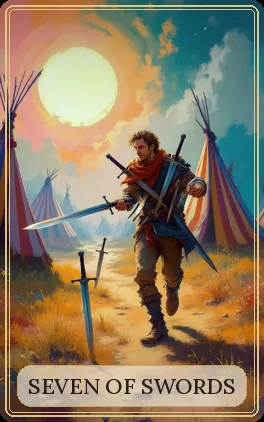
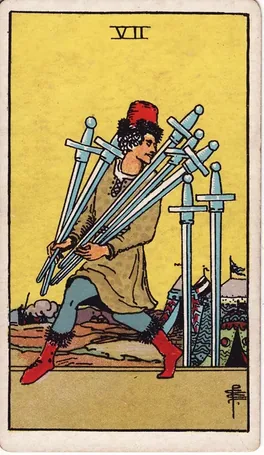
The Seven of Swords is the card of cunning. A man runs out of a camp with a bundle of swords under his arm, leaving two stuck in the ground behind him. There was no fight: he took what he wanted without anyone noticing. He wears a half-smile, and has the light step of someone who knows he cannot linger.
In a spread, the Seven of Swords speaks of strategy and secrecy — of acting on your own, through cleverness rather than force, of avoiding direct confrontation. It may be a smart manoeuvre, needed for self-protection. It may also be a deception, a half-truth, something done behind someone’s back. It is one of the most ambiguous cards in the suit: what decides it is the intention, and the cards beside it.
The card at a glance
| Card | Seven |
|---|---|
| Suit | Swords |
| Element | Air |
| Astrology | Moon in Aquarius (Golden Dawn) |
| Keywords | cunning, strategy, secrecy, discretion, cleverness, avoiding confrontation, acting alone, deception |
| Reversed | cunning found out, giving back, confession, guilty conscience, plan that fails |
| Yes or no | Maybe — it depends on whether something is being hidden |
The image on the card
In the Sol da Alma Tarot, a man with wavy brown hair runs along a dirt track through a camp of conical tents, striped red, yellow, white and blue, with their poles sticking out of the top. He wears brown leather clothing, loose trousers, boots and a red scarf around his neck. In his right hand he holds a sword out in front of him; against his other arm and on his back he carries a bundle of four more, held any old how. He glances sideways, with a half-smile. Behind him, stuck in the earth by the side of the track, two swords have been left. The ground is dry, golden grass; in the sky, orange and pink on one side and blue on the other, a large pale sun shines.
In the 1909 Rider-Waite-Smith, the scene is essentially the same, and it was the starting point for the Sol da Alma painting: a man tiptoes out of a military camp carrying five swords by their blades, and looks back over his shoulder; two swords remain stuck in the ground. The sky is yellow, the tents have flags, and in the distance a small group of figures can be seen. The Sol da Alma has the man running instead of sneaking, swaps the military tents for striped conical ones, and adds a large sun to the sky.
In the Marseille Tarot, the numbered cards have no scene. The Seven of Swords shows curved blades interlaced in a kind of oval, with a straight sword running through the centre, as in the other odd numbers of the suit. The man fleeing the camp is a creation of the Rider-Waite-Smith.
The symbolism, detail by detail
In this card nothing is said openly. Each detail adds a nuance to the difference between cleverness and deception.
- The man running away
- Someone who acts alone, on his own account, without asking permission. He may be a strategist, a survivor or a thief — the card does not say which.
- The five swords taken
- What can be got away with without confrontation: advantage, information, resources. They are held badly, in a bundle: the manoeuvre worked, but it is fragile.
- The two swords left behind
- What could not be taken, or what was left on purpose. It may be carelessness — evidence left behind — or a sign that not everything can be solved by cleverness.
- The sideways glance
- The watchfulness of someone who does not want to be caught. In the Rider-Waite-Smith, he looks back; in the Sol da Alma, he looks away with a half-smile, pleased with himself.
- The running
- In the Sol da Alma painting, the man runs, instead of creeping on tiptoe. Cunning picks up speed: he has to get out before anyone notices.
- The camp
- The group, the community, the rules everyone shares. The man is leaving it: he acts on the margins, against the group or in spite of it.
- The striped tents
- An addition of the Sol da Alma: they recall a fairground or a circus, a place of passing through and of appearances. Nothing there is permanent.
- The red scarf
- Daring, energy, a touch of vanity. Doing what he does takes nerve and a certain boldness.
- The large sun
- Everything happens in broad daylight. What is done in secret sooner or later ends up in plain view.
The history of the Seven of Swords
The tarot was born in northern Italy in the fifteenth century as a card game — the tarocchi — with the four suits of the Latin cards. In the oldest decks, such as those painted for the Visconti and the Sforza in Milan around 1450, and later in the Marseille decks, which settled into their form between the seventeenth and eighteenth centuries, the numbered cards showed only the suit symbols. The Seven of Swords was an arrangement of blades, and its meaning came from the suit and the number.
The Hermetic Order of the Golden Dawn, at the end of the nineteenth century, gave each numbered card a planet in a sign and a title. The Seven of Swords is the Moon in Aquarius, with the title ‘Lord of Unstable Effort’. The title underlines the fragile side of the card: an effort that rests on nothing solid, and can come apart at any moment.
The scene of the man running off with the swords was born with the Rider-Waite-Smith, drawn by Pamela Colman Smith under the direction of Arthur Edward Waite and published in 1909 — the first widely circulated deck with scenes on all the Minors. Waite describes a man carrying off five swords rapidly, leaving the other two stuck in the ground, with a camp close at hand, and gives the card the meanings of design, attempt, wish, hope and confidence — and also of quarrelling, a plan that may fail, annoyance. The modern reading has put the emphasis on cunning and secrecy, and that is the one the Sol da Alma follows.
The Seven of Swords upright: the meaning
Upright, the Seven of Swords is cunning. Someone gets what they want without facing anyone: through intelligence, strategy, discretion. It may be the person asking — who finds a clever way out of a difficult situation — or someone else, acting behind their back. The card speaks of plans that are not announced, of manoeuvres, of moves made in silence.
It is not always negative. There are situations in which direct confrontation does not help, and discretion is the wisest course: leaving a hostile environment without making a fuss, protecting an idea before showing it, acting alone when the group is no help. The Seven of Swords is also the card of someone who thinks for themselves.
But its warning is clear: what is taken on the quiet is poorly held. It may be a matter of deception, of a half-truth, of dishonesty — your own or someone else’s. And the two swords left in the ground are a reminder that nobody can take everything without leaving a trace.
The Seven of Swords reversed
Reversed, the Seven of Swords does not become its own opposite: it is the same cunning, brought into the open. Very often, it is the manoeuvre found out — the secret revealed, the deception caught, the truth coming to light. It can be good news for whoever was being deceived, and a warning for whoever was deceiving.
It can also speak of a guilty conscience: the decision to give back what was taken, to confess, to stop hiding. Or of cunning turned against oneself — self-deception, the excuses you make to yourself, the plan that fails from being too clever by half. In both cases, the card asks the same thing: stop running, and put the swords on the table.
The Seven of Swords in love
In love, the Seven of Swords calls for attention. It may speak of secrets in a relationship, of someone who does not tell the whole story, of infidelity, or simply of a person who protects themselves too much and does not show who they really are. It can also describe a relationship lived in secret, or someone who runs away from commitment without facing the conversation.
It is not always betrayal: sometimes it is just strategy — not showing your whole hand at the start, moving forward with care. For those who are single, it warns against people who promise a lot and show little. Reversed, it speaks of truths that come to the surface: a secret revealed, a frank conversation, someone who decides to be honest.
The Seven of Swords in work and money
At work, it is the card of strategy and office politics: discreet moves, information kept back, someone gaining an advantage without drawing attention. It can favour those who need to act intelligently and without fanfare — negotiating, preparing an exit, protecting an idea. But it also warns against disloyal colleagues, stolen ideas, promises that are not kept.
With money, it asks for care with contracts, with the small print, with deals that look too good to be true. It may speak of small schemes, of bending the rules, or of losses through carelessness. Reversed, it announces that something will come to light — an irregularity discovered, money returned, an account settled.
The Seven of Swords in health and wellbeing
In questions about wellbeing, the Seven of Swords is a reminder of the little evasions: the signs that are ignored, the advice that is heard and not followed, the habits hidden even from yourself. It asks you to be honest with yourself. The cards are no substitute for any kind of health care: here, as with any other card, the reading speaks of attitude, not of diagnosis.
The Seven of Swords in spiritual life
On the inner path, the Seven of Swords is an invitation to look at the small deceptions we practise on ourselves: the justifications, the shortcuts, the parts of life we would rather not examine. It is also the card of independent thought — leaving the camp of received ideas and going your own way. The difference between the two readings lies in sincerity: whoever sets out in search of the truth does not need to slip away in secret.
The Seven of Swords as advice
As advice, the Seven of Swords says: be strategic. Not every battle is won head-on; sometimes it is better to act discreetly, to think before showing your hand, to choose your moment. But it also says: do not deceive yourself. What is done in secret must be defensible in broad daylight. And if someone around you is playing behind your back, open your eyes.
The Seven of Swords in the positions of a spread
- In the past
- A manoeuvre, a secret or a deception that still has consequences — or a clever way out that solved a problem.
- In the present
- Something is not being said. It may be the strategy of the person asking, or someone else’s.
- In the future
- A moment when you will need to act with discretion and intelligence — or a warning of disloyalty.
- As an obstacle
- Dishonesty, a lack of transparency, or the temptation to run away rather than face things.
- As the outcome
- You get part of what you want, but not all of it. And what was done in secret may yet come to be known.
Numerology and correspondences
The Seven is what is done alone: with no support or rule any more, at the risk of whoever does it. In the suit of Swords — the suit of Air, of thought, of speech and of conflict — this is the mind acting on its own account, outside the group’s rules. After the crossing of the Six, thought now seeks its own advantage: it calculates, works its way around, takes the shortcut. It is intelligence without witnesses — capable of the best and the worst.
In the Golden Dawn tradition, the Seven of Swords corresponds to the Moon in Aquarius and bears the title ‘Lord of Unstable Effort’. The Moon is the heavenly body of what changes, what hides and what is felt without being said; Aquarius, an Air sign, is the sign of independence and thinking on the margins. The two together give the card the mind that acts alone and in the shadows, with a steadiness that is never complete.
Combinations with other cards
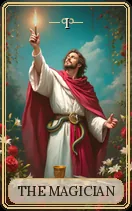 The Magician — Skill and manipulation: intelligence used to persuade, sometimes to deceive.
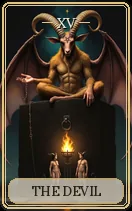 The Devil — Deception, dependence or foul play; a secret that binds.
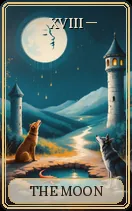 The Moon — Illusions and secrets: nothing is what it seems, and it pays to be suspicious.
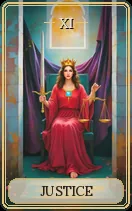 Justice — The deception found out; a matter that ends up being judged fairly.
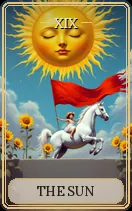 The Sun — The truth comes out into the light of day; what was hidden is revealed.
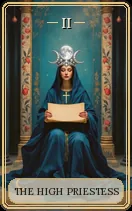 The High Priestess — Secrets kept; information that cannot yet be revealed.
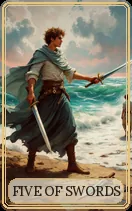 Five of Swords — Victory by less than clean means; watch out for disloyalty.
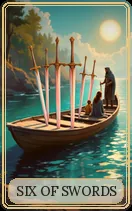 Six of Swords — A discreet exit; leaving without making a fuss.
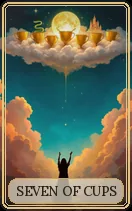 Seven of Cups — Fantasies and illusions; promises that will not be kept.
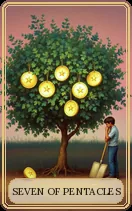 Seven of Pentacles — Take care with what you have invested: someone may be taking advantage.
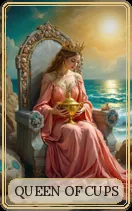 Queen of Cups — Intuition that unmasks a deception; sensing what is not being said.
Frequently asked questions
What does the Seven of Swords mean in tarot?
Cunning and strategy: getting something without direct confrontation, acting alone, keeping a secret. It may be a clever way out or a deception, depending on the intention and the neighbouring cards.
Does the Seven of Swords mean betrayal?
It can, especially with cards such as The Moon or The Devil. But not always: it often speaks simply of strategy, of discretion, or of someone protecting themselves without showing their whole hand.
What does the Seven of Swords mean in love?
Secrets, a lack of transparency, someone who does not tell the whole story or who avoids the conversation. Reversed, it speaks of truths coming to the surface and of a possible frank conversation.
Is the Seven of Swords reversed good?
It can be: the cunning is found out, secrets come to light, someone decides to give back what they took. It is good for whoever was being deceived, and a warning for whoever was deceiving.
Is the Seven of Swords a yes or a no?
It is a maybe. If the question involves trusting someone, it calls for caution. If it involves a strategy of your own, it says it may work — as long as you do not deceive yourself.
No sign-up · Reading written on the spot · Free