
Ten of Swords: meaning and symbolism of the tarot card
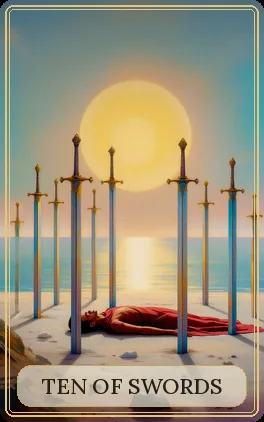
The Ten of Swords is the rock-bottom card. A man lies stretched out on the ground, surrounded by ten swords. The end has been reached: there is nothing more to lose, no more blows left to deal. And yet, on the horizon, the sun is rising. That is exactly the card’s message — the worst has happened, and that is why it is behind you.
In a spread, the Ten of Swords frightens many people who see it for the first time. It speaks of endings, of defeats, of exhaustion, of situations that cannot be mended. But it is rarely a card of catastrophe: it is a card of the full stop. It says that a painful cycle has reached its limit, that there is no point in continuing to fight for what is already over, and that, from here, the only possible direction is up.
The card at a glance
| Card | Ten |
|---|---|
| Suit | Swords |
| Element | Air |
| Astrology | Sun in Gemini (Golden Dawn) |
| Keywords | ending, rock bottom, exhaustion, defeat, full stop, the worst is over, turning point |
| Reversed | slow recovery, healing, getting up little by little; or refusing to accept the end |
| Yes or no | No to what you are asking — yes to what comes after |
The image on the card
In the Sol da Alma Tarot, the scene takes place on a beach of pale sand, at sunrise or sunset. A dark-haired man lies on his back on the sand, eyes closed and face serene, arms stretched out alongside his body. He is covered by a red cloth that leaves his shoulders bare and spreads over the sand down to his feet. Around him, ten tall swords are planted in the sand, points down, their golden hilts turned to the sky and their blades gleaming blue, pink and gold in the sunlight; none of them touches him. Behind, the sea is calm and blue, and a large, half-veiled disc of pale yellow sun rests on the horizon line, tracing a path of light across the water. The sky shades from blue to pink to yellow. On the sand lie a few stones and shells; on the left, in the foreground, there is a rock.
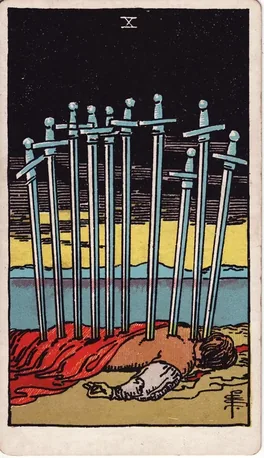
In the 1909 Rider-Waite-Smith, the image is far more violent: a man lies face down by the water, with the ten swords driven into his back, from neck to legs, and a red cloth over his body. The sky is black, but in the distance, above calm water and some hills, a band of yellow opens up — the light that is coming. One of the man’s hands, in view, makes a gesture with its fingers that many readers compare to a blessing. The Sol da Alma keeps the essential elements — the outstretched man, the red cloth, the ten swords, the calm water, the light on the horizon — but radically softens the scene: the swords are planted around the man rather than in his body, he lies on his back with a peaceful face, and the black sky has given way to a luminous dawn. The Sol da Alma painting puts the emphasis where the modern reading puts it: on the ending, not the wound; on the light that is coming, not the darkness that remains.
In the Marseille Tarot, the Dix d’Épée has no scene: it shows only the swords of the suit, in an ornamental design of interlaced blades. The outstretched man and the swords around him are a creation of Pamela Colman Smith.
The symbolism, detail by detail
This card speaks of an ending that is also a passage. Each detail adds a nuance to that idea.
- The outstretched man
- Exhaustion, defeat, the moment when there is no strength left to carry on. He is lying down because he has reached his limit — but nothing says he will not get up.
- The serene face
- In the Sol da Alma painting, the man is not suffering: he is resting. It is the paradoxical relief of someone who no longer has to fight, because everything that could happen has happened.
- The ten swords
- The suit at its fullest: every thought, every harsh word, every possible blow. Ten is the number in which nothing more will fit — and so the number in which the cycle closes.
- The swords around him, not in him
- In the Sol da Alma, the swords surround the man without piercing him. The ending is total, but the essence of the person has been left intact.
- The red cloth
- The life and passion that go on, the energy that seems lost but is only at rest. In the Rider-Waite-Smith, it is also read as the wound; here, it is above all a mantle.
- The sun on the horizon
- The day that is breaking. This is the detail that changes everything: however bad the ending, it is happening at dawn. The next cycle has already begun to arrive.
- The path of light on the water
- The way out that opens up ahead of whoever is on the ground. There is no need to see it yet; it is enough to know it is there.
- The calm sea
- After the storm, stillness. The emotions have settled; there is nothing left to stir up.
- The beach
- The borderland between land and water, between what has ended and what is coming. The man is on the brink of a crossing.
- The shells and stones
- What the sea leaves behind when it draws back: the remains, the lessons, the small treasures you pick up when the tide goes out.
The history of the Ten of Swords
In the first tarot decks, painted in northern Italy in the fifteenth century, and later in the Marseille decks, which took their settled form between the seventeenth and eighteenth centuries, the Ten of Swords was a pip card: just the swords of the suit, drawn in an ornamental pattern. It was used for playing, and its meaning in cartomancy came from the number and the suit.
At the end of the nineteenth century, the Hermetic Order of the Golden Dawn gave it the title ‘the Lord of Ruin’ and associated it with the Sun in Gemini. ‘Ruin’ is a strong word, but it helps to understand the card: it does not speak of a single wound, but of the collapse of a whole structure — a plan, a relationship, a way of thinking — that has come to an end.
The image known today was born in 1909, in the deck by Arthur Edward Waite and Pamela Colman Smith: the outstretched man with the ten swords driven into his back, under a black sky with a band of light. It is one of the most striking images in tarot, and it contributed to the card’s bad reputation. The modern reading, however, tends to stress the band of light and the idea that the worst is over — the same reading that the Sol da Alma painting makes explicit, by exchanging violence for rest and the black sky for dawn.
The Ten of Swords upright: the meaning
Upright, the Ten of Swords is the card of the ending that is complete. A situation has reached its full stop: a relationship that has ended, a project that has failed, a conflict that has been lost, a phase of life that has run its course. Everything that could happen has happened. The card does not say it is pleasant; it says it is final.
It is also the card of exhaustion. The person has fought, resisted, tried to save what could be saved — and has hit the ground. It may be physical and mental tiredness, the feeling of having given everything, defeat acknowledged. Sometimes it speaks of a betrayal or a wound inflicted by others; more often, of a process that has simply worn itself out.
And yet the card’s essential message is one of turning. When there is nothing more to lose, there is nothing more to fear. Rock bottom is also the firm ground on which you can, at last, plant your feet to climb back up. The worst is over — it is not still to come. The Ten of Swords often brings a kind of relief: the ending, however painful, frees you from the agony of waiting and of useless struggle.
That is why the card advises against prolonging what has ended. There is no point in reviving what has died or in continuing to strike at what is already down. What is needed now is to accept, to rest, and to let the day break.
The Ten of Swords reversed
Reversed, the Ten of Swords does not become its own opposite: it is the same ending, lived slowly. It is the slow recovery — the blades are drawn out one by one, without hurry, and the person gets up little by little. The card speaks of healing, of strength gradually returning, of a phase in which the worst no longer hurts so much but still leaves its marks. It asks for patience: nobody gets up from a blow like this in a single day.
In other cases, the reversal speaks of resisting the ending: the person refuses to accept that it is over, and stays lying in the same spot, reliving the fall. Or they fear a ruin that has not yet come and live as though it already had. In any of these senses, the card asks for the same thing — to accept what has ended, so that healing can begin.
The Ten of Swords in love
In love, the Ten of Swords often speaks of an ending: a separation, a disappointment, a relationship that has reached its limit. It may point to a painful break-up, or to a relationship that had been dead for some time and is finally recognised as such. It says, frankly, that there is no point in insisting.
But it also says that the suffering has an end. After this card comes the time to heal and to start again, with the experience that remains. Reversed, it is the card of emotional recovery, slow but steady — or a warning that you are clinging to a relationship that is already over.
The Ten of Swords in work and money
In work, the card may indicate the end of a job, a project or a collaboration, an acknowledged failure, or burnout that forces you to stop. Sometimes it speaks of a toxic working environment that has reached the point of no return. Hard as it is, the card sets you free: it closes a door that was no longer any use, so that another can open.
In money, it speaks of losses or of a lean period that has reached its lowest point. Upright, it asks you to accept the loss and stop feeding it; reversed, it points to a gradual recovery, made of small steps.
The Ten of Swords in health and wellbeing
In questions about wellbeing, the Ten of Swords speaks of extreme tiredness, of an absolute need for rest, of a body and mind begging to stop. It is the card of someone who lies down because they cannot go on — and who needs to do so. Reversed, it speaks of gradual recovery and of patience with your own pace. The cards are no substitute for any kind of health care: the reading speaks of attitude and tendency, not of diagnosis.
The Ten of Swords in spiritual life
On the inner path, the Ten of Swords is the death of the ego in miniature: the moment when all the ideas about who you were and what you ought to have fall away. Many traditions speak of this emptying as a condition of renewal — only someone who reaches the ground discovers what remains when everything else falls. The sun on the horizon is the promise of that renewal: the end of one form is the beginning of another.
The Ten of Swords as advice
As advice, the Ten of Swords says: let it end. Do not prolong the struggle, do not relive the fall, do not wait for what has died to rise again. Rest, accept, and turn towards the horizon. The worst is over; what comes next begins when you stop looking at the swords.
The Ten of Swords in the positions of a spread
- In the past
- A painful ending or a defeat that left its mark on the person, and which they are now coming out of.
- In the present
- The lowest point: something has ended, or is ending. The card says that from here on the only way is up.
- In the future
- The approaching end of a situation that has been dragging on; a full stop that, however hard, sets you free.
- As an obstacle
- The refusal to accept that something is over; or the exhaustion that prevents any reaction.
- As the outcome
- The matter comes to an end. Not in the way you wanted, perhaps — but definitively, making room for a new cycle.
Numerology and correspondences
Ten is the end of the cycle: everything the suit could give has been given, with all the abundance and weight that brings. In Swords — Air, thought, the word, decision and conflict — what the suit gives in excess are wounds: words that cut, decisions that divide, conflicts that wear you out. The Ten of Swords is the end of that cycle: cutting taken to the maximum, until there is nothing left to cut. That is why it is also the turning point — after the Ten, the sequence begins again with the Ace, the fresh clarity of a clear mind.
In the Golden Dawn, the card corresponds to the Sun in Gemini. At first sight, this is a surprising association: the Sun is the luminary of life and consciousness. But that is precisely what explains the card — the light rising on the horizon, the awareness that emerges when everything falls. Gemini, the sign of Air and of thought, provides the ground: it is the mind that is exhausted, and it is in the mind that the new day begins. The title the Golden Dawn gave it, ‘the Lord of Ruin’, speaks of the fall; the Sun that rules it speaks of what comes after.
Combinations with other cards
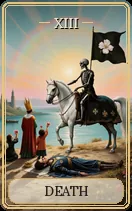 Death — A final and necessary ending; the transformation that demands letting go.
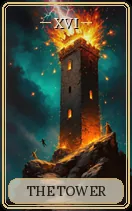 The Tower — A sudden and complete fall; what was badly built collapses for good.
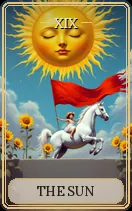 The Sun — After rock bottom, the light: a clear and joyful recovery.
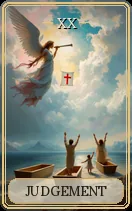 Judgement — Awakening after the ending; getting up and starting again with a new awareness.
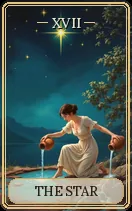 The Star — Hope born from ruin; the healing begins.
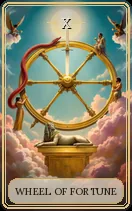 Wheel of Fortune — The wheel has hit the bottom — and, for that very reason, it will rise again.
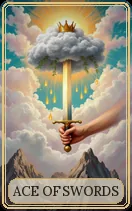 Ace of Swords — A clear-headed fresh start: the mind swept clean after everything has fallen.
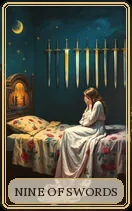 Nine of Swords — Anguish that reaches its limit and, for that reason, its end.
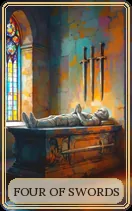 Four of Swords — Rest and recovery after the blow; stopping to heal.
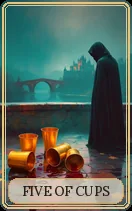 Five of Cups — Grieving a loss; mourning what has ended before moving on.
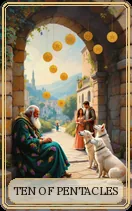 Ten of Pentacles — The end of a phase connected with family, inheritance or the home.
Frequently asked questions
What does the Ten of Swords mean in tarot?
The ending that is complete: a situation has reached its full stop, and the worst has already happened. It is rock bottom, but with the day breaking — from here, the only way is up.
What does the Ten of Swords mean in love?
Often, a separation or the end of a relationship that had already run its course. It says there is no point in insisting, and that the suffering has an end.
Is the Ten of Swords a yes or a no?
It is a no to what you are asking, especially if it is about saving something that is already over. But it is a yes to the fresh start that comes afterwards.
Is the Ten of Swords reversed a good sign?
It is the same card lived slowly: the slow recovery, the wounds healing. It can also indicate resistance to accepting the end. Either way, it asks for patience.
Does the Ten of Swords foretell disaster?
No. It does not predict tragic events: it describes the end of a painful cycle. The light on the horizon says that the worst is over, not that it is still to come.
No sign-up · Reading written on the spot · Free