Nine of Swords: meaning and symbolism of the tarot card
The Nine of Swords is the three-in-the-morning card. A woman has sat up in bed in the middle of the night and covers her face with her hands. Nine swords hang on the dark wall above her. Nobody is attacking her; the swords do not touch her. What woke her is what is running through her head — worry, remorse, fear of what may come.
In a spread, the Nine of Swords speaks of anguish, of anxiety and of sleepless nights. It is one of the heaviest cards in the deck to draw, because it gives shape to very real suffering. But the traditional reading adds an important nuance: the pain is often greater than the facts. The swords are on the wall, not in the body. What the card asks is that you tell apart what is actually happening from what the mind, alone and in the dark, makes of it.
The card at a glance
| Card | Nine |
|---|---|
| Suit | Swords |
| Element | Air |
| Astrology | Mars in Gemini (Golden Dawn) |
| Keywords | anguish, worry, sleeplessness, guilt, remorse, fear, thoughts that will not stop |
| Reversed | relief, fear named, unburdening, hope at daybreak; or hidden anguish |
| Yes or no | Not for now — but the fear is greater than the facts |
The image on the card
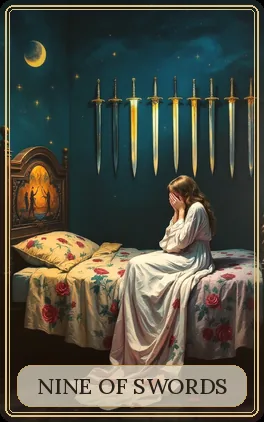
In the Sol da Alma Tarot, a young woman with long light-brown hair sits on the edge of a bed, in a loose white nightdress that falls to the floor, and hides her face in both hands. The bed is of dark turned wood, with a pillow and a cream-coloured coverlet printed with large red roses and green leaves. In the centre of the headboard is a painted panel in shades of orange and gold, where two dark figures face each other — one with an arm raised against the other. The bedroom wall is a deep petrol blue, scattered with small stars, and in the upper left corner there is a crescent moon. On the wall above the woman, nine swords hang in a row, all vertical and pointing downwards, some silver, some gold, a few gleaming as if catching the light.
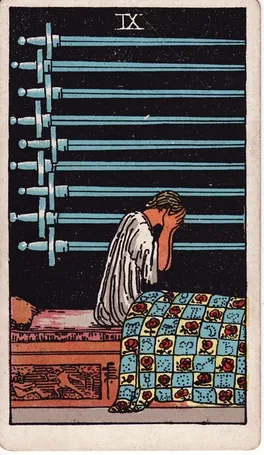
In the 1909 Rider-Waite-Smith, the scene is very similar: a figure sitting up in bed, in a white nightshirt, hides their face in their hands, in a room with a completely black background. The quilt is made of squares with roses and astrological symbols, and the side of the bed shows, carved into it, one figure attacking another. The nine swords are horizontal, stacked one above the other, like bars cutting across the darkness. The Sol da Alma follows this iconography — the seated figure, the hands over the face, the white nightdress, the roses on the quilt, the combat scene on the woodwork of the bed, the nine swords — but changes their arrangement: here the swords are vertical, hanging side by side, not stacked. The absolute black of the original has given way to a blue night, with stars and a moon, and the combat has moved from the side of the bed to the headboard. The night is less oppressive and more human; the pain is the same.
In the Marseille Tarot, the Neuf d’Épée is simply a design of the suit’s blades, curved and interlaced, with one straight sword running through the middle, and no scene of any kind. The sleepless woman is a creation of Pamela Colman Smith.
The symbolism, detail by detail
The card speaks of the mind that cannot rest. Each detail adds a nuance to that idea.
- The hands over the face
- Anguish, shame, weeping, the gesture of someone who does not want to see — or has already seen too much. It is also the gesture of someone alone with what they feel.
- The nine swords on the wall
- Thoughts: worries, guilt, scenarios, questions with no answer. They are hanging, not driven in — they threaten, but they do not wound. It is the image of anxiety: suffering over what has not yet happened, or can no longer be changed.
- The swords pointing downwards
- In the Sol da Alma painting, the blades point at the woman, as if they could fall at any moment. It is the weight of a threat hanging overhead, more felt than real.
- The night
- The hour when everything seems worse. In the dark, with no distractions and no other voices, the mind magnifies problems. This is, above all, a night-time card.
- The crescent moon
- The night is only halfway through, but it has an end. The waxing moon speaks of something still taking shape — and is a reminder that dawn always comes.
- The stars
- Small lights in the darkness: even at the worst of the night, there is some brightness for anyone who looks up.
- The bed
- The place of rest, turned into a place of wakefulness. The card very often speaks, quite literally, of nights of poor sleep.
- The roses on the coverlet
- Life, love, the beauty that is still there, within reach, but that the woman cannot see at that moment. The coverlet is still a possible comfort.
- The combat on the headboard
- The painted scene of one figure attacking another: the conflict replayed in memory, the argument you cannot get out of your head, the guilt over something done or suffered.
- The white nightdress
- Vulnerability and innocence. The woman is unprotected, without armour: that is how we are at night, alone with our own thoughts.
The history of the Nine of Swords
In the oldest tarot decks, from fifteenth-century northern Italy, and later in the Marseille Tarot, which took its settled form between the seventeenth and eighteenth centuries, the Nine of Swords showed only the swords of the suit, with no human figure. The meaning of the numbered cards came from the suit and the number, not from a picture.
At the end of the nineteenth century, the Hermetic Order of the Golden Dawn gave it the title ‘the Lord of Despair and Cruelty’ and associated it with Mars in Gemini. It is one of the darkest titles in the whole system, and it helped to fix the card’s reputation as one of the hardest in the deck.
Arthur Edward Waite and Pamela Colman Smith, in the 1909 deck, gave it the scene recognised today: the figure sitting up in bed, face hidden, beneath nine swords. By placing the suffering in a bedroom, at night, rather than on a battlefield, the painting transformed the card: despair came to be lived from within, as anguish and sleeplessness. It is this more psychological reading that prevails today — and that is why many readers insist that the Nine of Swords describes the fear more than the event.
The Nine of Swords upright: the meaning
Upright, the Nine of Swords is the card of anguish. It speaks of intense worry, of anxiety, of sleepless nights, of thoughts that go round and round and never reach any conclusion. Whoever draws it is often going through a time of great distress — over a concrete problem, a decision, a person, or a vague fear they cannot yet put a name to.
It is also a card of guilt and remorse. The mind keeps returning to the same point: what was said, what was done, what should have been done. The swords on the wall are those memories, which light up when everything else goes dark.
The key to the card lies in the fact that the swords do not touch the woman. The pain is often greater than the facts: what is feared has not yet happened, or it has happened and is less serious than it seems at three in the morning. This does not lessen the suffering — it is real — but it changes what can be done with it. It is not a matter of solving the whole world in the night; it is a matter of waiting for the light, and of not staying alone with what weighs on you.
Sometimes the Nine of Swords also speaks of worry about someone else: the anguish of watching someone close go through difficulties without knowing how to help.
The Nine of Swords reversed
Reversed, the Nine of Swords does not become its own opposite: it is the same anguish, but beginning to give way — or to hide. In the first sense, it is relief at daybreak. The fear is named, and it shrinks; you talk to someone, and the weight is shared; you look at the problem in daylight, and it has edges. It is often the card of unburdening, of help asked for, of the first good night’s sleep after many bad ones.
In the second sense, the reversal turns the anguish inwards: the worry you tell no one about, the guilt kept secret, the smile by day and the hands over the face at night. In this case, the card asks for precisely what the first reading promises: that the fear be spoken aloud, because it is in silence that it grows.
The Nine of Swords in love
In love, the Nine of Swords speaks of worry and insecurity: nights spent thinking about the relationship, jealousy, fear of losing the other person, or remorse over something that went wrong. It may describe the anguish of a separation, or the anxiety of waiting for an answer that does not come. Often, what is imagined is worse than what is actually going on.
The advice is to talk rather than ruminate. Reversed, it announces exactly that: a frank conversation that brings relief, a misunderstanding cleared up, the end of a period of heartache — or, if the anguish is being hidden, a warning that silence is wearing the relationship down.
The Nine of Swords in work and money
In work, the card describes the stress you take home with you: deadlines, fear of failing, fear of losing your job, a conflict you cannot get out of your head. It can indicate a period of great mental pressure, in which tiredness distorts your sense of what is urgent. It asks you to separate the real problems from the catastrophic scenarios, and to deal with them one at a time.
In money, it speaks of financial worries that keep you awake. Upright, it asks you to put your finances down on paper — the actual figure is usually less frightening than its shadow. Reversed, it shows that the squeeze is starting to ease, or that the moment has come to ask for help or advice.
The Nine of Swords in health and wellbeing
In questions about wellbeing, the Nine of Swords speaks of sleep, of rest and of mental tension. It asks for calming routines, less screen time at night, and above all that you do not carry what weighs on you alone. If the anguish goes on, the card is a reminder that seeking help is an act of courage. The cards are no substitute for any kind of health care: the reading speaks of attitude and tendency, not of diagnosis.
The Nine of Swords in spiritual life
On the inner path, the Nine of Swords is the dark night in miniature: the moment when the mind turns against itself and everything seems lost. Many traditions teach that this night is not overcome by fighting the thoughts, but by observing them — noticing that they are hanging on the wall, not driven into the body. The card invites prayer, meditation, any practice that brings the spirit back to the present, where the swords have not yet fallen.
The Nine of Swords as advice
As advice, the Nine of Swords says: do not decide anything at three in the morning. Wait for daylight, write down what is worrying you, talk to someone you trust. Separate what has happened from what you fear might happen. Fear that is named shrinks; fear kept silent grows.
The Nine of Swords in the positions of a spread
- In the past
- A period of great anguish whose marks — insecurity, mistrust, light sleep — can still be felt.
- In the present
- The person is worried, tired, ruminating. The card asks them to tell fact from fear.
- In the future
- A warning of a period of worry; or that, if nothing changes, the anxiety will grow. It is not a sentence: it is an alert.
- As an obstacle
- The anguish itself, which prevents clear thinking and action.
- As the outcome
- If fear keeps making the decisions, the matter brings more worry than solutions. Reversed, the end of the night.
Numerology and correspondences
Nine is the extreme of the suit: its quality taken to the limit, for better and for worse. In Swords — Air, thought, the word and decision — the limit is the mind without rest. Thought, which in the Ace cut through and clarified, here reaches the point where it no longer cuts anything: it only wounds the one who thinks. It is the intellect at its extreme, turned against itself. After the Eight, where the mind held you captive, the Nine is the mind that will not let you sleep; the Ten will close the cycle with rock bottom — and, for that very reason, with the turning point.
In the Golden Dawn, the card corresponds to Mars in Gemini. Mars is the planet of conflict, aggression and cutting; Gemini, the Air sign of thought and the word, always on the move. Together, they give an exact picture of the card: the war waged inside one’s head, with the mind’s own weapons. Hence the title the Golden Dawn gave it, ‘the Lord of Despair and Cruelty’ — a cruelty that, in this case, is almost always the one a person inflicts on themselves.
Combinations with other cards
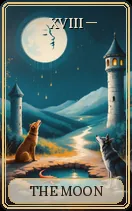 The Moon — Night-time fears and confusion; the imagination painting the worst-case scenario.
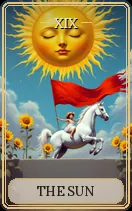 The Sun — The end of the night: the anguish lifts, the light returns.
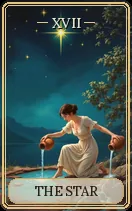 The Star — Hope after distress; healing that begins in silence.
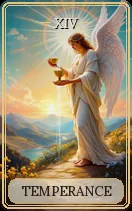 Temperance — Calm and patience to get through the anxiety; balance returning.
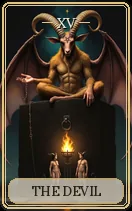 The Devil — Guilt or an obsession that holds you captive; compulsive thoughts.
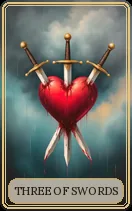 Three of Swords — A hurt you cannot get out of your head; nights spent crying over a heartbreak.
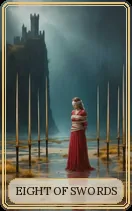 Eight of Swords — From mental prison to sleeplessness: the mind that traps you and will not let you rest.
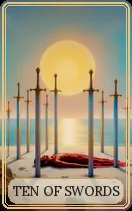 Ten of Swords — The worst comes to an end; after the anguish, the turning point.
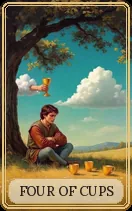 Four of Cups — Sadness and apathy; closing yourself off to what is offered.
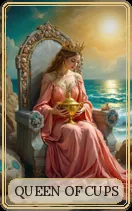 Queen of Cups — Someone who listens and welcomes; anguish shared is lighter.
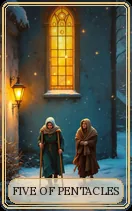 Five of Pentacles — Financial worries that keep you awake; fear of going without.
Frequently asked questions
What does the Nine of Swords mean in tarot?
Anguish in the night: worry, anxiety, guilt, thoughts that will not let you sleep. The card is a reminder that the pain is often greater than the facts.
What does the Nine of Swords mean in love?
Insecurity, jealousy, remorse or the suffering of a separation — nights spent thinking about the relationship. It asks for conversation rather than rumination.
Is the Nine of Swords a yes or a no?
It leans towards no, or towards ‘not yet’: the situation is wrapped in worry. But the fear is usually greater than the reality.
Is the Nine of Swords reversed a good sign?
Often, yes: it is relief at daybreak, the fear that is named and shrinks. It can also indicate hidden anguish, and in that case it asks you to talk about it.
Is the Nine of Swords the worst card in tarot?
It is one of the heaviest, but it does not predict disasters. Above all it describes a state of mind — anguish, fear, guilt — and the swords on the wall are a reminder that the suffering comes more from thought than from the facts.
No sign-up · Reading written on the spot · Free