
Queen of Cups: meaning and symbolism of the tarot card
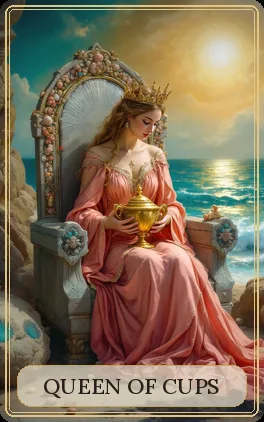
The Queen of Cups is the figure of calm, deep waters. Seated on a stone throne covered in shells, by the sea, a young queen holds a lidded golden cup in her lap and gazes at it in silence. She does not speak, she does not move, she gives no orders: she feels, and she holds what she feels. She is the image of mature compassion — of someone who can take in the pain of others because she has learnt to hold her own.
In a spread, the Queen of Cups speaks of intuition, empathy and care. She may represent a person — someone who listens, who supports, who understands without needing things explained — or an attitude that the situation calls for. Her strength is depth; her risk is the same thing, seen from the other side: someone who feels so much can lose their banks and drown in what they feel, or in what others feel.
The card at a glance
| Card | Queen |
|---|---|
| Suit | Cups |
| Element | Water |
| Astrology | Varies between schools |
| Keywords | compassion, empathy, intuition, care, serenity, emotional depth, welcome |
| Reversed | submerging emotion, excessive self-giving, emotional dependence, melancholy, fragile boundaries |
| Yes or no | Yes, calmly — the answer comes through intuition and care |
The image on the card
In the Sol da Alma Tarot, the Queen is a young woman with long golden-brown hair, wearing a tall-pointed golden crown. She wears a loose coral-coloured gown embroidered in gold at the neckline and sleeves, and a pendant on her breast. She sits on a throne of grey stone whose back is shaped like a large scallop shell, its frame entirely encrusted with shells and whelks of many colours; the arms of the throne end in blue and coral rosettes, and on one of them rests a small shell. Her eyes are lowered, and with both hands she holds in her lap a two-handled golden cup, closed with a lid. On the right, the turquoise sea breaks in white waves, and the sun, high in the sky, draws a path of golden light upon it; on the left, there are rocks carved with blue shells.
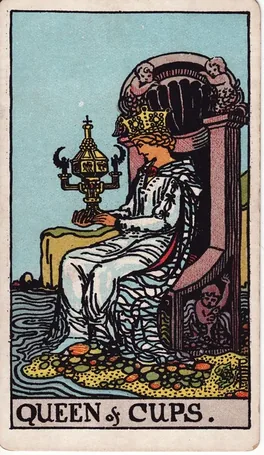
In the 1909 Rider-Waite-Smith, the Queen sits on a throne at the water’s edge, with coloured pebbles at her feet, and holds a very ornate cup, with handles shaped like winged figures and closed with a lid — the only closed cup in the suit in that deck — at which she gazes intently. At the top, the throne has a shell and small figures of sea children. The Sol da Alma follows this iconography closely: the throne by the sea, the shell on the back of the throne, the lidded cup, the gaze fixed upon it. What differs are the colours — the coral gown instead of the white and blue — the simpler cup, with no figures on the handles, and the golden sunlight on the sea, which is absent from the original.
In the Marseille Tarot, the Reine de Coupe is a seated, full-length figure with the cup, with no seascape. The sea, the shells and the lidded cup are contributions of the Rider-Waite-Smith.
The symbolism, detail by detail
The card speaks of a deep emotion that knows how to contain itself. Each detail adds a nuance.
- The lidded cup
- What is felt and not spilt. The Queen guards her inner world with care; she does not expose it, but she does not deny it either. It is the image of intimacy and of a secret well kept.
- The lowered gaze
- Attention turned inwards, contemplation, listening. The Queen of Cups perceives more than she sees.
- Both hands on the cup
- Care. She holds what she feels — and what others confide in her — with both hands.
- The sea beside her
- Emotion in its raw state, vast and in motion. The Queen sits at its edge, without going in: she feels the power of the waters, but stays on land.
- The stone throne
- Stability. This is what sets the Queen apart from the Page: sensitivity now has a firm seat.
- The shell on the back of the throne
- The shell is the house the sea makes; it guards and protects what is soft. It is also an ancient symbol linked to water and to the feminine.
- The shells and whelks on the throne
- Everything the sea has left behind: memories, experiences, small treasures gathered with patience.
- The path of light on the water
- The intuition that lights up the deep waters. The Queen does not need to see the bottom to know what is there.
- The coral gown
- A warm, soft colour, between the pink of tenderness and the red of life: mature affection, which warms without burning.
The history of the Queen of Cups
The queen has been one of the four court figures of each suit since the first tarot decks, painted in northern Italy in the fifteenth century. In the Marseille decks, which settled into their form between the seventeenth and eighteenth centuries, she is called Reine de Coupe and appears seated, cup in hand.
At the end of the nineteenth century, the Hermetic Order of the Golden Dawn reorganised the court figures and gave them other names, but the Queen kept hers — both there and, later, in the Thoth deck, by Aleister Crowley and Frieda Harris. Arthur Edward Waite and Pamela Colman Smith, in the 1909 deck, gave her the scene of the throne at the water’s edge and the ornate, lidded cup, which became the standard image and which the Sol da Alma follows closely.
The astrological and elemental attributions of the court cards vary between schools, and none is universally agreed. In everyday reading, however, the Queen of Cups is often regarded as the most emotional and most intuitive figure in the whole deck — Water lived from within.
The Queen of Cups upright: the meaning
Upright, the Queen of Cups is the card of compassion and empathy. She speaks of someone — the querent or another person — who feels deeply and who, for that very reason, knows how to take others in. She does not solve other people’s problems with quick advice: she listens, understands, is present. She is the figure people turn to when things go wrong.
She is also the card of intuition. The Queen perceives what is left unsaid, reads people, trusts what she feels. In a reading, she may say that the answer lies not in logic but in what is sensed, and that it is worth trusting that. She favours everything to do with care, creativity and inner life.
What sets her apart from mere sensitivity is containment. The cup is lidded: the Queen feels a great deal, but she does not come apart in what she feels. Her compassion is mature because it has banks — she knows where she ends and the other person begins.
The Queen of Cups reversed
Reversed, the Queen of Cups does not lose her sensitivity: she loses her banks. Emotion is no longer contained and begins to submerge — the person drowns in what they feel, or in what others feel. It may be the excessive self-giving of someone who looks after everyone and forgets themselves, emotional dependence, difficulty saying no.
It can also be the opposite movement, emotion turned inwards: melancholy, isolation, feelings kept in until they weigh heavy, a lidded cup no one can open. Or intuition confused with one’s own fantasies and fears. The card asks you to give the sea its banks — to look after yourself with the same tenderness with which you look after others.
The Queen of Cups in love
In love, the Queen of Cups is a card of great tenderness. She speaks of a relationship in which there is understanding, mutual care, emotional intimacy. She may represent an attentive, affectionate and faithful partner, or the querent’s own capacity to love. For someone who is single, she says that the heart is open and available, and that love comes when one is true to what one feels.
Reversed, she warns against giving too much without receiving, against dependence, against jealousy born of insecurity, or against keeping one’s feelings so guarded that the other person cannot reach them.
The Queen of Cups in work and money
In work, the Queen of Cups favours the caring and listening professions — health, education, counselling and support, social work — and also artistic and creative ones. She may represent an understanding colleague or boss, or ask you to use your intuition more in your decisions. She speaks of an environment in which human relationships matter.
With money, she is not a card of ambition: she is a card of sufficiency and generosity. She may indicate spending on others, or deciding with the heart. Reversed, she warns against lending or giving without measure, and against financial decisions made in a moment of emotion.
The Queen of Cups in health and wellbeing
In questions about wellbeing, the Queen of Cups speaks of looking after your emotional balance, of rest, of being near water, of anything that soothes. Reversed, she is a reminder that those who look after others also need looking after. The cards are no substitute for any kind of healthcare: the reading speaks of attitudes and tendencies, not of diagnoses.
The Queen of Cups in spiritual life
On the inner path, the Queen of Cups is contemplation. She is the card of someone who meditates, who prays, who listens to silence — of someone who looks into the cup. Her spirituality is made of compassion and intuition more than of doctrine. And she is a reminder that inner life needs to be guarded: not everything one feels should be said, and there are experiences that only ripen in secret.
The Queen of Cups as a person
When she represents someone, the Queen of Cups is traditionally a mature woman, or a person of any gender with these qualities: sensitive, intuitive, compassionate, welcoming, with a rich inner life. This is someone who listens without judging, who perceives what others feel before they say it, who often has an artistic talent. Her flaw is letting herself be carried away by other people’s emotions, or shutting herself up in her own.
The Queen of Cups as advice
As advice, the Queen of Cups says: listen to what you feel. Trust your intuition, be compassionate with yourself and with others, give time to what needs to be felt. And she also says: hold the cup. Empathy is not drowning in someone else’s pain — it is being able to support it without losing your footing.
The Queen of Cups in the positions of a spread
- In the past
- A person who cared, who took others in, who gave emotional security; or a period of great sensitivity.
- In the present
- The situation calls for empathy, listening and intuition — or there is someone like that beside the querent.
- In the future
- A phase of emotional serenity, or the arrival of someone who offers support.
- As an obstacle
- Excessive self-giving, emotions without banks, or shutting oneself away in what one feels.
- As the outcome
- The matter is resolved through understanding and care, more than through force.
The Queen and her correspondences
The Queen is the one who receives and sustains: the suit lived from within, with maturity and with no need to show it. In Cups, the suit of Water, this inwardness is doubled — the most inward figure of the most inward suit. That is why the Queen of Cups is, of all the court figures, the one that speaks most of feeling, sensing and keeping.
The element of the suit is Water. The elemental and astrological sub-attributions of the court cards vary between schools, and none is universally agreed; what matters is that the Queen represents Water that has settled and grown deep, after the movement of the Knight and before the rule of the King.
Combinations with other cards
 The High Priestess — Very strong intuition; knowing without needing to explain.
 The Moon — Deep, confused emotions; beware of fears passing themselves off as intuition.
 The Empress — Motherhood in the broad sense: care, creativity, nurturing.
 King of Cups — An emotionally mature couple; balance between feeling and governing what one feels.
 Two of Cups — A relationship of great tenderness and mutual understanding.
 Three of Swords — A hurt received with compassion; helping someone through heartbreak.
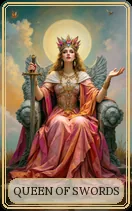 Queen of Swords — Heart and head in dialogue: empathy with clarity.
 Temperance — Emotional balance, healing of relationships, patience.
 Knight of Cups — Idealism that meets someone who knows how to receive it.
 The Devil — Emotional dependence; a devotion that binds instead of setting free.
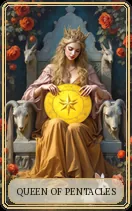 Queen of Pentacles — Practical and loving care: someone who supports through gestures and presence.
Frequently asked questions
What does the Queen of Cups mean in tarot?
Compassion and intuition: someone who feels deeply and knows how to contain what they feel so as to be able to support others.
What does the Queen of Cups mean in love?
A relationship of tenderness, care and emotional intimacy, or an attentive and affectionate partner. Reversed, she warns against excessive self-giving and dependence.
Is the Queen of Cups a yes or a no?
She leans towards yes, especially in matters of the heart. It is a serene yes, which asks you to trust your intuition.
Is the Queen of Cups reversed bad?
No. It is the same sensitivity without banks: emotions that submerge, excessive self-giving, or feelings shut away. She asks you to look after yourself as you look after others.
Does the Queen of Cups represent a woman?
Traditionally, a mature, sensitive and intuitive woman. But she can represent anyone with these qualities, or simply the attitude the situation calls for.
Why is the Queen of Cups’ cup covered?
Because the Queen keeps what she feels instead of spilling it. The closed cup is the image of intimacy, of inner life and of contained emotion.
No sign-up · Reading written on the spot · Free