
Queen of Swords: meaning and symbolism of the tarot card
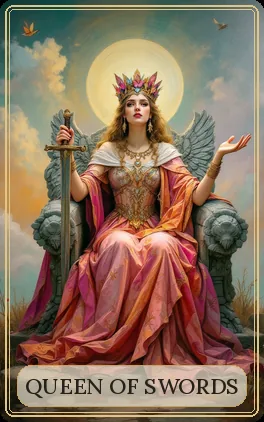
The Queen of Swords is the figure of the unveiled gaze. Seated on a winged stone throne, a sword in her right hand and her other hand open and raised, a queen looks straight at whoever is looking at her. She does not smile to please, nor does she lower her eyes: she sees. Hers is the clarity of someone who has been through loss and disappointment and has learned not to fool herself — nor to fool others.
In a spread, the Queen of Swords speaks of clarity, of honesty and of independence. It may represent a person — someone who tells the truth, who judges fairly, who is not swayed by flattery — or the attitude the situation calls for: seeing things as they are, not as you would like them to be. Her risk is the very edge of the sword: clarity that, without warmth, becomes coldness, and coldness that ends in isolation.
The card at a glance
| Card | Queen |
|---|---|
| Suit | Swords |
| Element | Air |
| Astrology | Varies between schools |
| Keywords | clear sight, clarity, honesty, independence, discernment, experience, the right word |
| Reversed | severity, coldness, bitterness, cutting criticism, isolation, mistrust |
| Yes or no | Yes, if the answer stands up to an honest look; no, if it depends on illusions |
The image on the card
In the Sol da Alma Tarot, the Queen is a young woman with long, wavy dark-blonde hair, seated facing forward on a throne of grey stone. On her head is a golden crown topped with points shaped like leaves or feathers, in pink, blue and green, and behind her head a large disc of pale light, like a veiled sun, forms a halo. She wears a full gown of pink and orange silk, with a bodice embroidered in gold and pale stones, and a white stole over her shoulders; she wears a gold necklace, earrings and bracelets. In her right hand she holds a long, gold-hilted sword upright, resting point-down on the ground like a staff. Her left hand is raised beside her shoulder, palm open and facing up. Behind her the throne has two great carved stone wings, and its arms end in lions’ heads, also of stone. She looks straight ahead, serious and serene. Around her is a sky of golden and blue clouds, two small birds in flight and, beside the throne, dry grasses.
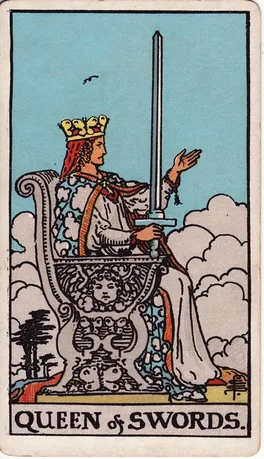
In the 1909 Rider-Waite-Smith, the Queen sits in profile, facing right, on a tall throne decorated with butterflies and, at its base, a winged child’s head. She holds her sword raised, point upwards, in her right hand, and holds out her open left hand, with a ribbon or tassel tied to her wrist. She has a crown with butterflies and a cloak patterned with clouds. Behind her are low clouds, trees and a single bird in the sky. The Sol da Alma keeps the essential gestures — the sword in one hand and the other hand open and raised, the carved stone throne, the clouds, the bird in the sky — but changes much of the rest: the Queen looks straight out rather than in profile, the sword rests point-down instead of being raised, the butterflies and winged child have given way to stone wings and lions’ heads, and the greyish-blue clothes of the original have become a warm pink and orange gown. The Sol da Alma Queen is less austere and more solemn; clear sight remains at the heart of the card.
In the Marseille Tarot, the Reine d’Épée is a seated, full-length figure with her sword, with no sky or landscape. The throne among the clouds and the open hand are contributions of the Rider-Waite-Smith.
The symbolism, detail by detail
The card speaks of a clear mind that knows what it sees. Each detail adds a nuance.
- The direct gaze
- Frankness. The Queen of Swords does not look away or hide behind evasions: she looks at things and people squarely, and expects the same of them.
- The sword
- Discernment, the ability to separate the true from the false, the essential from the incidental. It is the Queen’s weapon, but also her working tool.
- The sword pointing down
- In the Sol da Alma painting, the blade rests on the ground like a staff of justice: the Queen does not attack, but always has her judgement to hand. It is the authority of the word, not violence.
- The open, raised hand
- The gesture of someone who welcomes, receives or invites others to speak. Beside the sword, it is a reminder that the Queen’s clarity is not closed: she listens before she judges.
- The disc of light behind her head
- Mental clarity, awakened awareness. In the Sol da Alma, the light comes from behind the Queen, as if she herself were the source of the brightness.
- The stone wings
- Air, the suit’s element, and the elevation of thought. But they are made of stone: the Queen’s mind flies high and stays steady.
- The lions’ heads
- Courage and strength. The Queen of Swords may look delicate, but she rests on something solid and brave.
- The crown of feathers or leaves
- A light and colourful crown: authority that comes from thought and experience more than from power.
- The pink and orange gown
- The warmth that exists beneath the clarity. The Sol da Alma painting gives the Queen of Swords a humanity that the colder original does not show.
- The birds
- The freedom of thought, the view from above. The Queen sees far and sees from on high, like the birds.
- The dry grasses
- What has passed, what has been lost. Tradition says the Queen of Swords has known loss — and it is from that experience that her clarity comes.
The history of the Queen of Swords
The queen has been one of the four court figures of each suit since the first tarot decks, painted in northern Italy in the fifteenth century. In the Marseille decks, which took their settled form between the seventeenth and eighteenth centuries, she is called the Reine d’Épée and appears seated, sword in hand.
At the end of the nineteenth century, the Hermetic Order of the Golden Dawn reorganised the court cards and gave them other names, but the Queen kept hers — both there and, later, in the Thoth deck by Aleister Crowley and Frieda Harris. Arthur Edward Waite and Pamela Colman Smith, in the 1909 deck, gave her the scene of the throne in profile among the clouds, with the sword raised and the open hand, which became the reference image.
In traditional cartomancy, the Queen of Swords was for a long time given a dark reading: the widow, the woman alone, the woman who has suffered. The modern reading has kept the idea of experience and loss, but has turned it into a quality — the clear sight of someone who can no longer be fooled, the independence of someone who has learned to rely on herself. The astrological and elemental attributions of the court cards vary between schools, and none of them is universally agreed.
The Queen of Swords upright: the meaning
Upright, the Queen of Swords is the card of clear sight. It speaks of seeing clearly, even what you would rather not see: a relationship as it really is, a problem without the trimmings, a person without the mask they wear. The Queen is not carried away by illusions or by flattery; she weighs the facts, hears both sides, and reaches an honest conclusion.
It is also the card of the right word. The Queen of Swords tells the truth, even when it is costly — but she tells it with measure, without cruelty, because she knows the weight of words. In a reading, she may ask you to speak plainly, to set boundaries, to say no without apologising.
It also speaks of independence. The Queen rules alone on her throne: she does not need other people’s approval to know what she thinks. The card often describes someone who has been through loss, disappointment or separation, and has come out of it wiser, freer and less naive.
Her clear sight is not coldness. The open hand beside the sword is a reminder that the Queen listens before she judges, and that clarity can be a form of care: telling someone the truth is often a way of respecting them.
The Queen of Swords reversed
Reversed, the Queen of Swords does not lose her intelligence: she loses her warmth. Clear sight becomes severity, frankness becomes cutting criticism, independence becomes isolation. It may speak of someone bitter, who judges harshly, who does not forgive, who uses words like blades; or of the person asking, shut up in a mistrust that protects them and leaves them alone.
It can also be clear sight turned against oneself: merciless self-criticism, an old pain that has hardened, the refusal to trust again. Or, on the contrary, clarity being lost — letting yourself be fooled, pretending not to see. The card asks you to open your hand again: truth spoken without compassion does not enlighten, it wounds.
The Queen of Swords in love
In love, the Queen of Swords speaks of relationships lived with eyes open. It asks for honesty, clear communication and mutual respect, more than blind passion. It may describe someone who values their independence and will not commit without trust, or a phase in which you need to see the relationship as it is. For someone coming out of a separation, it is the card of a person who has learned and does not repeat the same mistakes.
Reversed, it warns against coldness, constant criticism, a mistrust that drives the other person away, or against closing your heart for fear of being hurt again.
The Queen of Swords in work and money
In work, the Queen of Swords favours everything that calls for discernment, rigour and communication: analysis, law, writing, teaching, management, consultancy. She may represent a demanding and fair boss or colleague who tells it like it is. She asks for decisions based on facts, not on personal likes and dislikes.
In money, it is a card of clear sight and financial independence. It asks you to do your sums clearly and not to be taken in by promises. Reversed, it warns against excessive rigidity, or against deals spoiled by mistrust and conflict.
The Queen of Swords in health and wellbeing
In questions about wellbeing, the Queen of Swords asks for clarity and discipline: getting properly informed, sticking to what you have decided, not fooling yourself. Reversed, she is a reminder that mental tension and being hard on yourself are tiring too, and that the body needs rest and tenderness. The cards are no substitute for any kind of health care: the reading speaks of attitude and tendency, not of diagnosis.
The Queen of Swords in spiritual life
On the inner path, the Queen of Swords is discernment: the ability to tell truth from illusion, real experience from spiritual fantasy. It is the card of someone who seeks with a clear head and does not accept easy promises. It is also a reminder that pain, when passed through with clear eyes, can become wisdom.
The Queen of Swords as a person
When it represents someone, the Queen of Swords is traditionally a mature woman, or a person of any gender with these qualities: intelligent, perceptive, independent, honest to the point of bluntness. This is someone who has lived enough not to be fooled, who gives spot-on advice, who has a dry sense of humour and a keen sense of justice. Her faults are harshness, being quick to criticise, and a certain difficulty in showing what she feels.
The Queen of Swords as advice
As advice, the Queen of Swords says: see clearly. Look at the facts, not at what you would like to be true; say what you think honestly and with measure; set the boundaries you need to set. And it also says: keep your hand open. Clear sight is stronger when it does not close the heart.
The Queen of Swords in the positions of a spread
- In the past
- A loss or disappointment that taught the person to see clearly; or a clear-sighted, demanding person who left a mark on their path.
- In the present
- The situation calls for clarity and honesty — or there is someone like this beside the person asking.
- In the future
- A phase of clear sight and independence; a truth that is about to become obvious.
- As an obstacle
- Coldness, criticism, mistrust, or the refusal to see what is right in front of you.
- As the outcome
- The matter is resolved through clarity and honest words, more than through emotion.
The Queen and its correspondences
The Queen is the one who receives and sustains: the suit lived from within, with maturity and without needing to show it. In Swords, the suit of Air — thought, the word, decision and conflict — this inwardness is that of a mind that no longer needs to fight to prove anything: it thinks clearly, judges calmly, speaks when it must. That is why the Queen of Swords is, of all the court cards, the one that best represents clear sight.
The suit’s element is Air. The elemental and astrological sub-attributions of the court cards vary between schools, and none is universally agreed; what matters is that the Queen represents Air that has settled and grown clear — the sky after the wind — after the movement of the Knight and before the rule of the King.
Combinations with other cards
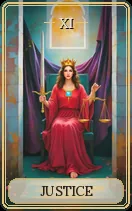 Justice — Justice and discernment; an impartial, well-founded decision.
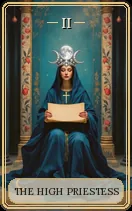 The High Priestess — Intuition and reason together; knowing what you know and what you sense.
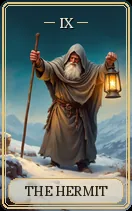 The Hermit — Solitude by choice, reflection; wisdom that comes from experience.
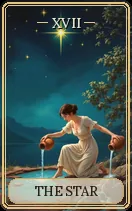 The Star — After loss, hope; clear sight that learns to trust again.
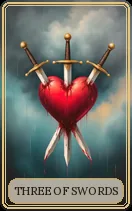 Three of Swords — A hurt that taught you to see clearly; pain turned into wisdom.
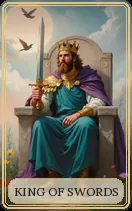 King of Swords — Intellectual authority; a couple or a partnership of great clarity.
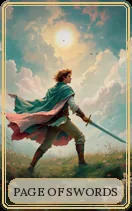 Page of Swords — A teacher and an apprentice; teaching how to observe and to think.
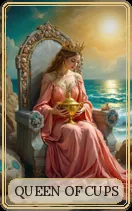 Queen of Cups — Head and heart in dialogue: empathy with clear sight.
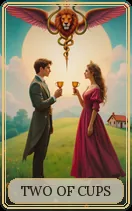 Two of Cups — A relationship founded on honesty and clear conversation.
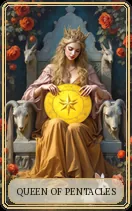 Queen of Pentacles — Practical clarity: good sense and good management of resources.
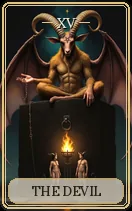 The Devil — Seeing clearly a tie that binds; breaking free of a dependency.
Frequently asked questions
What does the Queen of Swords mean in tarot?
Clear sight: seeing without veils, telling the truth with measure, judging with clarity. She is the figure of someone who has learned from loss and can no longer be fooled.
What does the Queen of Swords mean in love?
A relationship lived with eyes open, with honesty and respect for each person’s independence. Reversed, it warns against coldness, criticism and mistrust.
Is the Queen of Swords a yes or a no?
It is a yes if the answer stands up to an honest look; a no if it depends on illusions. The card asks you to see the situation as it really is.
Is the Queen of Swords reversed a bad sign?
It is not the opposite of the card: it is the same clear sight without warmth — severity, cutting criticism, isolation. It asks you to open your hand again.
Does the Queen of Swords represent a woman?
Traditionally, a mature, intelligent and independent woman. But she can represent anyone with these qualities, or simply the attitude of clarity the situation calls for.
Why is the Queen of Swords said to have known loss?
In traditional cartomancy she was read as the widow or the woman alone. The modern reading has kept the idea of experience and turned it into a quality: the clear sight of someone who has suffered and learned.
No sign-up · Reading written on the spot · Free