
Knight of Swords: meaning and symbolism of the tarot card
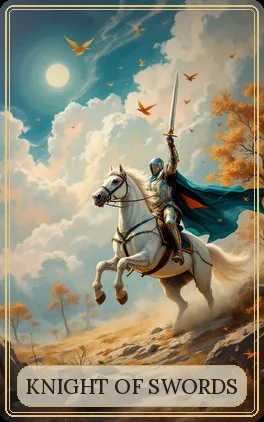
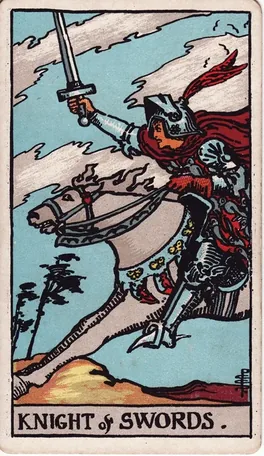
The Knight of Swords is the figure of the charge. An armoured knight raises his sword high on a white horse rearing up in the middle of the wind. He does not wait, he does not negotiate, he does not ask permission: he advances. He is the suit of Air set in motion — thought turned into action, the word launched at a gallop, the decision that will not be taken back.
In a spread, the Knight of Swords speaks of speed, of courage and of frankness. It may represent a person — someone direct, impetuous, who goes straight to the heart of things — or the energy of a situation that suddenly starts to move. It is one of the fastest cards in the deck, and one of the most ambiguous: the same force that frees up what was stuck can trample anyone standing in the way.
The card at a glance
| Card | Knight |
|---|---|
| Suit | Swords |
| Element | Air |
| Astrology | Varies between schools |
| Keywords | swift action, courage, frankness, determination, attack, blunt truth, sudden change |
| Reversed | rashness, aggression, impatience, words that ride roughshod, action without a plan |
| Yes or no | Yes — and quickly, as long as there is a clear head behind the haste |
The image on the card
In the Sol da Alma Tarot, a knight in full armour, silver with gold trim, and a closed helmet rides a white horse with a pale mane that rears up on its hind legs, forelegs in the air. With his right arm stretched towards the sky, the knight raises a long, straight-bladed sword. A blue-green cloak lined with orange billows out behind him, lifted by the wind. The horse faces left, and its hooves raise dust from dry, rocky ground with golden grasses. On the right stand trees with orange autumn foliage; in the background, on the left, other smaller trees in the same colour. The sky is an intense blue-green, with large white and pinkish clouds, a pale disc of sun or moon in the upper left corner, and several orange birds — or leaves — flying in the wind.
In the 1909 Rider-Waite-Smith, the Knight of Swords is a charge at full gallop: the knight, in armour, with a red cloak and a red plume on his helmet, raises his sword and drives his white horse at full speed to the left. There are butterflies and birds on the horse’s harness; in the background, torn clouds and trees bent by the wind. The Sol da Alma follows the same iconography — the armoured knight, the raised sword, the white horse facing left, the wind, the clouds and the birds — but changes the moment: instead of the full-stretch gallop, the horse rears, at the instant of setting off or pulling up. The red cloak has become blue-green with an orange lining, the helmet is closed and has no plume, and the wind-bent trees have given way to autumn trees. The charge is the same; the Sol da Alma paints it at the second of greatest tension.
In the Marseille Tarot, the Cavalier d’Épée is a mounted knight with his sword, on a horse moving forward, with no landscape or sky. The wind, the clouds and the galloping charge are contributions of the Rider-Waite-Smith.
The symbolism, detail by detail
The card speaks of a mind that has already decided and is launching itself forward. Each detail adds a nuance.
- The rearing horse
- Raw force, on the edge of control. It is the instant before the charge — or the sudden pulling up of someone who has gone too fast. The horse is in the knight’s hands, but only just.
- The white horse
- Purity of intention: the Knight of Swords believes in what he defends. He does not act out of malice but out of conviction — which makes him more effective and, at times, more dangerous.
- The sword raised to the sky
- Truth proclaimed, the idea carried like a banner, the attack announced. The Knight does not hide his weapon: he shows it.
- The full armour
- Protection and hardness. The Knight is ready for the impact, but also closed off — he feels little of the blows he deals.
- The closed helmet
- His face cannot be seen: the Knight of Swords acts from the idea, not from emotion. It is the impersonal side of his action.
- The cloak in the wind
- Speed and the suit’s element, Air. The orange lining, the colour of fire, shows the ardour beneath the metallic coolness.
- The dust
- The trail left behind by someone passing at speed. What the Knight has left along the way cannot always be seen.
- The autumn trees
- The turning of the season, time moving on. In the Sol da Alma painting, the Knight rides through a landscape that is changing.
- The birds and leaves in the air
- Thoughts and words flying, carried by the wind of action — quick, scattered, hard to catch once released.
- The restless sky
- The great clouds on the move: the Knight of Swords does not arrive on calm days. His coming changes the weather.
The history of the Knight of Swords
The knight has been one of the tarot’s court figures since the first decks, painted in northern Italy in the fifteenth century — and this is, in fact, one of the differences between tarot and ordinary playing cards, which have only three court cards per suit. In the Marseille decks, which took their settled form between the seventeenth and eighteenth centuries, he is called the Cavalier d’Épée and appears on horseback, sword in hand.
At the end of the nineteenth century, the Hermetic Order of the Golden Dawn reorganised the court cards of the Minors and changed their names and their hierarchy; in the Thoth deck by Aleister Crowley and Frieda Harris, the system is different again. The Knight’s place in the court therefore varies according to the school. Arthur Edward Waite and Pamela Colman Smith, in the 1909 deck, kept the traditional order — Page, Knight, Queen, King — and gave the Knight of Swords the galloping charge against the wind that became the reference image.
In the usual reading, the Knight of Swords is considered the fastest and most impetuous of the four knights. The astrological and elemental attributions of the court cards vary between schools, and none of them is universally agreed.
The Knight of Swords upright: the meaning
Upright, the Knight of Swords is the card of swift, decisive action. A situation that had stalled suddenly starts moving; someone goes straight in and forces things along. It may be the person asking, finally determined to act, or someone else who arrives and changes everything. The card speaks of courage, of determination, of getting straight to the point.
It is also the card of truth spoken bluntly. The Knight of Swords does not soften or embellish: he says what he thinks, defends what he believes, cuts what has to be cut. In a situation full of ambiguities, this may be exactly what is needed — someone to set the record straight.
It also speaks of sudden changes: events arriving quickly, decisions made in an instant, an unexpected turn. The Knight brings the wind with him, and the wind changes the weather.
What he lacks, even upright, is patience and tact. The Knight moves so fast that he does not always see where he is putting his hooves. The card favours action, but it is a reminder that haste without direction is just noise: you need to know where you are going before you spur the horse on.
The Knight of Swords reversed
Reversed, the Knight of Swords does not lose his speed: he loses control. Determination becomes rashness, frankness becomes aggression, courage becomes recklessness. It may speak of someone who tramples on others to get there faster, of words that hurt needlessly, of decisions made in the heat of the moment and regretted afterwards.
It can also point to the same energy held back: the urge to act without knowing where to go, impatience that burns itself out with no result, mental restlessness that never reaches a conclusion. Or a conflict that drags on because nobody is willing to back down. The card asks you to hold the reins — to think once before charging.
The Knight of Swords in love
In love, the Knight of Swords speaks of fast-moving passion and frank conversations. It may announce someone who arrives suddenly and wins you over quickly — direct, confident, not one for beating about the bush — or a phase in which things need to be called by their name. In a relationship, it may point to a necessary argument that brings out what had been left unsaid.
Its risk is a lack of gentleness: the Knight tells the truth, but does not always tell it with care. Reversed, it warns against violent arguments, impulsive decisions — such as ending a relationship in a moment of anger — or against someone who comes on fast and leaves just as quickly.
The Knight of Swords in work and money
In work, it is a card of ambition and action. It favours anyone who has to make quick decisions, defend a position, negotiate firmly, push a project forward come hell or high water. It may point to a sudden change, a hard-fought promotion, a competition. It may also represent a demanding colleague or boss, quick and not very diplomatic.
In money, it asks for decisions that are quick but thought through. Upright, it favours anyone who seizes an opportunity at the right moment; reversed, it warns against hasty investments, impulse buying, or money disputes that get worse for lack of calm.
The Knight of Swords in health and wellbeing
In questions about wellbeing, the Knight of Swords speaks of a great deal of energy and a great deal of haste — of a fast pace of life that can lead to burnout. It asks you to channel that energy into physical movement and to slow down before your body demands it. Reversed, it brings to mind the minor accidents of someone always rushing about. The cards are no substitute for any kind of health care: the reading speaks of attitude and tendency, not of diagnosis.
The Knight of Swords in spiritual life
On the inner path, the Knight of Swords is the fervour of someone who has just discovered a truth and wants to defend it at all costs. It is a precious energy — the courage to break with illusions, to question, to change one’s life — but one that needs tempering. The card is a reminder that truth is not imposed by force, and that the quickest mind is not always the wisest.
The Knight of Swords as a person
When it represents someone, the Knight of Swords is traditionally a young man, or a person of any gender with these qualities: intelligent, brave, direct, quick to decide and to act, with little patience for hesitation. This is someone who defends what they believe tooth and nail, who says what they think without a filter, and who enjoys a challenge. Their faults are impulsiveness, a lack of tact and a certain tendency to ride roughshod over others.
The Knight of Swords as advice
As advice, the Knight of Swords says: go forward. Make the decision, say what you have to say, do not let the matter drag on. But it also says: hold the reins. Courage that does not look where it is going becomes recklessness, and truth spoken carelessly wounds more than it clarifies.
The Knight of Swords in the positions of a spread
- In the past
- A quick decision or a sudden change that set everything in motion; or a confrontation whose consequences are still being felt.
- In the present
- The matter is speeding up. It is a time to act with courage — or someone is forcing the pace.
- In the future
- Fast-moving events on the way; a person or a piece of news that will suddenly change the situation.
- As an obstacle
- Rashness, aggression, words spoken in the heat of the moment.
- As the outcome
- The matter is resolved quickly and directly, perhaps not without some clash.
The Knight and its correspondences
The Knight is the one who sets out: the suit put into motion, on its way somewhere, with the haste and courage of someone on the move. In Swords, the suit of Air — thought, the word, decision and conflict — this movement is that of the idea turning into action, the word being hurled, the cut being made. Air, already the swiftest element, here gains the speed of the gallop: that is why the Knight of Swords is considered the fastest of all the court cards.
The suit’s element is Air. The elemental and astrological sub-attributions of the court cards vary between schools, and none is universally agreed; what matters is that the Knight represents Air in motion — the wind blowing in a single direction — after the curiosity of the Page and before the serene clarity of the Queen and the rule of the King.
Combinations with other cards
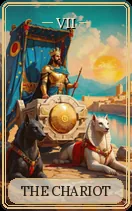 The Chariot — Victory through determination; pressing on without stopping until the goal is reached.
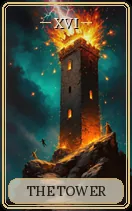 The Tower — A sudden, violent rupture; someone or something knocking down what was standing.
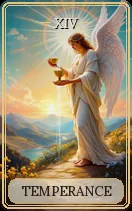 Temperance — Haste tempered by patience; acting quickly, but with measure.
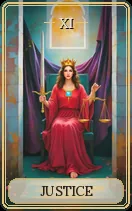 Justice — Defending a just cause; a legal process resolved quickly.
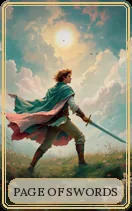 Page of Swords — From news to action: a piece of information that triggers an immediate reaction.
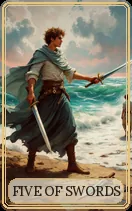 Five of Swords — A conflict in which you win the argument and lose the relationship.
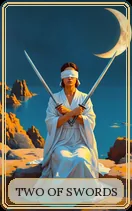 Two of Swords — The end of indecision: someone cuts the knot and chooses.
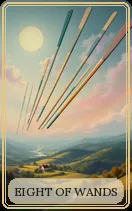 Eight of Wands — Everything happens very fast; news, journeys, decisions coming thick and fast.
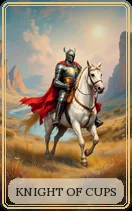 Knight of Cups — Two knights, two rhythms: the head that races and the heart that dreams.
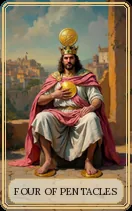 Four of Pentacles — Rapid change clashing with the wish to hold on to what you have.
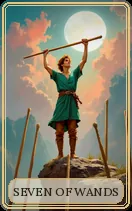 Seven of Wands — Defending your position tooth and nail; a fight worth fighting.
Frequently asked questions
What does the Knight of Swords mean in tarot?
Swift, decisive action: truth spoken bluntly, someone who goes straight in and forces things to move. Courage and frankness, with the risk of rashness.
What does the Knight of Swords mean in love?
A fast-moving passion, someone direct and confident, or a frank conversation that gets the relationship unstuck. Reversed, it warns against violent arguments and decisions made in the heat of the moment.
Is the Knight of Swords a yes or a no?
It leans towards yes, and quickly — especially if the question is about taking action. But it is a yes that calls for a clear head: haste without a plan can spoil the result.
Is the Knight of Swords reversed a bad sign?
It is not the opposite of the card: it is the same energy out of control — rashness, aggression, impatience. It asks you to think before you charge.
Does the Knight of Swords represent a person?
It can: traditionally, a young man, or any intelligent, brave and impetuous person. It can also simply be the energy of a situation that is speeding up.
No sign-up · Reading written on the spot · Free