
King of Wands: meaning and symbolism of the tarot card
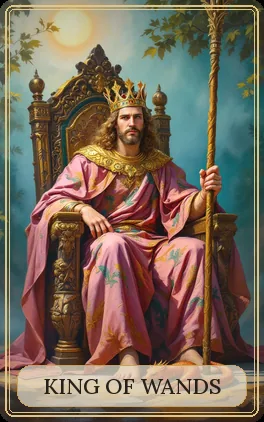
The King of Wands is the last rung of the suit of Fire, and the highest. Seated on a golden throne, crown on his head and wand in hand, he looks straight at the viewer, with the calm of someone who no longer needs to prove anything. At his feet, a salamander — the creature that, according to ancient legend, lived in the midst of flames. The Fire that was a seed in the Ace, a discovery in the Page and a charge in the Knight is here brought under rule.
In a spread, the King of Wands speaks of leadership, vision and enterprise: someone who knows where they want to go and takes others along. He may be a real person who carries weight in the situation, or an attitude the person asking is called on to adopt. The card says it is time to step out in front — but it reminds you that leading is not the same as imposing.
The card at a glance
| Card | King |
|---|---|
| Suit | Wands |
| Element | Fire |
| Astrology | Varies between schools |
| Keywords | leadership, vision, enterprise, initiative, charisma, courage, honour |
| Reversed | impulsive authority, tyranny, arrogance, impatience, unrealistic expectations |
| Yes or no | Yes — if there is decision and direction |
The image on the card
In the Sol da Alma Tarot, the King of Wands sits facing forwards, on a tall throne of gilded wood, carved with scrolls and topped with spheres at the corners. He has shoulder-length curly brown hair, a short beard and a gold crown set with red stones. He wears a full pink robe, covered in green and gold motifs, and over his shoulders a broad collar embroidered in gold. He is barefoot. His right hand rests, relaxed, on the arm of the throne; with his left he holds, quite upright, a tall golden wand worked in a spiral. At his feet, on the stone floor, lies a small orange salamander. The background is a misty blue-green, with a veiled sun in the top left-hand corner and leafy branches framing the scene.
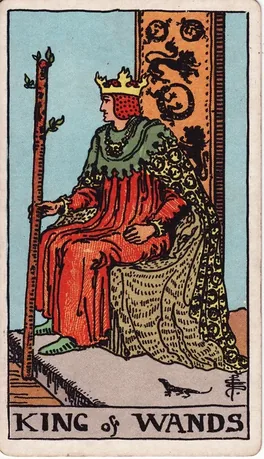
In the 1909 Rider-Waite-Smith, the essential elements are the same, and they were the starting point for the Sol da Alma painting: the king on the throne, the wand in his hand, the salamander at his feet. But in Pamela Colman Smith’s deck the king is shown in profile, facing left, wearing a red tunic, a green cape and a yellow mantle with salamanders, and behind him is a backrest decorated with lions and salamanders; his crown seems made of flames, and the wand, of wood, has green shoots. In the Sol da Alma the king looks straight ahead, and that changes the card: he is no longer gazing at the horizon, he is facing the person asking. The red has become pink, the salamanders on the mantle have given way to looser motifs, the backrest has lost its lions, and the living wand has become a golden staff, closer to a sceptre. The salamander on the ground remains, the most distinctive detail of the card.
In the Marseille Tarot, the Roy de Bâton is also seated, with a large staff, but with no salamander and no landscape: the figure fills the card, and the staff, smooth and massive, looks more like a club than a branch.
The symbolism, detail by detail
Everything about the King of Wands speaks of a fire that has learnt to govern itself. Each detail shows one face of his authority.
- The salamander
- The creature that ancient legends said lived in fire without burning, and which the occult tradition made the emblem of the element. At the king’s feet, it says that he masters the flame rather than being mastered by it.
- The golden wand
- Will turned into authority. In the Rider-Waite-Smith it still has leaves; in the Sol da Alma it is a golden staff, held upright: the will of the suit has become the power to decide.
- The direct gaze
- In the Sol da Alma the king looks straight at the viewer. It is the frankness of someone who stands by his decisions — and also the demand of someone who expects to be followed.
- The crown with red stones
- Command and responsibility. The red of the stones is a reminder that this king’s authority is born of fire, not of inheritance.
- The pink robe
- The red of the suit softened. This king has human warmth, not just strength; he is energetic, but not aggressive.
- The bare feet
- A detail of the Sol da Alma’s own: despite the throne and the crown, the king keeps direct contact with the ground. He is a leader who has not lost touch with the concrete.
- The golden throne
- The position won, stability. After all the movement of the suit, Fire has finally settled.
- The hand resting on the arm of the throne
- Calm and assurance. The king is neither tense nor on the defensive: he rules with no apparent effort.
- The veiled sun and the leaves
- The light and life surrounding the scene. This king’s fire is creative — it makes things grow, it does not destroy.
The history of the King of Wands
The king has been the highest figure in each suit since the earliest tarots of northern Italy in the fifteenth century, which had four court figures per suit: page, knight, queen and king. In the Marseille decks, which took their settled form between the seventeenth and eighteenth centuries, this card is called the Roy de Bâton and shows a seated king with a large staff.
In 1909, Arthur Edward Waite and Pamela Colman Smith gave him the throne with lions and salamanders and the small living salamander at his feet. In the book that accompanied the deck, Waite described the nature the card corresponds to as ardent, swift, animated, impassioned and noble, and gave it the meaning of a friendly man, a countryman, generally married, honest and conscientious.
The astrological and elemental attributions of the court cards vary from school to school — the Golden Dawn, for example, reorganised the names and roles of the court figures differently from the other traditions — and none can be taken as settled. The reading they all share is that of the King as the suit expressed outwardly, with authority. That is the Sol da Alma’s reading.
The King of Wands upright: the meaning
Upright, the King of Wands is the card of leadership with vision. It speaks of someone who knows what they want, who sees further than others and who has the energy and charisma to get them working towards a common purpose. He is not an office manager: he is an entrepreneur, a founder, someone who opens up new paths.
In a spread, it often says it is time to step out in front. To take the decision that has been put off, to launch the project, to tell others where you are going. The card favours initiative, the courage to take calculated risks and confidence in one’s own vision. The Fire of the suit is no longer impulse — it is direction.
It is also a card of honour and generosity. The King of Wands is loyal to those who follow him, inspires by example and has a strong sense of mission. His authority does not come from the fear he instils, but from the trust he inspires.
The King of Wands reversed
Reversed, the King of Wands does not lose his authority: he loses his sense of measure. The leader becomes bossy, vision becomes stubbornness, firmness slides into tyranny. It is impulsive authority — giving orders out of impatience rather than direction, deciding alone, demanding of others what they cannot give, getting irritated when things do not move at the desired speed.
It can also describe a fire that has turned inwards: someone with the ability to lead who does not dare, who has big ideas and does not carry them through, or who has worn themselves out carrying everything alone. Sometimes it is the arrogance of someone who thinks they are infallible and stops listening.
In both cases, the card asks that the true meaning of command be found again: the king rules for a purpose, not to impose himself. Leading also means knowing how to listen, to delegate and to wait.
The King of Wands in love
In love, the King of Wands is a strong, passionate presence: someone generous, protective, loyal, who takes the initiative and knows what they want. For those who are single, it can announce such a person, or say it is time to go after what you desire instead of waiting. In a relationship, it speaks of mature passion, of a partner who gives direction to life as a couple.
His difficult side is control. The King of Wands likes to decide, and may forget to ask. Reversed, it warns against authoritarianism, jealousy, the pride that makes it hard to apologise, or a relationship in which only one partner makes the decisions.
The King of Wands in work and money
In work, it is one of the best cards in the deck for anyone who wants to be an entrepreneur, lead a team, launch a business or gain a position of responsibility. It speaks of strategic vision, the ability to motivate, the courage to decide. It may represent a boss, a business partner, a mentor or an important client — or say that the time has come for the person asking to take that place.
In money, it speaks of initiative and well-calculated risks: investing in a project of your own, expanding a business, backing an idea with a future. Reversed, it warns against investments made out of pride or impatience, and against the temptation to grow faster than the foundations allow.
The King of Wands in health and wellbeing
In questions about wellbeing, the King of Wands speaks of vitality and discipline: taking your own habits in hand, with determination. Reversed, it points to the risk of overwork and the tension of wanting to control everything. The cards are no substitute for any kind of health care: the reading offers attitudes and tendencies, never diagnoses.
The King of Wands in spiritual life
On the inner path, the King of Wands is the will placed in the service of a greater purpose. It speaks of someone who has discovered their mission and takes it on responsibly, and who inspires others by example. The salamander at his feet is the right image: the inner fire is neither put out nor allowed to run unchecked — it is inhabited, with mastery and with calm.
The King of Wands as a person
When it represents someone, the King of Wands is traditionally a mature man — or a person of any gender with these qualities — charismatic, enterprising, confident, frank, with a sense of honour. He is the founder of a company, the natural leader of a group, the mentor who gives you courage. He can also be impatient, demanding and not much given to taking orders.
The King of Wands as advice
As advice, the King of Wands says: step out in front. Set the course, decide, take responsibility for what you want to build. But it also says: govern your own fire before you govern others — authority that convinces is worth more than authority that is imposed.
The King of Wands in the positions of a spread
- In the past
- A courageous decision, or a person in authority who set the course of the situation.
- In the present
- The moment calls for leadership: stepping out in front, deciding, giving the matter direction.
- In the future
- A position of responsibility on the way, or an influential person who will carry weight in the situation.
- As an obstacle
- Authoritarianism, impatience, pride; or someone who controls and leaves no room.
- As the outcome
- The matter is concluded through initiative and vision; a project that establishes itself.
The King and the suit of Wands
The King is the one who rules: the suit expressed outwardly, with authority, responsibility and the hardness that sometimes comes with it. In Wands, the suit of Fire — will, drive, the work that gets under way and the energy spent making things happen — this makes for the entrepreneur: the will that no longer needs to run like the Knight, because it has learnt to make others run in the right direction.
In the tarot, the court cards have no fixed astrological attribution: the schools differ, and it is best not to take any as settled. The safe reading is that of the hierarchy. After the discovery of the Page, the movement of the Knight and the inwardness of the Queen, the King closes the suit with mastery: Fire in its fullness, alight, directed and placed in the service of a great work.
Combinations with other cards
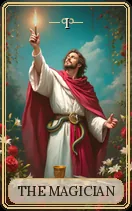 The Magician — Will backed by means and talent; the ability to turn an idea into reality.
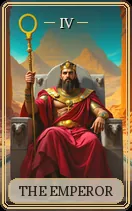 The Emperor — Reinforced authority; solid leadership, but one that can become rigid.
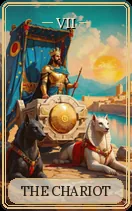 The Chariot — Victory through determination; a project that moves forward under firm command.
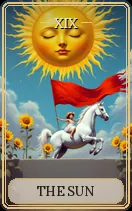 The Sun — Success, recognition, leadership that shines.
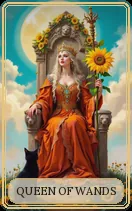 Queen of Wands — A strong, passionate couple; two leaders who recognise each other.
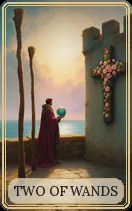 Two of Wands — Planning expansion; a long-term vision taking shape.
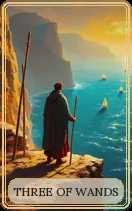 Three of Wands — A growing enterprise; the first results of a bold gamble.
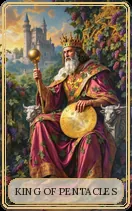 King of Pentacles — A prosperous business; entrepreneurial vision on solid foundations.
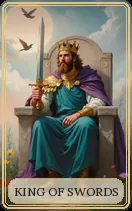 King of Swords — Firm, well-considered decisions; authority with clarity.
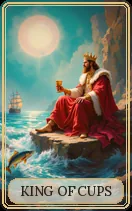 King of Cups — Firmness tempered by understanding; a leader who knows how to listen.
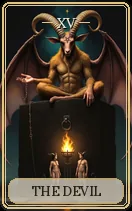 The Devil — Power used to control; ambition that has turned into domination.
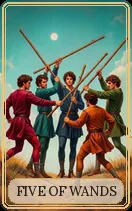 Five of Wands — Leadership conflicts; a power struggle within a team.
Frequently asked questions
What does the King of Wands mean in tarot?
Leadership, vision and enterprise: someone who knows where they are going and takes others along. It asks you to step out in front with confidence and a clear direction.
Is the King of Wands a yes or a no?
It is a yes, especially when the outcome depends on the initiative of the person asking. Reversed, it is a risky yes — watch out for impatience and pride.
What does the King of Wands mean in love?
A passionate, protective, loyal person who takes the initiative. Reversed, it warns against control, jealousy or a relationship in which only one partner decides.
What does the salamander mean on the King of Wands?
It is the creature that ancient legends said lived in fire without burning, and which became the emblem of the element of Fire. At the king’s feet, it shows that he masters his own energy.
Is the King of Wands reversed bad?
It is not a condemnation. It is the same authority without measure — impatience, authoritarianism, arrogance — or leadership that is not taken up. It asks for balance and for listening.
No sign-up · Reading written on the spot · Free